In the culturally rich landscape of Indore, stands a private residential condominium called the Yellow Stone House. The unique 5 bedroom home was built on a flat rectangular piece of land (42’6”x77’6”) covering over 3293 sqft in area.
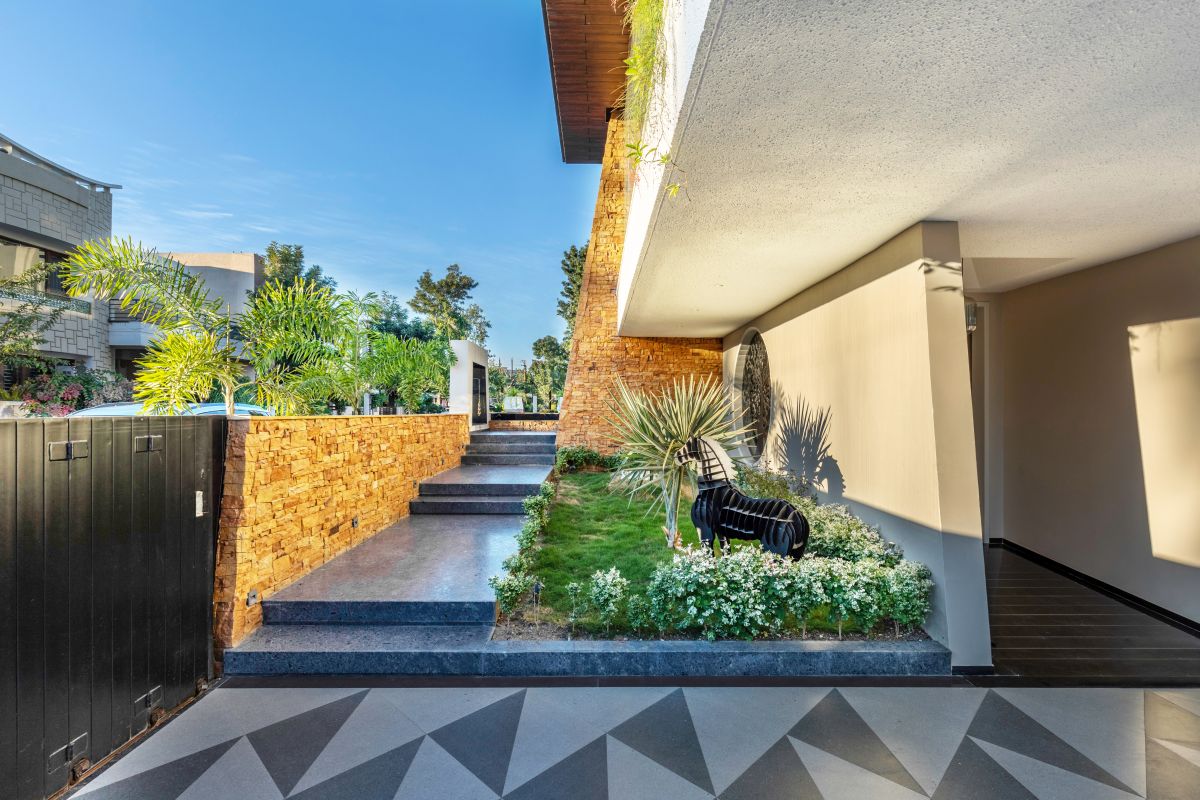
As the name suggests, the abode carries an interesting identity of the yellow stone cladding along with the majority of the facade. The entire elevation has a few vertical surfaces of walls that incline at angles taking it away from the two-dimensional world of drawing. This in turn helps to capture a sensation of movement over in a static state. The structure, almost frozen in movement embraces the concept of light and ventilation with large openings, transparent surfaces, and shadow play.


The House splits into three levels and has its public and service requirements accommodated on the ground floor. The vast parking area also functions as a multi-utility area capable of hosting a small crowd. A series of steps from the gates of the residence carries one to the Main door.


On entering the First floor one is directed towards the compact formal living or drawing room that bleeds out into an open terrace. With half of its enclosing walls in glass, the room invites the surrounding environment inside. This space invites openness and interaction and gives the feel of infinity with a vision to the sky. The interiors of this room have a yellow stone wall, wooden ceiling, and nature-inspired fabric colors. The terrace garden is also shared by a bedroom that opens up to the lively part of the neighborhood.


At the Heart of the home is filled with a beautiful staircase and a double-height internal courtyard finished with the same Yellowstone. Every other space or activity revolves around this vertical volume. The walls of the staircase taper in the same fashion as the openings and the elevation facade. This courtyard also houses a pooja room, secluded from the chaos of daily routine. This courtyard hence becomes a beautiful sanctuary by itself, with the adjacent spaces being the most engaging areas for the residents.
With major bedrooms zoned on this level, the second floor becomes private heaven. The addition of a bar and a semi-open terrace garden also lend the space qualities to host and entertain family and friends with the evening cityscape as a backdrop.


Following the concept in interior design, the pivot doors are also angular in design. The color palette is inspired by nature with shades of green in the drawing-room to earthy brown tones in the master bedroom. Nature-inspired wall paintings become a focal point and a source of inspiration. Altogether, the residence was laid out such that the spaces efficiently complement regular activities while being closely connected and aligned with the natural cycle to help maintain a healthy lifestyle.


Perhaps in an ambitious way, the design approach for this residence was to create aspirational spaces which reinforce the desire to touch the sky as we rise to support the conception of a happy and healthy lifestyle around natural elements.
Elevations –


Drawings-


Video –
Project Facts –
Project Name: Yellow Stone House
Architecture Firm: Span Architects
Firm Location: Indore – India
Completion Year: 2020
Gross Built Area: 7200 sqft.
Site area: 3293 sqft.
Spec: 4 Car parking, Servant room, Office, Drawing room, Living, Dining & Kitchen, 5 Bedrooms, G+2
Project location: Prakrati Vihar Colony, Indore
Lead Architects: Ar. Anand Maroo, Ar. Arpit Khandelwal, Ar. Pratik Gupta
Media Provider
illustration : Haritha John Surrao
Photo credits: Ruuhchitra, Viplove Jain
Additional Credits
Design Team: Anand Maroo, Arpit Khandelwal, Pratik Gupta, Prerna Jain, Aditya Chintawar, Anika Saklecha
Engineering: Er. Nilesh Sharma