Rohan Retreat, a weekend house at Pune by Madhav Joshi and Associates

The. Site was selected , such that, the terrain slope down gently towards a meandering stream, which cut through a shallow valley. The location commands interesting views all around. In order to exploit all the facets of landscape the plan evolved as a fan shape capturing each view in different directions.

Rohan at Pune by Madhav Joshi and AssociatesThe design brief was to create a weekend house that would be multifunctional with a lounge, dining room, kitchen , two bedrooms with attached bathroom and verandah.

The. Site was selected, such that, the terrain slope down gently towards a meandering stream, which cut through a shallow valley. The location commands interesting views all around. In order to exploit all the facets of landscape the plan evolved as a fan shape capturing each view in different directions.

A linear circulation spine holds the entire geometry together, while the radiating walls enclose the functional spaces. The difference in heights between the corridor and the living areas creates interest and provides a visual balance between the building volumes. One wall of each shape angles out further to ensure visual privacy between the spaces, while shielding successive spaces.

The spirit of exterior flows inside, in terms of style articulation and the rustic, yet contemporary ambience . The lucid  detailing lends a structural clarity, very much like the building itself. The amalgamation of location available materials with simple , modest and cost effective interior creates the perfect setting for the weekend retreat . The build has a purist expression where each material performs to its obvious structural potentials

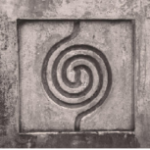
The landscape too, has been designed to merge and meld with the farmland on which the farmhouse is set. Many interesting details of symbolism and iconography have been incorporated, into the landscaping and paving to make it a ‘process of discovery’ as one walks in and around the farmhouse. For instance the cast-n-situ concrete paving has impressions of the plan and a section of the building to help orient the visitor; pug- mark motifs and leaves contribute to telling an interesting story; while traditional elements like the ‘ pata varavanta’  ,  the ‘ukhal’ outside the kitchen and the ‘ Tulsi vrindavan’ in the arrival court add meaning to the context, Thus celebrating playfulness and joy in nature in tranquil settings.

Leave a Reply

Your email address will not be published. Required fields are marked *

This site uses Akismet to reduce spam. Learn how your comment data is processed.

Recent

Gender, Hysteria, and Architecture - The Witch Hunt. Henry Ossawa Tanner. Source - Wikiart

Gender. Hysteria. Architecture. | “When Did Care Become Confinement?”

Was architecture used by society to spatially “manage” women and their autonomy? Aditi A., through her research study as a part of the CEPT Writing Architecture course, examines the period before psychiatry, when fear had already become architectural, tracing how women’s autonomy was spatially managed through domestic regulation, witch hunts, informal confinement, and early institutional planning.

Read More »

A Modernist’s Doubt: Symbolism and the Late Career Turn

Why did acclaimed modernist architects suddenly introduce historical symbolism like arches, decorative elements, and other cultural references into their work after decades of disciplined restraint? Sudipto Ghosh interrogates this 1980s-90s symbolic turn as a rupture in architecture, questioning whether this represents an authentic reconnection with content and memory, or is it a mere superficial gesture towards absent meanings. Drawing from Heidegger’s analysis of the Greek temple, he distinguishes two modes of architectural representation, ultimately judging that this turn was a nascent rebellion against modernism that may have failed to achieve genuine integration of context, material, and memory.

Read More »
Ode to Pune - A Vision. © Narendra Dengle - 1

The City That Could Be: An Ode to Pune

Narendra Dengle, through his poem written in January 2006, presents a deep utopic vision for Pune—what the city could be as an ecologically sustainable, equitable city that balances nature with development. He sets ambitious benchmarks for prioritizing public transport over cars, preserving heritage, addressing slum rehabilitation humanely, and empowering local communities

Read More »
(left) Turtle Poem 1999 & Calligraphy 2006, by H. Masud Taj. © H. Masud Taj. (right) Photograph of Hassan Fathy 1976, © Martin Lyons

“Hassan Fathy’s head was in the heavens, heart in the right place, and feet planted firmly on earth.”—H. Masud Taj on his Turtle poem & Hassan Fathy

H. Masud Taj elucidates how, as a young architecture student, he dropped out of his institution to travel and learn from monuments, discovering in Gaudí’s Sagrada Familia a turtle column that catalyzed an inquiry, hearing Hassan Fathy’s explication of the turtle in Cairo, ultimately crystallizing in Taj’s poetic meditation on dwelling.

Read More »
Education Authority Bill - Viksit Bharat Shiksha Adhishthan Bill - Architecture Education, A. Srivathsan

Education Authority Bill: Its Implications for Architecture Education

A. Srivathsan in his preliminary overview of the new Viksit Bharat Shiksha Adhishthan Bill, notes that the bill could transform architectural education. The VBSA Bill proposes restructuring India’s higher education regulation, by dissolving UGC and related authorities, creating three new councils for regulation, accreditation, and standards.

Read More »

Featured Publications

New Release

We Are Hiring

Stories that provoke enquiry into built environment

www.architecture.live

Subscribe & Join a Community of Lakhs of Readers