Sameep-Padora-Roddam-House-at-Jubilee-Hills-Hyderabad

Fort House at Jubilee Hills, Hyderabad, by Sameep Padora and Associates

Referencing forts as a primer the formal development of the project attempts to balance a need for privacy/protection from the outside while developing layered and tiered open spaces for social engagement.
Sameep-Padora-Roddam-House-at-Jubilee-Hills-Hyderabad

The primary program brief from the couple who owned the house was a desire to build a house that was to be their ‘fortress from the cacophony of the world outside’ while creating a sizable space to be used frequently for entertaining friends and guests.

Sameep-Padora-Roddam-House-at-Jubilee-Hills
Site Plan

Referencing forts as a primer the formal development of the project attempts to balance a need for privacy/protection from the outside while developing layered and tiered open spaces for social engagement.

Privacy & Scale

Our first effort was to distance the notion of privacy from that of scale.

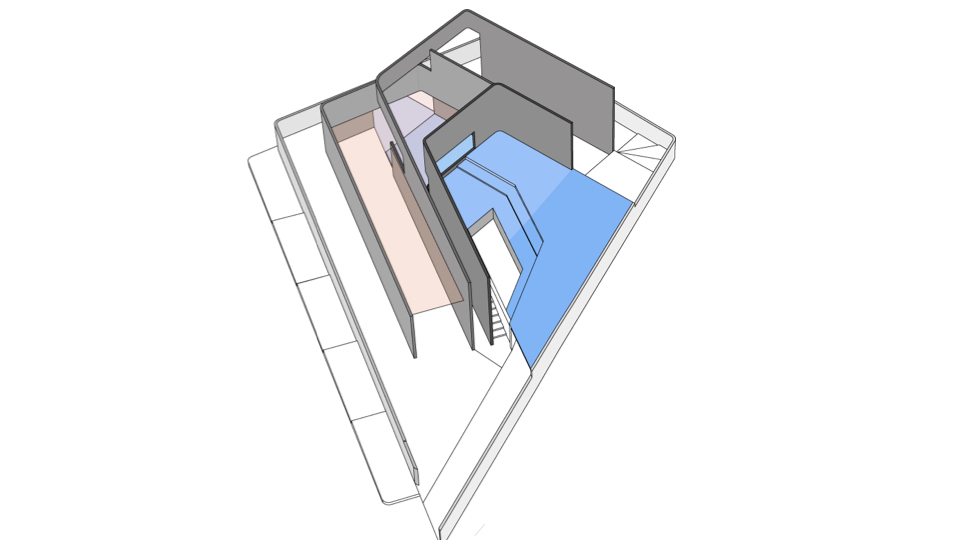
Formally the boundary wall becomes part of the three parallel limestone clad wall set that configure program between them and ascend in height as they gain distance from the street scaling the house down to human proportions.

Wearing the Courtyard Inside Out

This need for privacy and climatic sheltering on the south side street (to mitigate the harsh southern sun) creates a largely impervious facade. The solidity of this construct is completely obliterated once inside the house by sectional overlapping and linked multilevel a hybrid courtyard that is both internalised and external and hence becomes a container for the massive entertainment space required by the client. This void/court cuts the through the sectional width of the house becoming a programmatic connect for the independently accessible strands of private (family) and public (work &entertainment) spaces that intersect in the physical centre of the house.

Drawings

Project: Private Home
MEP Consultant: R.N. Joshi
Location: Hyderabad, Andhra Pradesh, India
Structural Consultant: Facet
Size: 1300 sq. meters.
Year of Completion: March2014
Design Team: Viresh Mhatre, Harsha Nalwaya, Aanoshka Choksi, Mythili Shetty
Photographs: Edmund Sumner

Leave a Reply

Your email address will not be published. Required fields are marked *

This site uses Akismet to reduce spam. Learn how your comment data is processed.

Recent

Feature image - Ego, Equity, and Experience Architectural Employment in India. Nitin Mandhan

Ego, Equity, and Experience: Architectural Employment in India

Through his detailed critique, Nitin Mandhan talks about the architectural education and employment in India, highlighting outdated minimum standards of education by Council of Architecture, poor industry-academia links, exploitative low-paid work, and elitist access. He argues for reform in the education standards, ethical workplace systems, better mentoring, and collective responsibility from institutions, council, and practices to create fair, sustainable careers.

Read More »

“The new architect must be an environmental thinker, a social listener, a technological innovator, and an ethical actor.” – Ravindra Punde on reimagining architecture education in India

Ravindra Punde, architect and academician, calls for a fundamental reimagining of architecture education in India, arguing it must shift from colonial pedagogies to address climate change, social inequality, and ethical responsibility through ecology-centred, community-engaged, and culturally diverse learning.

Read More »
Architecture-in-Development — Global Challenge 2025 Shortlists

“The stronger promise in Architecture-in-Development’s Do-it-Together (DiT) ethos is that design can be measured by what it connects and sustains, not just by what it costs or how quickly it is implemented.”—Nipun Prabhakar

Nipun Prabhakar, in his article on the 2025 Global Challenge finalists of Architecture-in-Development (A––D), elaborates on how community-led design defines the new frontline of practice. They showcase us a future where design is measured not only by metrics or capital, but by its capacity to connect, care, and endure.

Read More »
Rome Scholarship in Architecture 2026-27—Call for Applications

Rome Scholarship in Architecture 2026-27—Call for Applications

The Rome Scholarship in Architecture calls for applications for a six-month residency (Jan-June 2027) at the British School at Rome for a postgraduate or early-career architect. It includes £1000 monthly grant, board, and access to BSR resources for a self-directed research programme in Italy. Deadline: December 15, 2025.

Read More »

Featured Publications

We Are Hiring