Sameep-Padora-Roddam-House-at-Jubilee-Hills-Hyderabad

Fort House at Jubilee Hills, Hyderabad, by Sameep Padora and Associates

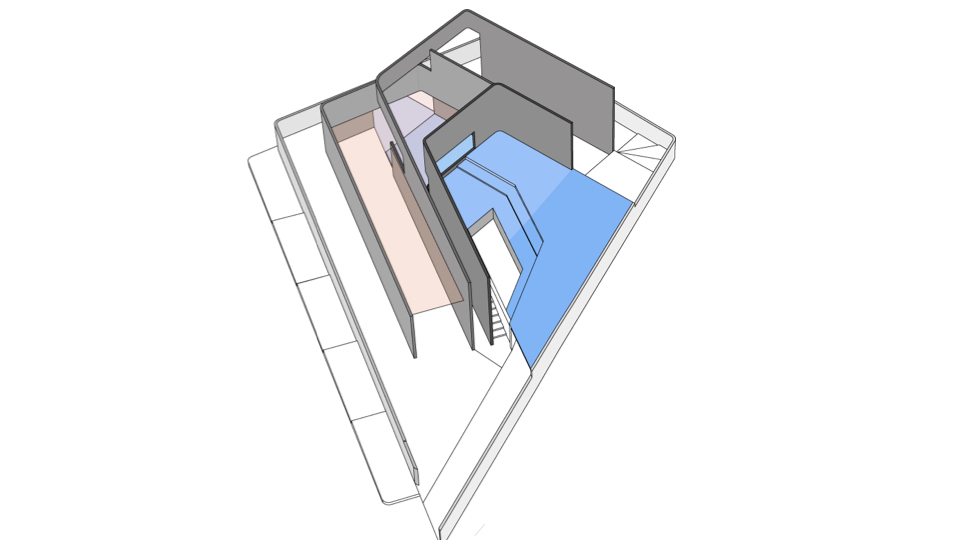
Referencing forts as a primer the formal development of the project attempts to balance a need for privacy/protection from the outside while developing layered and tiered open spaces for social engagement.
Sameep-Padora-Roddam-House-at-Jubilee-Hills-Hyderabad

The primary program brief from the couple who owned the house was a desire to build a house that was to be their ‘fortress from the cacophony of the world outside’ while creating a sizable space to be used frequently for entertaining friends and guests.

Sameep-Padora-Roddam-House-at-Jubilee-Hills
Site Plan

Referencing forts as a primer the formal development of the project attempts to balance a need for privacy/protection from the outside while developing layered and tiered open spaces for social engagement.

Privacy & Scale

Our first effort was to distance the notion of privacy from that of scale.

Formally the boundary wall becomes part of the three parallel limestone clad wall set that configure program between them and ascend in height as they gain distance from the street scaling the house down to human proportions.

Wearing the Courtyard Inside Out

This need for privacy and climatic sheltering on the south side street (to mitigate the harsh southern sun) creates a largely impervious facade. The solidity of this construct is completely obliterated once inside the house by sectional overlapping and linked multilevel a hybrid courtyard that is both internalised and external and hence becomes a container for the massive entertainment space required by the client. This void/court cuts the through the sectional width of the house becoming a programmatic connect for the independently accessible strands of private (family) and public (work &entertainment) spaces that intersect in the physical centre of the house.

Drawings

Project: Private Home
MEP Consultant: R.N. Joshi
Location: Hyderabad, Andhra Pradesh, India
Structural Consultant: Facet
Size: 1300 sq. meters.
Year of Completion: March2014
Design Team: Viresh Mhatre, Harsha Nalwaya, Aanoshka Choksi, Mythili Shetty
Photographs: Edmund Sumner

Leave a Reply

Your email address will not be published. Required fields are marked *

This site uses Akismet to reduce spam. Learn how your comment data is processed.

Recent

Folles de la Salpétrière, (Cour des agitées.) (Madwomen of the Salpétrière. (Courtyard of the mentally disturbed.))

Gender. Hysteria. Architecture. | “How Did a Diagnosis Learn to Draw Walls?”

Did these spaces heal women or teach them how to disappear? Aditi A., through her research study as a part of the CEPT Writing Architecture course, in this chapter follows hysteria as it migrates from text to typology, inquiring how architectural decisions came to stand in for care itself. Rather than assuming architecture responded to illness, the inquiry turns the question around: did architecture help produce the vulnerability it claimed to manage?

Read More »
Gender, Hysteria, and Architecture - The Witch Hunt. Henry Ossawa Tanner. Source - Wikiart

Gender. Hysteria. Architecture. | “When Did Care Become Confinement?”

Was architecture used by society to spatially “manage” women and their autonomy? Aditi A., through her research study as a part of the CEPT Writing Architecture course, examines the period before psychiatry, when fear had already become architectural, tracing how women’s autonomy was spatially managed through domestic regulation, witch hunts, informal confinement, and early institutional planning.

Read More »

A Modernist’s Doubt: Symbolism and the Late Career Turn

Why did acclaimed modernist architects suddenly introduce historical symbolism like arches, decorative elements, and other cultural references into their work after decades of disciplined restraint? Sudipto Ghosh interrogates this 1980s-90s symbolic turn as a rupture in architecture, questioning whether this represents an authentic reconnection with content and memory, or is it a mere superficial gesture towards absent meanings. Drawing from Heidegger’s analysis of the Greek temple, he distinguishes two modes of architectural representation, ultimately judging that this turn was a nascent rebellion against modernism that may have failed to achieve genuine integration of context, material, and memory.

Read More »
Ode to Pune - A Vision. © Narendra Dengle - 1

The City That Could Be: An Ode to Pune

Narendra Dengle, through his poem written in January 2006, presents a deep utopic vision for Pune—what the city could be as an ecologically sustainable, equitable city that balances nature with development. He sets ambitious benchmarks for prioritizing public transport over cars, preserving heritage, addressing slum rehabilitation humanely, and empowering local communities

Read More »

Featured Publications

New Release

We Are Hiring

Stories that provoke enquiry into built environment

www.architecture.live

Subscribe & Join a Community of Lakhs of Readers