Indian Boutique Store, at Taj Skyline, Ahmedabad | Designed By Shayona Consultant | Prashant Parmar Architect  

Indian Boutique Store, at Taj Skyline, Ahmedabad | Designed By Shayona Consultant | Prashant Parmar Architect  

Nueva, an Indian Boutique Store, located in the Taj skyline in Ahmedabad, is a textile retail store of 375sq.ft.Area. Bringing together a natural palette with Indian folk art-inspired space helped create an oasis that the owner truly desired. The natural material palette comprising exposed concrete, wood, brass, lime plaster together with metalwork and mirror wall. - Shayona Consultants
Indian Boutique Store, at Taj Skyline, Ahmedabad | Designed By Shayona Consultant | Prashant Parmar Architect  

Indian Boutique Store, at Taj Skyline, Ahmedabad | Designed By Shayona Consultant | Prashant Parmar Architect   1

Nueva, an Indian Boutique Store, located in the Taj skyline in Ahmedabad, is a textile retail store of 375sq.ft.Area.

Bringing together a natural palette with Indian folk art-inspired space helped create an oasis that the owner truly desired. The natural material palette comprising exposed concrete, wood, brass, lime plaster together with metalwork and mirror wall.
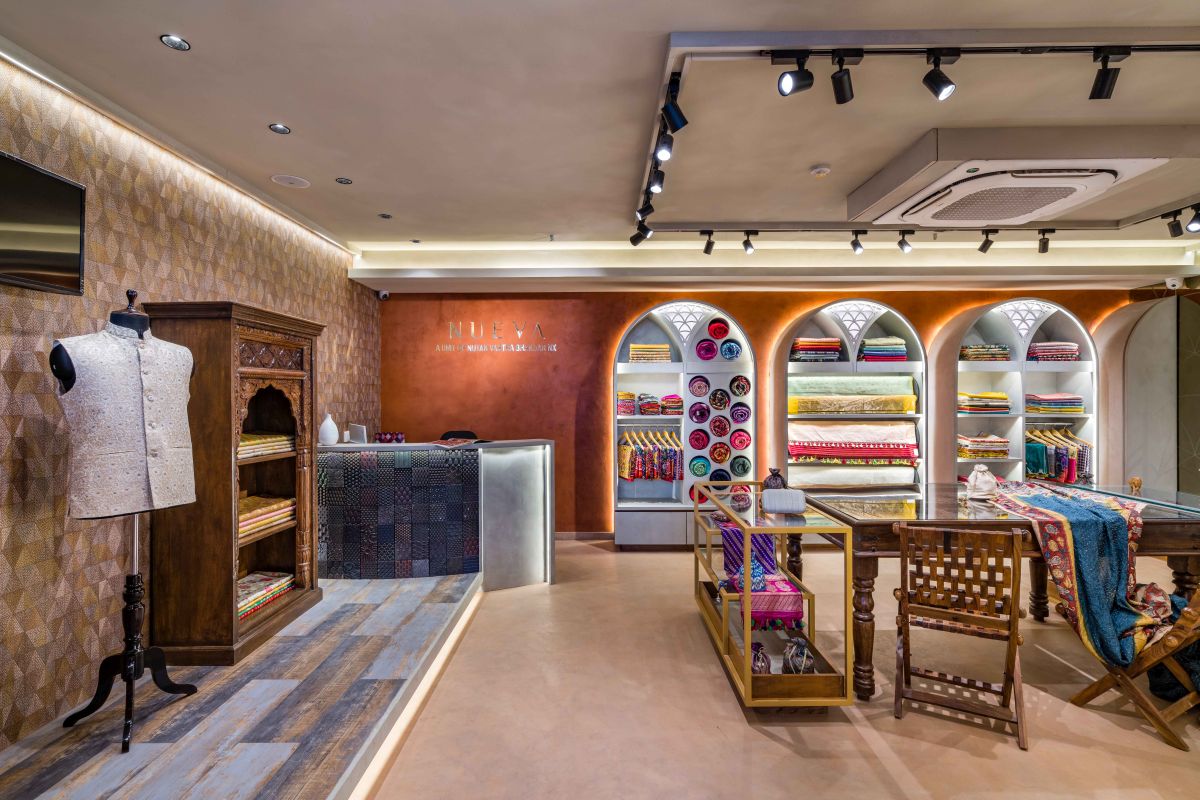


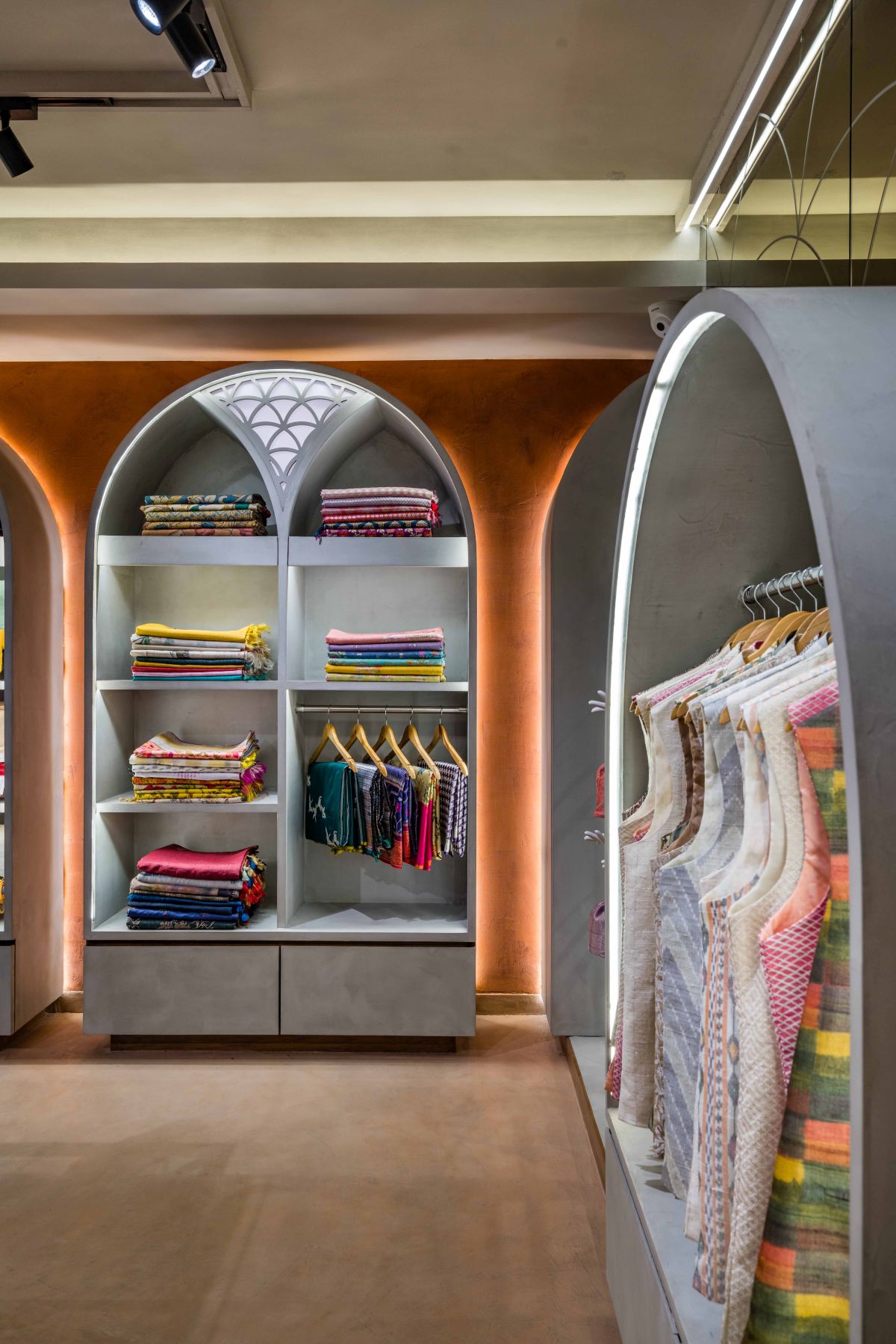
The exposed concrete ceiling together with the smooth lime plaster finish on the walls and floor create a rustic charm.

The walls with its natural rustic lime plaster-finish backgrounds the light-toned display units.


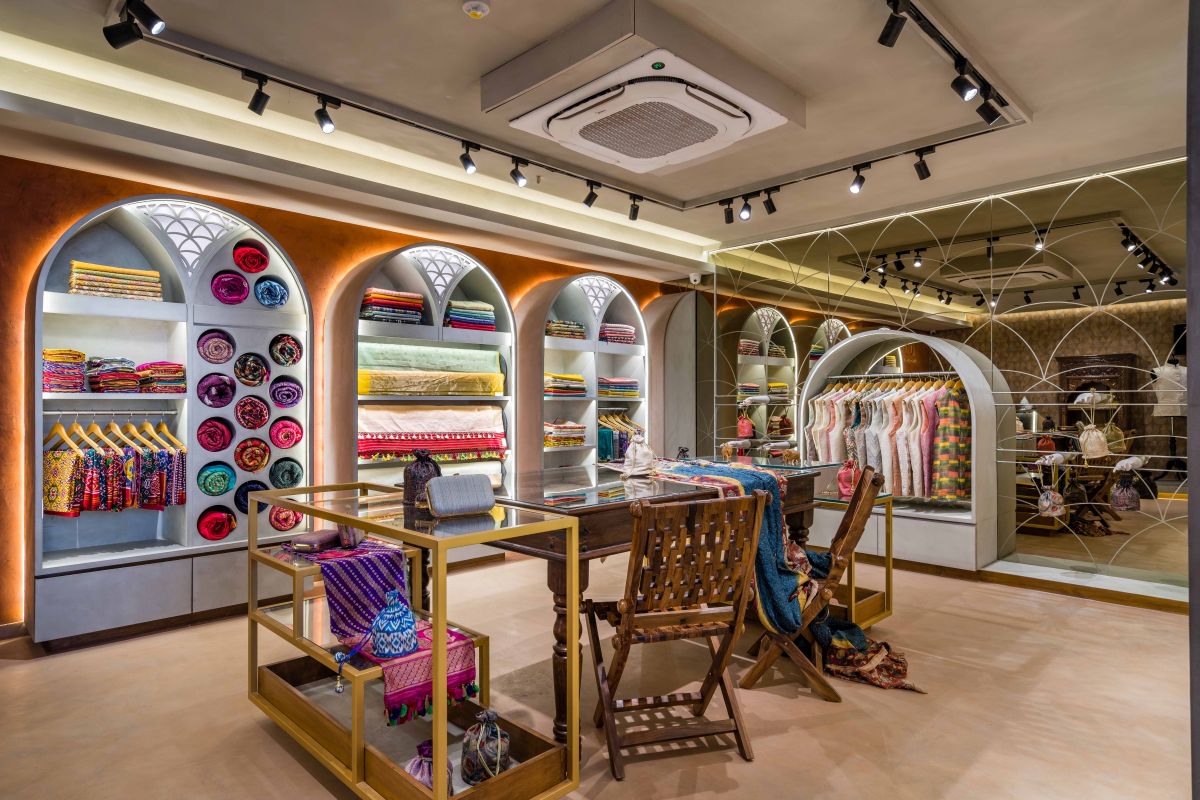
A unique center table has been customized out of a wooden heritage door, finished with a glass top to add a classical look to this astonishing textile retail shop. The wooden-carved chairs are perfectly paired up with this center table. The minimal furniture helps create more space to move around.

“One of the larger design objectives was to subdue the compact space with the use of soft colors, arches and curved edges.”


The arched narrative is carried through in the detailing of the display units and the mirror wall.

Considering space constraints, open metal shelves have been provided for display units.


Light-toned arched display units sheathe the stock of the textiles, counterbalancing the darker rustic tone of walls. These display units are customized on the basis of the quantity of stock to be displayed. The hole-cuts for dupattas and the shelves for thaan collection add creative interior details to the store.


The combination adds buoyancy to this textile retail store.

The mirror wall is creatively designed to look spacious and acts as a dramatic backdrop to the whole space.

The hand murals, hanging out from the wall, for displaying traditional purses is wisely designed to look attractive to customers whilst keeping in mind the space constraint.


The reception table is also made on-site with an idea to use the stamps of textiles, with a silvery-golden textured wall.

Track lights in the ceiling, defused lights behind the display units help to highlight the furniture and space within.

From the consoles to the treatment of the walls, there is subtle continuity in the design language throughout this space that softens and elevates the textile retail store.

Project Facts –

Project Name: Indian Boutique Store @ Taj Skyline, Ahmedabad

Architecture Firm: Shayona Consultant

Principal & Founder Architect: Ar. PrashantParmar

Firm Location: Ahmedabad, Gujarat, India

Completion Year: 2021

Carpet Area: 375 sq.ft

Project location: Taj Skyline, Sindhu Bhavan Road, Ahmedabad, Gujarat, India

Photo credits: Inclined Studio

Design Team: Ar. HarikrushnaPattani, Ar. Hemang Mistry, Ar. Ashish Rathod, Ms.Pooja Solanki, Ar. Vasavi Mehta.

Leave a Reply

Your email address will not be published. Required fields are marked *

This site uses Akismet to reduce spam. Learn how your comment data is processed.

Recent

Source - Deccan Chronicle

Wall As a Public Space
“To read public space only as a spatial condition, as a matter of square footage, zoning, or physical access, is to miss half the picture.”
—Reshma Esther Thomas

Reshma Esther Thomas examines how Hyderabad’s flyover pillars, painted with Cheriyal-style murals under the GHMC’s ‘City Art Scape’ initiative, reveal the paradox of managed public space. What appears to be beautification is actually cultural assertion in the wake of the 2014 bifurcation, bureaucratising a surface that once belonged to those without institutional power.

Read More »
Khazans in Slavador du Mundo, Bardez, Goa. © Kusum Priya (1)

The Map That Was Never Yours
“If publicness is reduced to what is legally accessible, then these landscapes were never public to begin with.”
—V.V. Kusum Priya

As part of our editorial: What makes a space public?, V.V. Kusum Priya argues that Section 39A of Goa’s 2024 Town and Country Planning Act this isn’t just a legal issue, and that it’s the erosion of an unrecognised but collectively sustained commons, and a question of what “public” really means and who benefits from the legislations surrounding this.

Read More »
Life on the public spaces in downtown Calcutta. Source - Wikimedia


“Appropriation of public spaces is the genesis of political movements, of ideological apparatus, and of endangering the city’s multi-dimensional fabric.”
—Dr. Seema Khanwalkar

Dr. Seema Khanwalkar, explores how the public spaces in India are dynamic, contested areas shaped by informal economies, migration, and social negotiation. She reveals how the transactional activities democratise ownership of these spaces, while the political and religious appropriation increasingly displaces this organic vitality, creating exclusion and anxiety. This shrinking of inclusive public space threatens urban social fabric, yet remains largely absent from city planning conversations, making it a far deeper crisis than mere encroachment.

Read More »
Sen Kapadia


“… people like Sen [Kapadia] don’t really leave. They become the questions we continue to ask.”
—A Tribute by Nuru Karim

Nuru Karim reflects on his relationship with Sen Kapadia through three transformative “states of being”—as a student, as a studio colleague, and as an independent professional. To capture Sen’s essence, Karim draws on three powerful metaphors: a mountain (commanding yet silent), a banyan tree (generous and sheltering), and a river (unseen yet ever-present). Together, these images paint a portrait of a man whose quiet depth left an indelible mark on all who encountered him.

Read More »
Sen Kapadia

Nirbhaya Nirgun
“Sen [Kapadia] found his own light early. He followed it without apology and without detour, and never let anyone dim it.”
—A Tribute by Pinkish Shah

Pinkish Shah’s homage to Sen Kapadia, celebrates him as fearless and formless in both life and work. Intellectually rooted in Louis Kahn and Sri Aurobindo, Sen pursued architecture that transcended form toward essential silence. Known for his courage, he maintained quiet, unwavering independence throughout his career.

Read More »

Featured Publications

New Release

Stories that provoke enquiry into built environment

www.architecture.live

Subscribe & Join a Community of Lakhs of Readers

We Need Your Support

To be able to continue the work we are doing and keeping it free for all, we request our readers to support in every way possible.

Your contribution, no matter the size, helps our small team sustain this space. Thank you for your support.

Contribute using UPI

Contribute Using Cards