Indian Boutique Store, at Taj Skyline, Ahmedabad | Designed By Shayona Consultant | Prashant Parmar Architect  

Indian Boutique Store, at Taj Skyline, Ahmedabad | Designed By Shayona Consultant | Prashant Parmar Architect  

Nueva, an Indian Boutique Store, located in the Taj skyline in Ahmedabad, is a textile retail store of 375sq.ft.Area. Bringing together a natural palette with Indian folk art-inspired space helped create an oasis that the owner truly desired. The natural material palette comprising exposed concrete, wood, brass, lime plaster together with metalwork and mirror wall. - Shayona Consultants
Indian Boutique Store, at Taj Skyline, Ahmedabad | Designed By Shayona Consultant | Prashant Parmar Architect  

Indian Boutique Store, at Taj Skyline, Ahmedabad | Designed By Shayona Consultant | Prashant Parmar Architect   1

Nueva, an Indian Boutique Store, located in the Taj skyline in Ahmedabad, is a textile retail store of 375sq.ft.Area.

Bringing together a natural palette with Indian folk art-inspired space helped create an oasis that the owner truly desired. The natural material palette comprising exposed concrete, wood, brass, lime plaster together with metalwork and mirror wall.
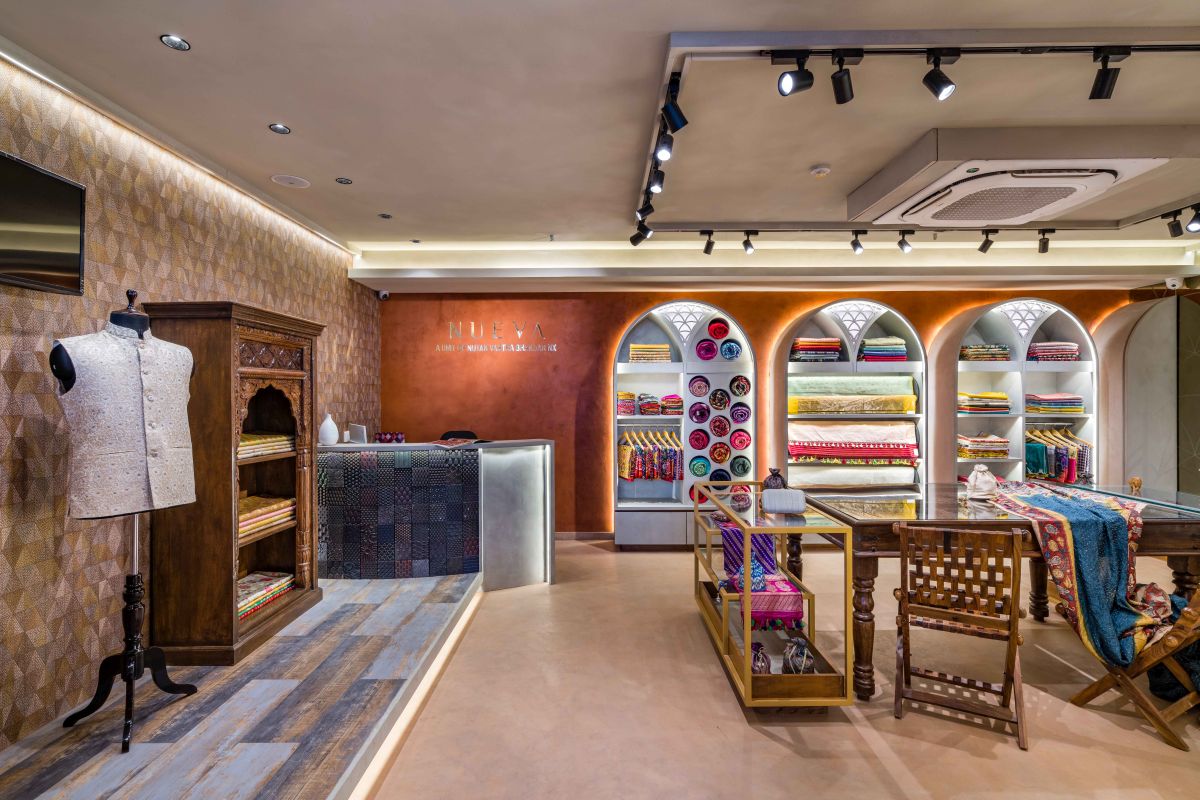


The exposed concrete ceiling together with the smooth lime plaster finish on the walls and floor create a rustic charm.

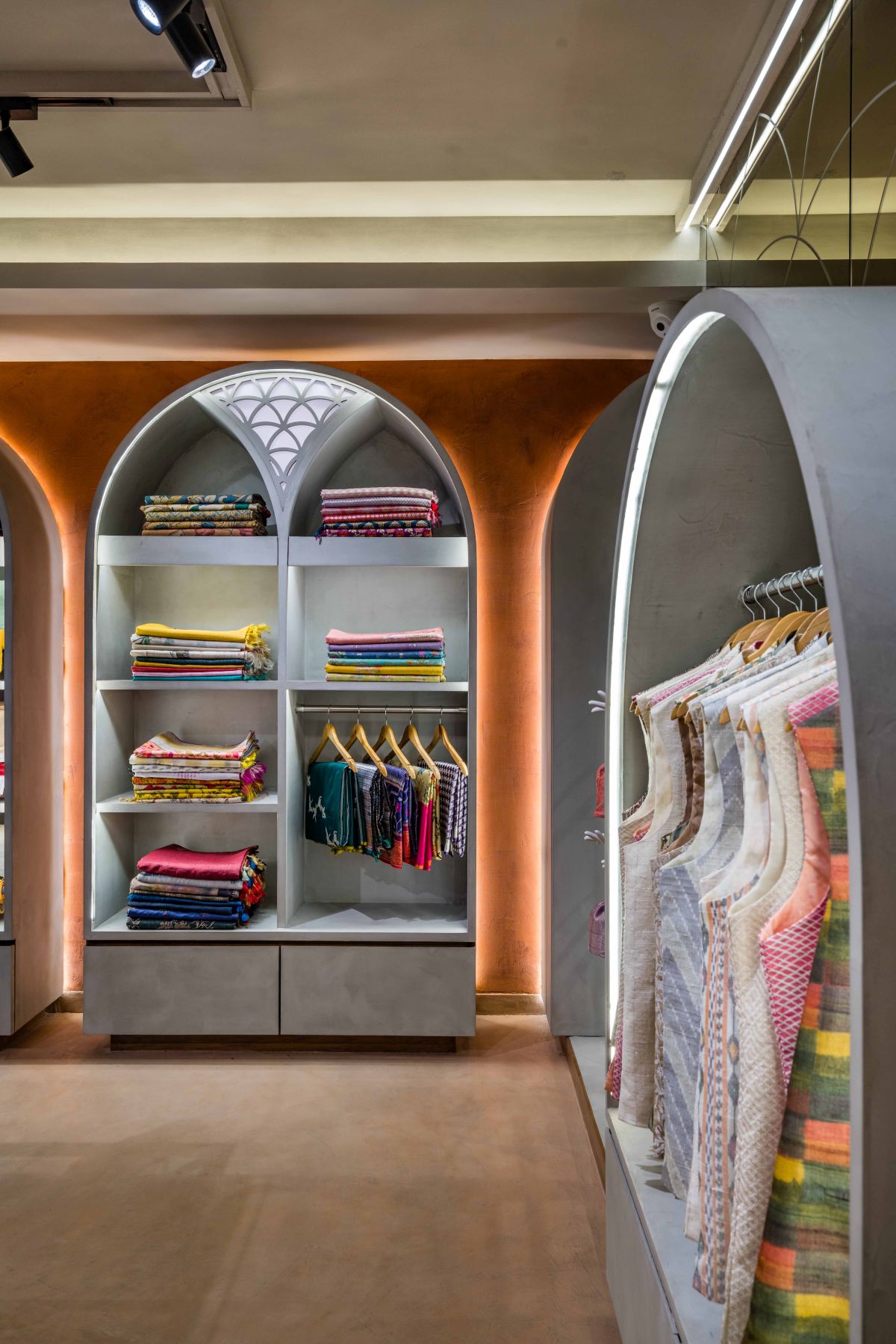
The walls with its natural rustic lime plaster-finish backgrounds the light-toned display units.


A unique center table has been customized out of a wooden heritage door, finished with a glass top to add a classical look to this astonishing textile retail shop. The wooden-carved chairs are perfectly paired up with this center table. The minimal furniture helps create more space to move around.

“One of the larger design objectives was to subdue the compact space with the use of soft colors, arches and curved edges.”


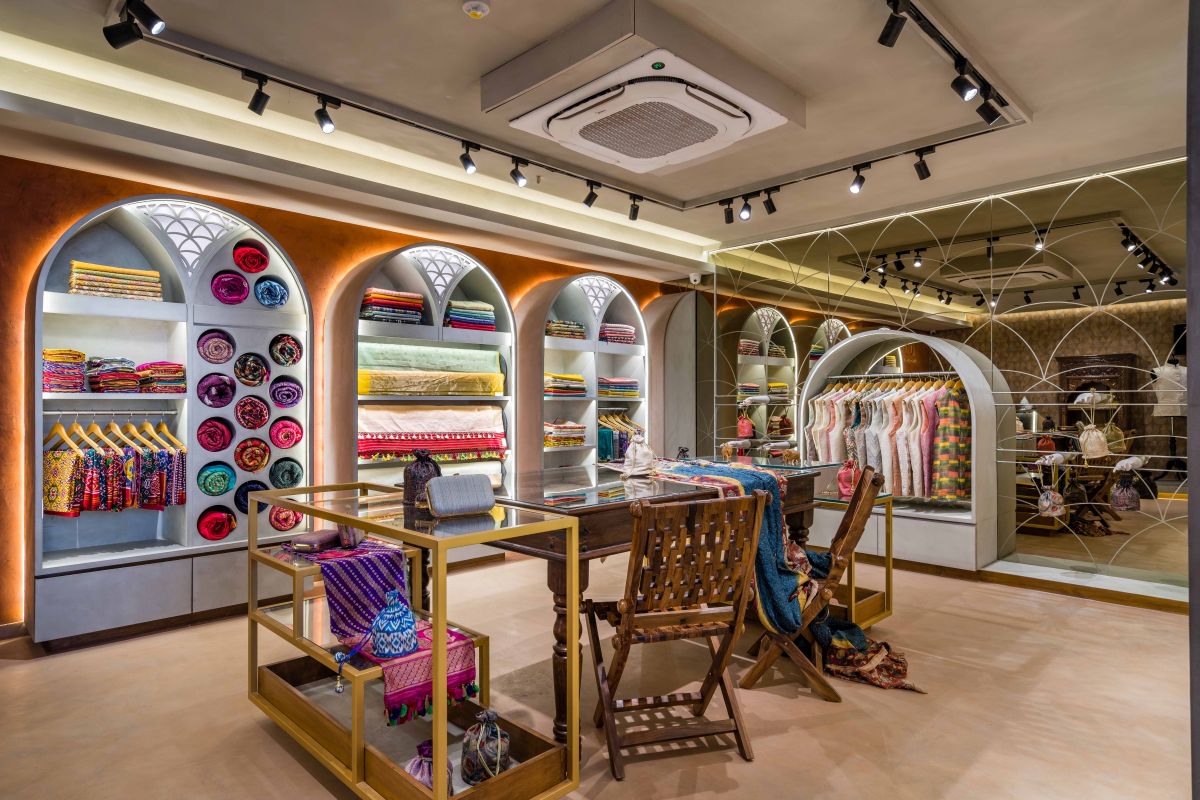
The arched narrative is carried through in the detailing of the display units and the mirror wall.

Considering space constraints, open metal shelves have been provided for display units.


Light-toned arched display units sheathe the stock of the textiles, counterbalancing the darker rustic tone of walls. These display units are customized on the basis of the quantity of stock to be displayed. The hole-cuts for dupattas and the shelves for thaan collection add creative interior details to the store.


The combination adds buoyancy to this textile retail store.

The mirror wall is creatively designed to look spacious and acts as a dramatic backdrop to the whole space.

The hand murals, hanging out from the wall, for displaying traditional purses is wisely designed to look attractive to customers whilst keeping in mind the space constraint.


The reception table is also made on-site with an idea to use the stamps of textiles, with a silvery-golden textured wall.

Track lights in the ceiling, defused lights behind the display units help to highlight the furniture and space within.

From the consoles to the treatment of the walls, there is subtle continuity in the design language throughout this space that softens and elevates the textile retail store.

Project Facts –

Project Name: Indian Boutique Store @ Taj Skyline, Ahmedabad

Architecture Firm: Shayona Consultant

Principal & Founder Architect: Ar. PrashantParmar

Firm Location: Ahmedabad, Gujarat, India

Completion Year: 2021

Carpet Area: 375 sq.ft

Project location: Taj Skyline, Sindhu Bhavan Road, Ahmedabad, Gujarat, India

Photo credits: Inclined Studio

Design Team: Ar. HarikrushnaPattani, Ar. Hemang Mistry, Ar. Ashish Rathod, Ms.Pooja Solanki, Ar. Vasavi Mehta.

Leave a Reply

Your email address will not be published. Required fields are marked *

This site uses Akismet to reduce spam. Learn how your comment data is processed.

Recent

Folles de la Salpétrière, (Cour des agitées.) (Madwomen of the Salpétrière. (Courtyard of the mentally disturbed.))

Gender. Hysteria. Architecture. | “How Did a Diagnosis Learn to Draw Walls?”

Did these spaces heal women or teach them how to disappear? Aditi A., through her research study as a part of the CEPT Writing Architecture course, in this chapter follows hysteria as it migrates from text to typology, inquiring how architectural decisions came to stand in for care itself. Rather than assuming architecture responded to illness, the inquiry turns the question around: did architecture help produce the vulnerability it claimed to manage?

Read More »
Gender, Hysteria, and Architecture - The Witch Hunt. Henry Ossawa Tanner. Source - Wikiart

Gender. Hysteria. Architecture. | “When Did Care Become Confinement?”

Was architecture used by society to spatially “manage” women and their autonomy? Aditi A., through her research study as a part of the CEPT Writing Architecture course, examines the period before psychiatry, when fear had already become architectural, tracing how women’s autonomy was spatially managed through domestic regulation, witch hunts, informal confinement, and early institutional planning.

Read More »

A Modernist’s Doubt: Symbolism and the Late Career Turn

Why did acclaimed modernist architects suddenly introduce historical symbolism like arches, decorative elements, and other cultural references into their work after decades of disciplined restraint? Sudipto Ghosh interrogates this 1980s-90s symbolic turn as a rupture in architecture, questioning whether this represents an authentic reconnection with content and memory, or is it a mere superficial gesture towards absent meanings. Drawing from Heidegger’s analysis of the Greek temple, he distinguishes two modes of architectural representation, ultimately judging that this turn was a nascent rebellion against modernism that may have failed to achieve genuine integration of context, material, and memory.

Read More »
Ode to Pune - A Vision. © Narendra Dengle - 1

The City That Could Be: An Ode to Pune

Narendra Dengle, through his poem written in January 2006, presents a deep utopic vision for Pune—what the city could be as an ecologically sustainable, equitable city that balances nature with development. He sets ambitious benchmarks for prioritizing public transport over cars, preserving heritage, addressing slum rehabilitation humanely, and empowering local communities

Read More »

Featured Publications

New Release

We Are Hiring

Stories that provoke enquiry into built environment

www.architecture.live

Subscribe & Join a Community of Lakhs of Readers