The’ Splash House’, at Ahmedabad, by The ART Container

Profile of the resident of the house, nuclear mid-aged family with child studying abroad, but loves to entertain guests. So, the public areas of leisure are extremely joyful with splashes of colors. Their only inclination was to have spectacular bright living spaces. - The ART Container

The ART Container

Profile of the resident of the house, nuclear mid-aged family with child studying abroad, but loves to entertain guests. So, the public areas of leisure are extremely joyful with splashes of colors. Their only inclination was to have spectacular bright living spaces.

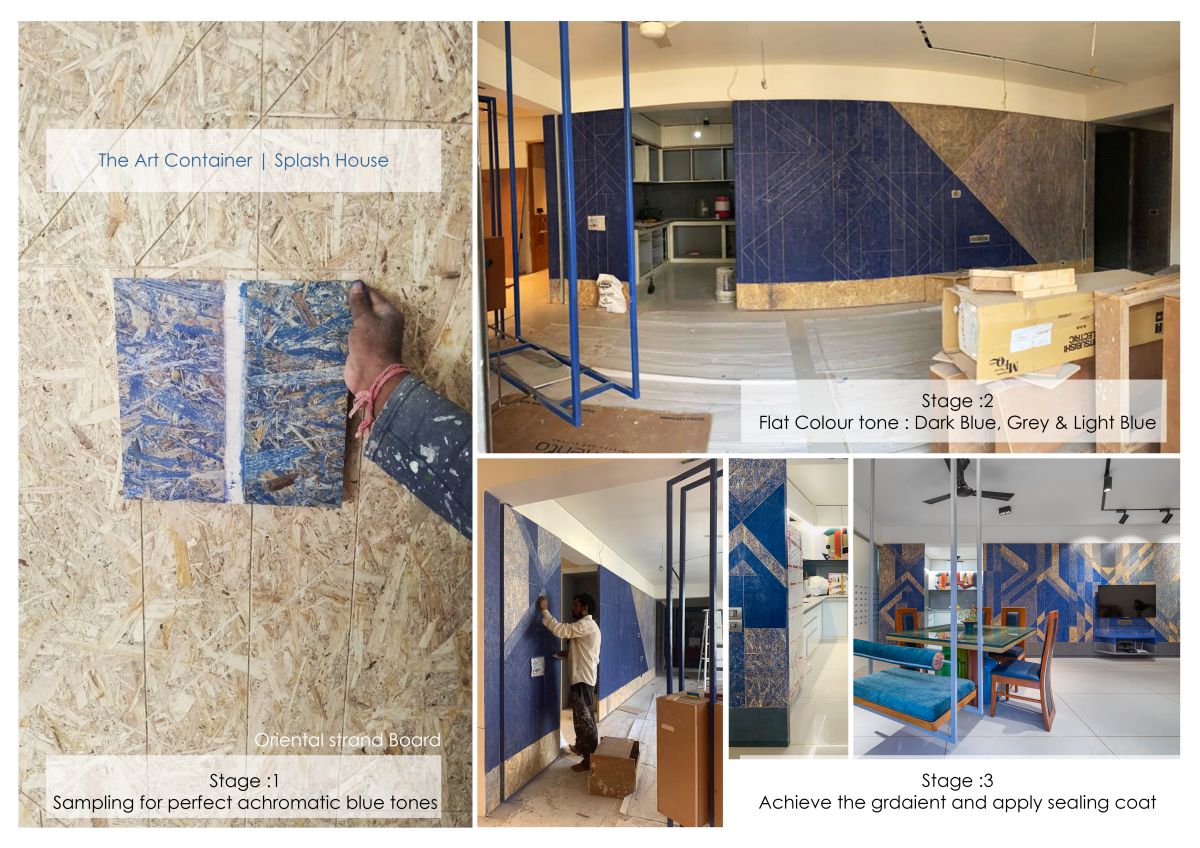
That’s where our experiments lead in finding correct materiality, texture & bright splash to fit the language of the house. Keeping in mind the renewable building material with increasing wood reserves every year, our material palette got defined with an oriental strand board. And staining with multiple color gradients became a perfect canvas for the house. The staining process included multiple layers of step in polishing and sanding to get an achromatic color appearance. Choice of the blue wall with a gradient of grey door camouflage the approach of each bedroom along with powder basin. Graphical patterns on triangulation initiate perception to a new utopia of blue surreal melancholy thoughts. A breakthrough from a mundane work environment, home is joy and peace.

The concept behind the Tabletop came as the house placed in the surrounding neighboring of a recognized world heritage city; vavs / stepwells were designed to store water in changing seasons. This unique connection was brought in the dining table top articulated as stepwell and water reflection, along with table legs as an expression of tunnels in varied shapes and sizes. The juxtaposition of different materials like MS, Resin and wood composite makes this furniture fine craftsmanship. Changing a notion of seating on a chair by a floating bench with a dining table, which was specially designed for the project.

The kitchen in white tonal was kept minimalistic with an approach of colorful back-painted glass artwork. It truly expresses the notion of ‘When the art meets cooking’.

A screen was introduced to separate and yet connect partially when needed. A perfect feature of the utility is where it allows storage from both spaces dining and formal living. Here, the console is a floating structure resting on metal frame members where none of the individual frames are connected to each other. In-between a pivot screen is designed to bifold partially and pivot completely. Being stained in different color tones, the furniture itself is a breath-taking gaze of pause.

To Integrate additional functions to have extra wardrobe space and additional pooja room, minor changes in plan allowed to spatially bring effortless convenience to the daily rituals of the family.

Tweaking the form and yet retaining function in the wardrobe, allowed clients to bifurcate and order their daily utilities efficiently. A blue console with a grey sliding wardrobe along with a white to blue ombre fluted bed backdrop compliments the blue splash of the house.

The’ Splash House’, at Ahmedabad, by The ART Container 2

The interior follows a bright color scheme with a positive vibe. It truly completes an aspiration of joyful, bright, and colorful escape from a mundane busy daily routine. Throughout the space, there are elements of surprise and splash of colors.

Drawings – 

Project Facts –

PROJECT TYPE: RESIDENTIAL APARTMENT

PROJECT NAME: SPLASH HOUSE

ARCHITECTS: THE ART CONTAINER

LOCATION: AHMEDABAD, INDIA

YEAR BUILT: 2021

AREA: 2200 SQ FT

PROJECT COST: 30-35 LAKH APPROX

FIRM NAME: THE ART CONTAINER

FIRM LOCATION: AHMEDABAD, GUJARAT, INDIA

LEAD DESIGNER: RAVEENA PANCHAL

PHOTOGRAPHY: INCLINED STUDIO

Leave a Reply

Your email address will not be published. Required fields are marked *

This site uses Akismet to reduce spam. Learn how your comment data is processed.

Recent

Source - Deccan Chronicle

Wall As a Public Space
“To read public space only as a spatial condition, as a matter of square footage, zoning, or physical access, is to miss half the picture.”
—Reshma Esther Thomas

Reshma Esther Thomas examines how Hyderabad’s flyover pillars, painted with Cheriyal-style murals under the GHMC’s ‘City Art Scape’ initiative, reveal the paradox of managed public space. What appears to be beautification is actually cultural assertion in the wake of the 2014 bifurcation, bureaucratising a surface that once belonged to those without institutional power.

Read More »
Khazans in Slavador du Mundo, Bardez, Goa. © Kusum Priya (1)

The Map That Was Never Yours
“If publicness is reduced to what is legally accessible, then these landscapes were never public to begin with.”
—V.V. Kusum Priya

As part of our editorial: What makes a space public?, V.V. Kusum Priya argues that Section 39A of Goa’s 2024 Town and Country Planning Act this isn’t just a legal issue, and that it’s the erosion of an unrecognised but collectively sustained commons, and a question of what “public” really means and who benefits from the legislations surrounding this.

Read More »
Life on the public spaces in downtown Calcutta. Source - Wikimedia


“Appropriation of public spaces is the genesis of political movements, of ideological apparatus, and of endangering the city’s multi-dimensional fabric.”
—Dr. Seema Khanwalkar

Dr. Seema Khanwalkar, explores how the public spaces in India are dynamic, contested areas shaped by informal economies, migration, and social negotiation. She reveals how the transactional activities democratise ownership of these spaces, while the political and religious appropriation increasingly displaces this organic vitality, creating exclusion and anxiety. This shrinking of inclusive public space threatens urban social fabric, yet remains largely absent from city planning conversations, making it a far deeper crisis than mere encroachment.

Read More »
Sen Kapadia


“… people like Sen [Kapadia] don’t really leave. They become the questions we continue to ask.”
—A Tribute by Nuru Karim

Nuru Karim reflects on his relationship with Sen Kapadia through three transformative “states of being”—as a student, as a studio colleague, and as an independent professional. To capture Sen’s essence, Karim draws on three powerful metaphors: a mountain (commanding yet silent), a banyan tree (generous and sheltering), and a river (unseen yet ever-present). Together, these images paint a portrait of a man whose quiet depth left an indelible mark on all who encountered him.

Read More »
Sen Kapadia

Nirbhaya Nirgun
“Sen [Kapadia] found his own light early. He followed it without apology and without detour, and never let anyone dim it.”
—A Tribute by Pinkish Shah

Pinkish Shah’s homage to Sen Kapadia, celebrates him as fearless and formless in both life and work. Intellectually rooted in Louis Kahn and Sri Aurobindo, Sen pursued architecture that transcended form toward essential silence. Known for his courage, he maintained quiet, unwavering independence throughout his career.

Read More »
Prof Shireesh Atmaram Deshpande

“Professor Shireesh Deshpande chose the far more difficult task: to mould young minds into thoughtful, responsible, and rooted architects.”—A Tribute by Sarbjit Singh Bagha

Sarbjit Singh Bagha shares his tribute to Prof. Shireesh Atmaram Deshpande (1934–2026), a pioneering figure in Indian architectural education who passed away on 10 April 2026 at 91. Known affectionately as “Dada,” he spent nearly four decades at VNIT Nagpur, founding India’s first M.Arch. programme and introducing innovative pedagogy. He served as President of the Indian Institute of Architects (1992–1994). Choosing teaching over professional practice, he shaped generations of architects.

Read More »

Featured Publications

New Release

Stories that provoke enquiry into built environment

www.architecture.live

Subscribe & Join a Community of Lakhs of Readers

We Need Your Support

To be able to continue the work we are doing and keeping it free for all, we request our readers to support in every way possible.

Your contribution, no matter the size, helps our small team sustain this space. Thank you for your support.

Contribute using UPI

Contribute Using Cards