The House of Solid Stone, Jaipur, by Malik Architecture

"In India, the economy of hand-made is still comparable with mechanized methods. The house of Solid Stone in Jaipur presented us with an opportunity to explore and evolve a method of building that has been prevalent in traditional buildings for centuries. We laid out a simple brief: no material other than stone should be used for construction. This made us dive deeply into the art of 'making' with stone." - Malik Architecture
The House of Solid Stone, Jaipur, by Malik Architecture 1

The house in Jaipur presented Malik Architecture with an opportunity to explore and evolve a method of building that has been prevalent in traditional buildings for centuries. A simple brief was laid out: no material other than stone should be used for construction.

The House of Solid Stone, Jaipur, by Malik Architecture 3

This made us dive deeply into the art of ‘making‘ with stone.

Malik Architecture

Rajasthan is synonymous with sandstone as a building material but, over the last few decades, this material has been reduced to a ‘cladding ‘medium and its potential as a robust and sustainable structural element has not been explored.

The traditional method of load-bearing construction relied on the impermeable thickness of walls. This was reengineered to develop a hollow interlocking structural wall system that creates a more effective thermal break, provides space to integrate services within the wall cavity, and effectively reduces the material consumption by 30%.

Floor systems alternate between vaults and large single-span stone pieces. Every building element from the basement raft/retaining walls/lintels/door and window jambs/reveals/stairs/screens etc has been made from stone blocks, either from the quarry ( superstructure elements) or excavated from the site ( substructure elements).
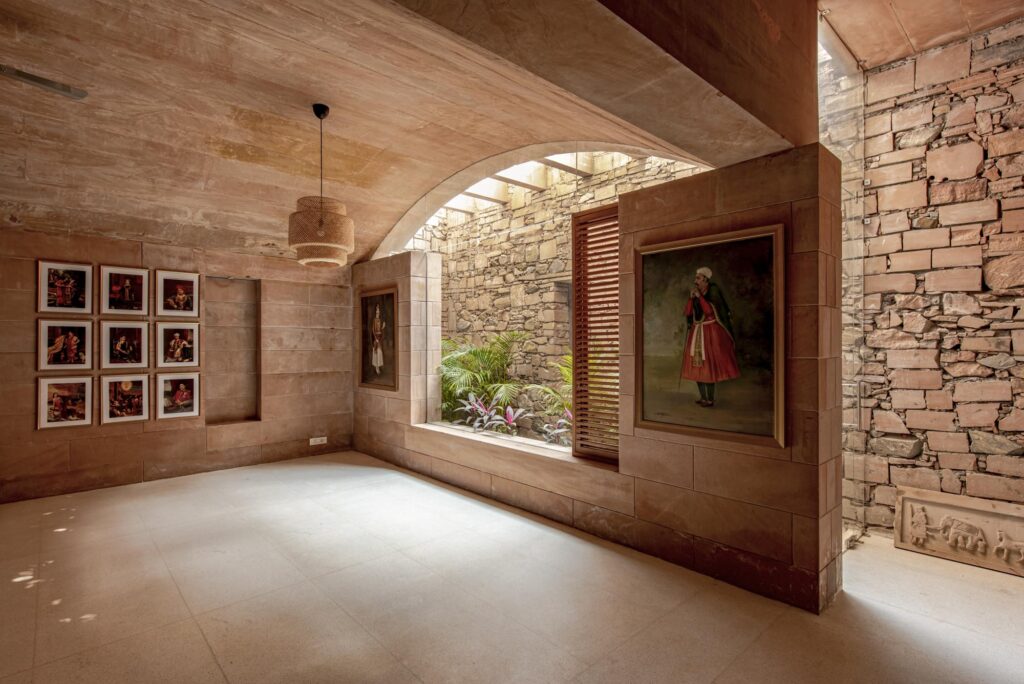
The house is arranged around a narrow courtyard that extends into even narrower slits and fissures as it weaves its way through the house, essentially drawing on the proportions of voids and interstitial spaces of traditional dwellings as a method to counter the effect of the harsh summer sun.

The House of Solid Stone, Jaipur, by Malik Architecture 29

Large front and rear-facing glazing are shaded by deep overhangs and operable, hand-cut stone screens to modulate light, privacy, and views.

Drawings

Images

Project Facts:

Location: Hanuman Nagar, Jaipur, Rajasthan
Site Area: 4700 sq.ft.
Built Up Area: 8000 sq.ft.
Status: Completion 2019
Design Team: Kamal Malik, Arjun Malik, Ketan Chaudhary, Payal Hundiwala, Soumya Shukla, Neha Kotian.
Photography: Fabian Charuau, Bharath Ramamrutham

Consultants:

Structure: GES – Global Engineering Services.
Plumbing: GES – Global Engineering Services.
Electrical: GES – Global Engineering Services.
HVAC Consultant: Coolair System- Daikin
Rain Water Harvesting: Mungekar and Associates
Landscape Consultant: Malik Architecture

Contractors:

Structure And Civil: Angira Interiors– Naresh Suthar
Glazing: Angira Interiors– Naresh Suthar
Stone Facade: Angira Interiors– Naresh Suthar
HVAC: Coolair System – Javed Shaikh
Plumbing And Firefighting: Angira Interiors– Naresh Suthar
Electrical: Vespl-Vora electric service
Interiors & Carpentry: Angira Interiors– Naresh Suthar

One Response

Leave a Reply

Your email address will not be published. Required fields are marked *

This site uses Akismet to reduce spam. Learn how your comment data is processed.

Recent

A Modernist’s Doubt: Symbolism and the Late Career Turn

Why did acclaimed modernist architects suddenly introduce historical symbolism like arches, decorative elements, and other cultural references into their work after decades of disciplined restraint? Sudipto Ghosh interrogates this 1980s-90s symbolic turn as a rupture in architecture, questioning whether this represents an authentic reconnection with content and memory, or is it a mere superficial gesture towards absent meanings. Drawing from Heidegger’s analysis of the Greek temple, he distinguishes two modes of architectural representation, ultimately judging that this turn was a nascent rebellion against modernism that may have failed to achieve genuine integration of context, material, and memory.

Read More »
Ode to Pune - A Vision. © Narendra Dengle - 1

The City That Could Be: An Ode to Pune

Narendra Dengle, through his poem written in January 2006, presents a deep utopic vision for Pune—what the city could be as an ecologically sustainable, equitable city that balances nature with development. He sets ambitious benchmarks for prioritizing public transport over cars, preserving heritage, addressing slum rehabilitation humanely, and empowering local communities

Read More »
(left) Turtle Poem 1999 & Calligraphy 2006, by H. Masud Taj. © H. Masud Taj. (right) Photograph of Hassan Fathy 1976, © Martin Lyons

“Hassan Fathy’s head was in the heavens, heart in the right place, and feet planted firmly on earth.”—H. Masud Taj on his Turtle poem & Hassan Fathy

H. Masud Taj elucidates how, as a young architecture student, he dropped out of his institution to travel and learn from monuments, discovering in Gaudí’s Sagrada Familia a turtle column that catalyzed an inquiry, hearing Hassan Fathy’s explication of the turtle in Cairo, ultimately crystallizing in Taj’s poetic meditation on dwelling.

Read More »
Education Authority Bill - Viksit Bharat Shiksha Adhishthan Bill - Architecture Education, A. Srivathsan

Education Authority Bill: Its Implications for Architecture Education

A. Srivathsan in his preliminary overview of the new Viksit Bharat Shiksha Adhishthan Bill, notes that the bill could transform architectural education. The VBSA Bill proposes restructuring India’s higher education regulation, by dissolving UGC and related authorities, creating three new councils for regulation, accreditation, and standards.

Read More »
Open Hand Monument, Chandigarh. Via Chandigarh Tourism

Revisiting Chandigarh: A Vitalised Metaphoric Urban Forest

Suneet Paul reflects on Chandigarh’s modernist planning, lush green spaces, and iconic architecture, highlighting architects like Le Corbusier’s and S.D. Sharma’s contributions, high quality of life for residents, and the city’s enduring appeal despite emerging urban challenges.

Read More »

Featured Publications

New Release

We Are Hiring

Stories that provoke enquiry into built environment

www.architecture.live

Subscribe & Join a Community of Lakhs of Readers