Unbuilt Architectural Project: Multisport Complex, Flyying Seeds

Unbuilt Project: MULTI SPORTS COMPLEX FOR SCHOOL AT GREATER FARIDABAD, by Flyying Seeds

The major requirement was to create a consolidated proposal wherein all these curricular activities houses under one roof within a square site at the south-west side of the school property.
Unbuilt Architectural Project: Multisport Complex, Flyying Seeds

Unbuilt Architectural Project: Multisport Complex, Flyying Seeds“The intend was to create a multi level yet well connected versatile public spaces catering to the defined and undefined student activities that includes covered sports arena, Gymnasium, Auditorium, Mess, training Centers and lots of free spaces for growing students”

DESIGN APPROACH

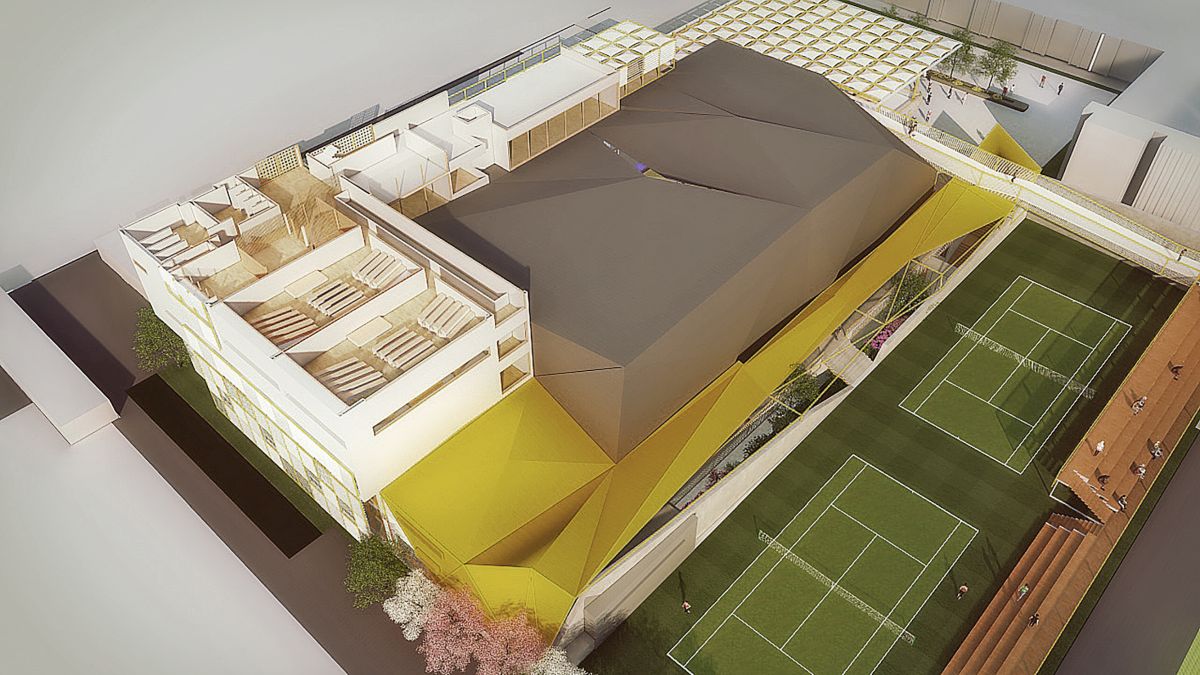
The existing site included the school campus both primary secondary and senior blocks with all the sports facilities within adjacent playgrounds. The major requirement was to create a consolidated proposal wherein all these curricular activities houses under one roof within a square site at the south-west side of the school property. An integrated Mess and a Training centre were aditional reqirements to the proposal. We starteby considering the whole site to house an introvert space that eventually opens up to the physical and social environment around. By pushing the ground level below 10 feet we created a lower ground door that housed the 300 capacity student mess, the pool and adjacent Gymnasium. This level opens out to pockets of Sunken courts created to induce light and life in the activities happening in that level. The ground level or the main arena includes the main Match court superimposed with the practice courts.

Unbuilt Architectural Project: Multisport Complex, Flyying Seeds
Concept Sheet

Multisport Complex at School, Faridabad, Flyyingseeds

This level is directly connected with the School building by the Gallery of fame. The gallery also looks into the sunkencourts and the pool below. The design was aimed to become such that it just doesnt house the courts but also aims to provide good and healthy atmosphere to studens to facilitate interaction, team spirit and group activities .

The site is a part of the existing school property in Fariabad, abutting the main road. Once the project is nearing completion, the approach road, that lies defunct now shall serve as a main entry to the sports complex. thus, the proposed design was expected to create a landmark and acts as an iconic gateway to the school premises.

More Images:

Drawings:

Design team: Abhinav Chaudhary, Shubham Vasudev, Debopriyo, Kakoli Bhattacharya

Location: DPS, Greater Faridabad, Haryana
Client: Delhi Public School
Construction Status: Ongoing
Total plot Area: 4000 sqmt
Total Builtup Area: 7200 sqmt
Ground coverage Area: 2500 sqmt
Approximate Cost: 300 Million Rs.

Leave a Reply

Your email address will not be published. Required fields are marked *

This site uses Akismet to reduce spam. Learn how your comment data is processed.

Recent

Folles de la Salpétrière, (Cour des agitées.) (Madwomen of the Salpétrière. (Courtyard of the mentally disturbed.))

Gender. Hysteria. Architecture. | “How Did a Diagnosis Learn to Draw Walls?”

Did these spaces heal women or teach them how to disappear? Aditi A., through her research study as a part of the CEPT Writing Architecture course, in this chapter follows hysteria as it migrates from text to typology, inquiring how architectural decisions came to stand in for care itself. Rather than assuming architecture responded to illness, the inquiry turns the question around: did architecture help produce the vulnerability it claimed to manage?

Read More »
Gender, Hysteria, and Architecture - The Witch Hunt. Henry Ossawa Tanner. Source - Wikiart

Gender. Hysteria. Architecture. | “When Did Care Become Confinement?”

Was architecture used by society to spatially “manage” women and their autonomy? Aditi A., through her research study as a part of the CEPT Writing Architecture course, examines the period before psychiatry, when fear had already become architectural, tracing how women’s autonomy was spatially managed through domestic regulation, witch hunts, informal confinement, and early institutional planning.

Read More »

A Modernist’s Doubt: Symbolism and the Late Career Turn

Why did acclaimed modernist architects suddenly introduce historical symbolism like arches, decorative elements, and other cultural references into their work after decades of disciplined restraint? Sudipto Ghosh interrogates this 1980s-90s symbolic turn as a rupture in architecture, questioning whether this represents an authentic reconnection with content and memory, or is it a mere superficial gesture towards absent meanings. Drawing from Heidegger’s analysis of the Greek temple, he distinguishes two modes of architectural representation, ultimately judging that this turn was a nascent rebellion against modernism that may have failed to achieve genuine integration of context, material, and memory.

Read More »
Ode to Pune - A Vision. © Narendra Dengle - 1

The City That Could Be: An Ode to Pune

Narendra Dengle, through his poem written in January 2006, presents a deep utopic vision for Pune—what the city could be as an ecologically sustainable, equitable city that balances nature with development. He sets ambitious benchmarks for prioritizing public transport over cars, preserving heritage, addressing slum rehabilitation humanely, and empowering local communities

Read More »

Featured Publications

New Release

We Are Hiring

Stories that provoke enquiry into built environment

www.architecture.live

Subscribe & Join a Community of Lakhs of Readers