Unbuilt Architectural Project: Multisport Complex, Flyying Seeds

Unbuilt Project: MULTI SPORTS COMPLEX FOR SCHOOL AT GREATER FARIDABAD, by Flyying Seeds

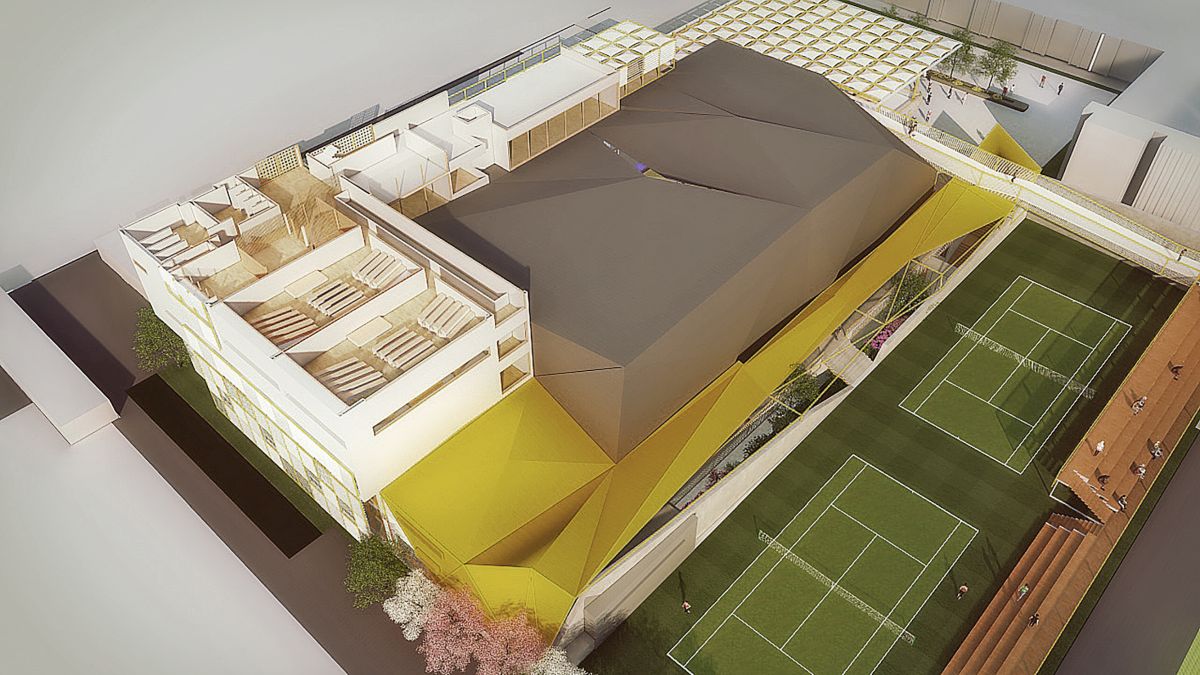
The major requirement was to create a consolidated proposal wherein all these curricular activities houses under one roof within a square site at the south-west side of the school property.
Unbuilt Architectural Project: Multisport Complex, Flyying Seeds

Unbuilt Architectural Project: Multisport Complex, Flyying Seeds“The intend was to create a multi level yet well connected versatile public spaces catering to the defined and undefined student activities that includes covered sports arena, Gymnasium, Auditorium, Mess, training Centers and lots of free spaces for growing students”

DESIGN APPROACH

The existing site included the school campus both primary secondary and senior blocks with all the sports facilities within adjacent playgrounds. The major requirement was to create a consolidated proposal wherein all these curricular activities houses under one roof within a square site at the south-west side of the school property. An integrated Mess and a Training centre were aditional reqirements to the proposal. We starteby considering the whole site to house an introvert space that eventually opens up to the physical and social environment around. By pushing the ground level below 10 feet we created a lower ground door that housed the 300 capacity student mess, the pool and adjacent Gymnasium. This level opens out to pockets of Sunken courts created to induce light and life in the activities happening in that level. The ground level or the main arena includes the main Match court superimposed with the practice courts.

Unbuilt Architectural Project: Multisport Complex, Flyying Seeds
Concept Sheet

Multisport Complex at School, Faridabad, Flyyingseeds

This level is directly connected with the School building by the Gallery of fame. The gallery also looks into the sunkencourts and the pool below. The design was aimed to become such that it just doesnt house the courts but also aims to provide good and healthy atmosphere to studens to facilitate interaction, team spirit and group activities .

The site is a part of the existing school property in Fariabad, abutting the main road. Once the project is nearing completion, the approach road, that lies defunct now shall serve as a main entry to the sports complex. thus, the proposed design was expected to create a landmark and acts as an iconic gateway to the school premises.

More Images:

Drawings:

Design team: Abhinav Chaudhary, Shubham Vasudev, Debopriyo, Kakoli Bhattacharya

Location: DPS, Greater Faridabad, Haryana
Client: Delhi Public School
Construction Status: Ongoing
Total plot Area: 4000 sqmt
Total Builtup Area: 7200 sqmt
Ground coverage Area: 2500 sqmt
Approximate Cost: 300 Million Rs.

Leave a Reply

Your email address will not be published. Required fields are marked *

This site uses Akismet to reduce spam. Learn how your comment data is processed.

Recent

Source - Deccan Chronicle

Wall As a Public Space
“To read public space only as a spatial condition, as a matter of square footage, zoning, or physical access, is to miss half the picture.”
—Reshma Esther Thomas

Reshma Esther Thomas examines how Hyderabad’s flyover pillars, painted with Cheriyal-style murals under the GHMC’s ‘City Art Scape’ initiative, reveal the paradox of managed public space. What appears to be beautification is actually cultural assertion in the wake of the 2014 bifurcation, bureaucratising a surface that once belonged to those without institutional power.

Read More »
Khazans in Slavador du Mundo, Bardez, Goa. © Kusum Priya (1)

The Map That Was Never Yours
“If publicness is reduced to what is legally accessible, then these landscapes were never public to begin with.”
—V.V. Kusum Priya

As part of our editorial: What makes a space public?, V.V. Kusum Priya argues that Section 39A of Goa’s 2024 Town and Country Planning Act this isn’t just a legal issue, and that it’s the erosion of an unrecognised but collectively sustained commons, and a question of what “public” really means and who benefits from the legislations surrounding this.

Read More »
Life on the public spaces in downtown Calcutta. Source - Wikimedia


“Appropriation of public spaces is the genesis of political movements, of ideological apparatus, and of endangering the city’s multi-dimensional fabric.”
—Dr. Seema Khanwalkar

Dr. Seema Khanwalkar, explores how the public spaces in India are dynamic, contested areas shaped by informal economies, migration, and social negotiation. She reveals how the transactional activities democratise ownership of these spaces, while the political and religious appropriation increasingly displaces this organic vitality, creating exclusion and anxiety. This shrinking of inclusive public space threatens urban social fabric, yet remains largely absent from city planning conversations, making it a far deeper crisis than mere encroachment.

Read More »
Sen Kapadia


“… people like Sen [Kapadia] don’t really leave. They become the questions we continue to ask.”
—A Tribute by Nuru Karim

Nuru Karim reflects on his relationship with Sen Kapadia through three transformative “states of being”—as a student, as a studio colleague, and as an independent professional. To capture Sen’s essence, Karim draws on three powerful metaphors: a mountain (commanding yet silent), a banyan tree (generous and sheltering), and a river (unseen yet ever-present). Together, these images paint a portrait of a man whose quiet depth left an indelible mark on all who encountered him.

Read More »

Featured Publications

New Release

Stories that provoke enquiry into built environment

www.architecture.live

Subscribe & Join a Community of Lakhs of Readers

We Need Your Support

To be able to continue the work we are doing and keeping it free for all, we request our readers to support in every way possible.

Your contribution, no matter the size, helps our small team sustain this space. Thank you for your support.

Contribute using UPI

Contribute Using Cards