Winery At Nasik

Winery at Nashik, by Sachin Agshikar Architects

This post gives information on a winery which is located in the valleys of Nasik by Sachin Agshikar Architects. The final proposal was also to have an Experience Lounge on top of the hill along with library, shop and office space. But the project is only 25 % completed to date.
Winery At Nasik

Winery at nasik
The site was basically a hill and had come at a cost. So it was decided that every inch has to be utilized for the plantation of grapes. The only portion which was difficult to plant was the valley passing through the middle of the plot. This area was chosen to build the winery.

Winery at Nashik, by Sachin Agshikar Architects 2


Winery at Nashik, by Sachin Agshikar Architects 4

Even though this made the construction process difficult, the building blocks emerging unexpectedly from the valley was striking when seen from the road. The contours also helped in creating stepped platforms within the building, helping the manufacturing process of wine using gravity. It was a preferred way of making wine where the grape crusher is located at higher level and the tanks are located below to avoid pumping.

Winery at Nashik, by Sachin Agshikar Architects 6

The main approach road was intentionally taken around the hill so that the building which was quite big in size (as it has to house huge stainless steel tanks), was not seen. Having placed within the valley, it was almost invisible- as you land up on top of the hill which is in level with the roof of the building, which was to be landscaped. A small structure on top indicates entry point to this large building and one is slowly exposed to an interesting space with double height volume and stainless steel tanks and pipes, shining in the controlled natural light entering through the skylights.

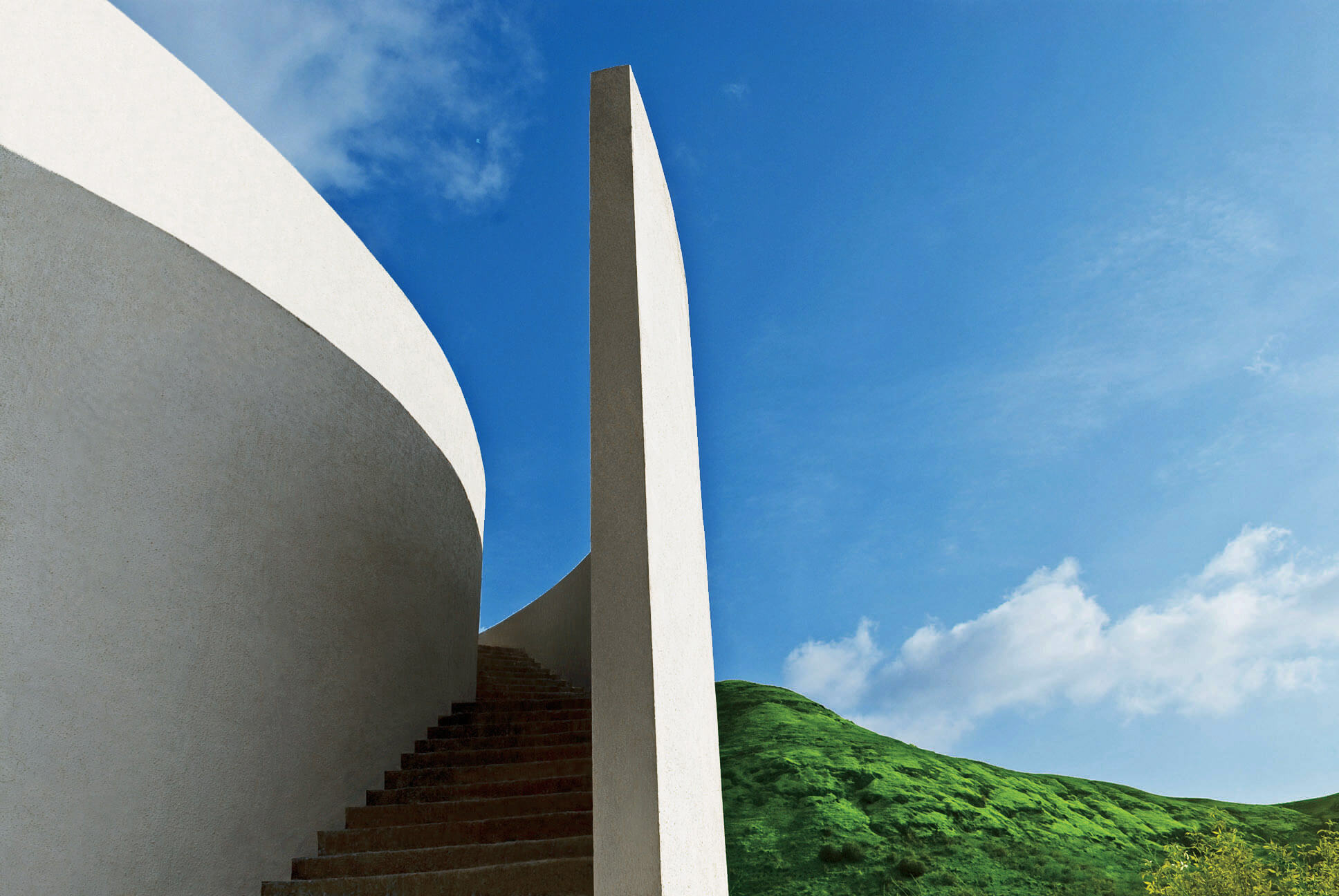
A gigantic circular tank was placed on the highest point of the site. A wall peeling off the cylinder was mainly to accommodate the staircase leading to the rooftop. An amazing view of a lake far beyond, is seen from this point.

The final proposal was also to have an Experience Lounge on top of the hill along with library, shop and office space. Unfortunately only 25% of the entire proposal was built and the rest is on hold till date. The images of completed project till date has been given below.


Drawings:


One Response

Leave a Reply

Your email address will not be published. Required fields are marked *

This site uses Akismet to reduce spam. Learn how your comment data is processed.

Recent

Edwin Lutyens' bust which was replaced by C. Rajagopalachari's bust in Rashtrapathi Bhavan

“Changing The Statue Does Not Change the Room”—Geethu Gangadhar on Edwin Lutyens’ Bust Removal

The current Indian government replaced Edwin Lutyens’ bust with freedom fighter C. Rajagopalachari’s at Rashtrapati Bhavan, framing it as decolonisation. But symbolic gestures don’t dismantle colonial mindsets embedded in governance, caste, and institutions. Geethu Gangadhar raises an important question: whether this removal is a way to eradicate colonial baggage or systemic removal of history.

Read More »
Massing during construction, retaining the exposed concrete facade composition, cross columns and profiled beams. Archival collection of Tibet House, 1977. Accessed in 2026

Brutalist India | Tibet House, New Delhi

As part of Brutalist India series Bhawna Dandona writes about Tibet House in New Delhi which is a non-profit cultural centre dedicated to preserving Tibetan heritage, founded in 1965 at the Dalai Lama’s request. The current building’s foundation was laid in 1974, with architect Shivnath Prasad.

Read More »
Vivek Rawal

Architecture, Power, and the Poor | “As a profession, architecture lacks moral position and has become complicit in the neoliberal dispossession of the poor.”—Vivek Rawal

Vivek Rawal argues that architecture—as a profession—is structurally aligned with political and economic power rather than social justice. He critiques how architectural education and practice prioritise developers and real estate over communities, turning housing into a market commodity. Even movements like sustainability and participation, he says, often become tools for elite consumption rather than genuine empowerment. True moral reform, according to Rawal, would mean architects relinquishing control and enabling community-led design and housing decisions.

Read More »
The Chunli Guesthouse, Shanghai, China by TEAM_BLDG 1

The Chunli Guesthouse, Shanghai, China by TEAM_BLDG

The Chunli Guesthouse, Shanghai, China by TEAM_BLDG’s response to nature, memory, and the spirit of place. The design takes “Catching” as its spiritual core, emphasizing the relationship between the architecture and the surrounding rice field landscape.

Read More »

Featured Publications

New Release

Stories that provoke enquiry into built environment

www.architecture.live

Subscribe & Join a Community of Lakhs of Readers

We Need Your Support

To be able to continue the work we are doing and keeping it free for all, we request our readers to support in every way possible.

Your contribution, no matter the size, helps our small team sustain this space. Thank you for your support.

Contribute using UPI

Contribute Using Cards