The Shaded House, at Ahmedabad, by Shayona Consultant

The Shaded House, at Ahmedabad, by Shayona Consultant

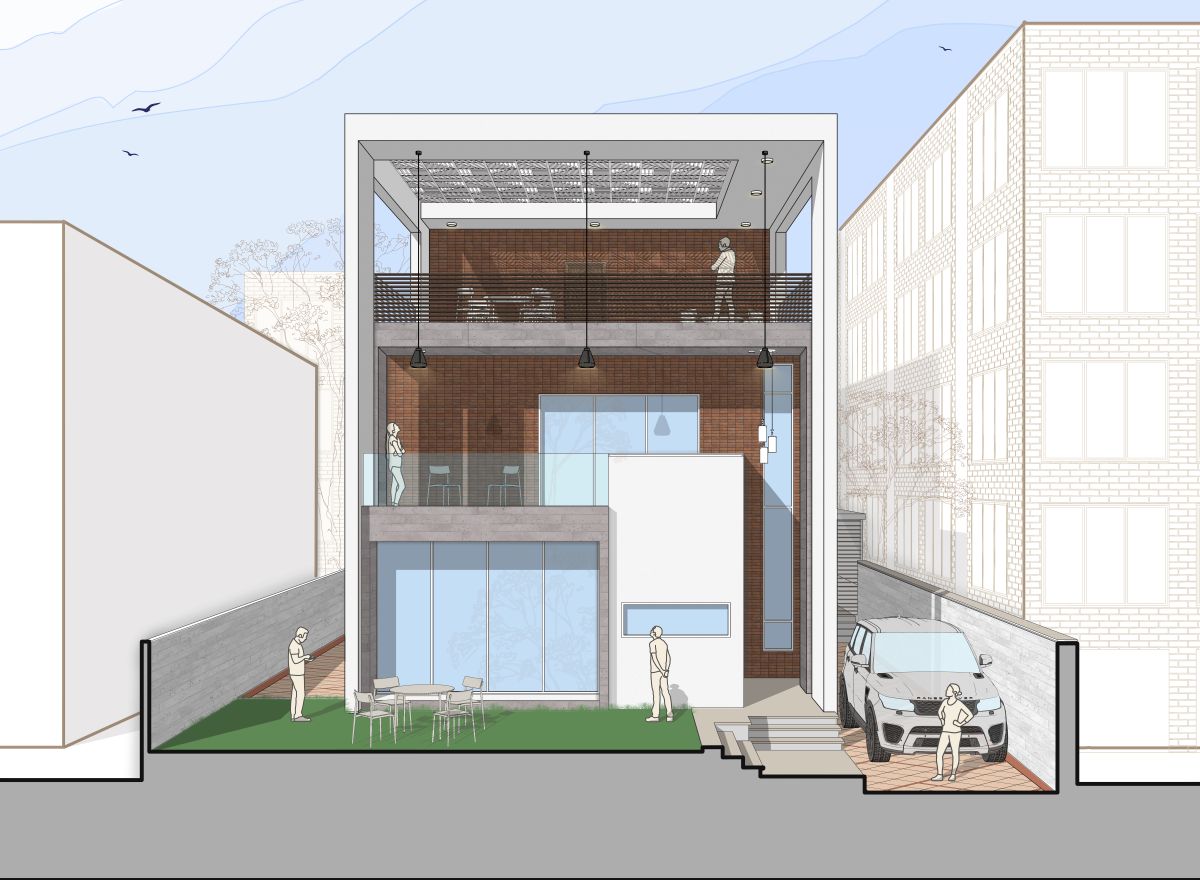
A multitude of massive frames at various levels, spacious semi-covered green terraces at all floor levels getting animated with play of light as it permeates through the geometrically patterned MS trellis at the top of the largest frame and a unique experience of varying volumes right from the entry ... All this sum’s up very briefly the spatial experience of “The Shaded House”. - Shayona Consultant
The Shaded House, at Ahmedabad, by Shayona Consultant

The Shaded House, at Ahmedabad, by Shayona Consultant 1


A multitude of massive frames at various levels, spacious semi-covered green terraces at all floor levels getting animated with play of light as it permeates through the geometrically patterned MS trellis at the top of the largest frame and a unique experience of varying volumes right from the entry … All this sum’s up very briefly the spatial experience of “The Shaded House”.


Client had a requirement of 4BHK Bungalow, along with garden space which permits interaction with nature through air, natural light and even rainfall.


The 45’ x 90’ site was surrounded by 2-4 storey building on three sides in Paldi area of Ahmedabad city. The sole permissible frontage – the only means for natural light, aeration and establishing visual connections with nature and outdoors was merely 27’. Both these factors were challenging for the Architect.


The facade is expressive creating a self-shading structure. The elevated gardens on the south-east are created out of grey cubes-cladded with wooden figured MCM cladding material, while the walls looks astonishing with brick cladding. A simple white frame as a base element, is stretched up to the highest level placing a striking MS screen on the top of it. It adds character to the design that overlook the green spaces on site and helps to cut out harsh sunlight entering into the interior spaces by creating a magical play of light and shadow.


Entry veranda gives you feel of volumetric difference of triple height to double height. Vestibule gives the impression of open-plan layout that allows for a seamless transition from one space to another.


The layout of the house is uncomplicated and flows naturally from common to private activities.
 

The Shaded House, at Ahmedabad, by Shayona Consultant 9


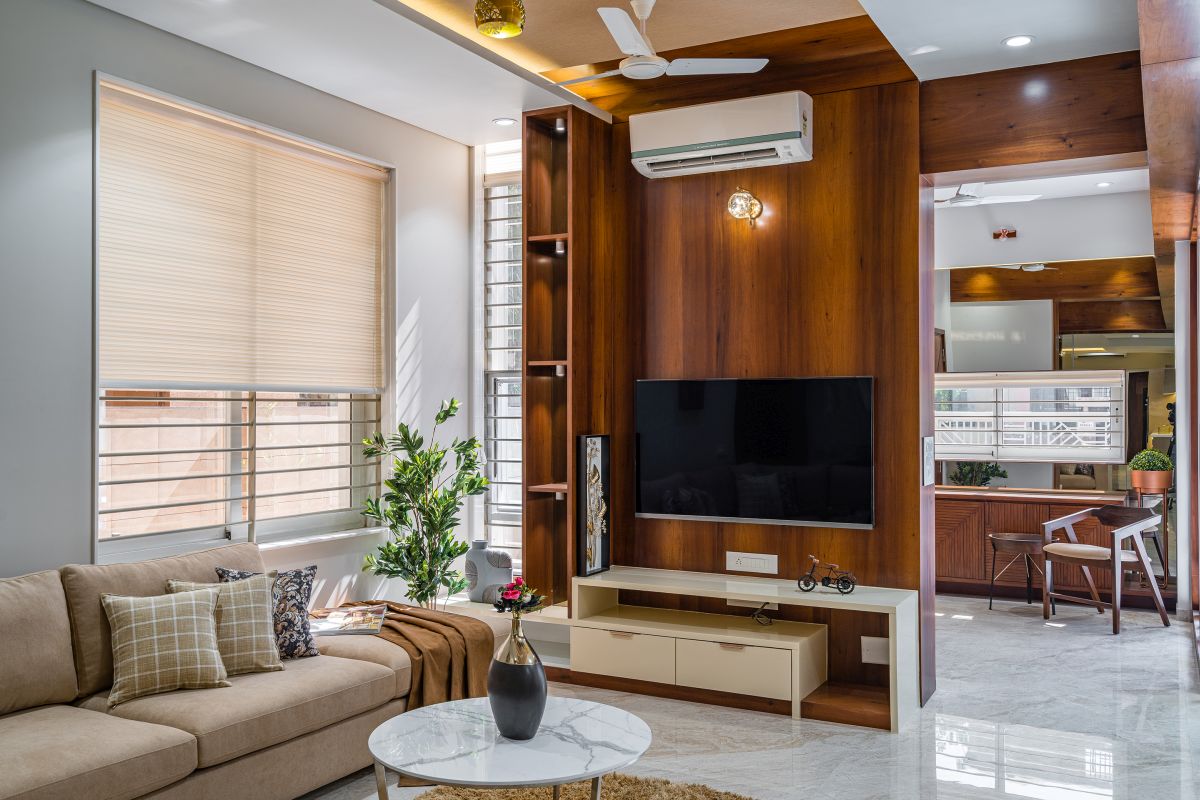
The bright & airy living room exudes a sense of refined taste with its plush, nude-colored sofas, stone cladded wall and sunlight that seeps in through the tall windows connecting the front garden. The front garden acts as a source of light and ventilation for the ground floor.
 

The Shaded House, at Ahmedabad, by Shayona Consultant 11


Engulfed by common activities on three sides, the family room acts as a cosy entertainment room for the family members.
 

The Shaded House, at Ahmedabad, by Shayona Consultant 13


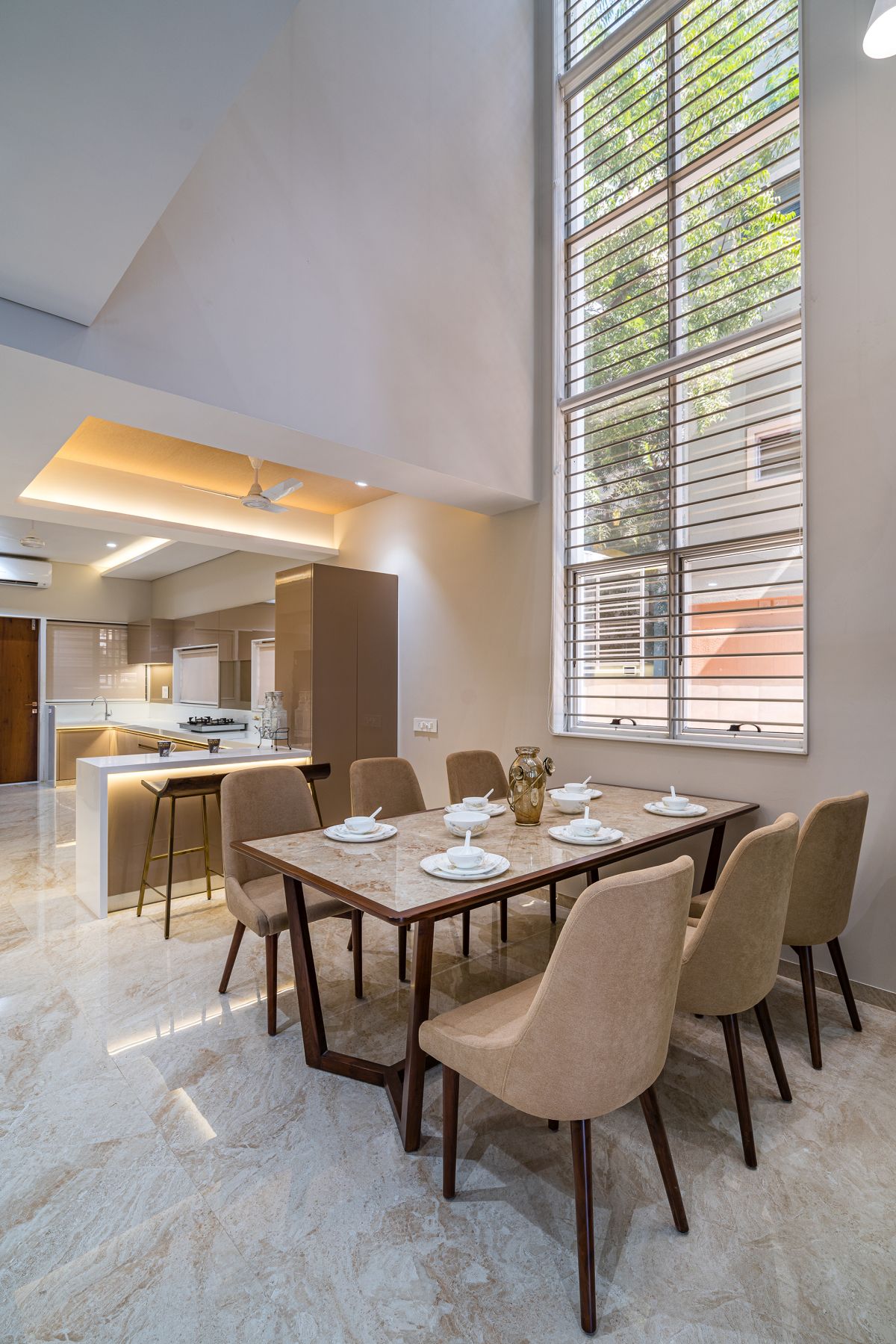
The dining is connected with the puja room on the north-east side, acts as a central core with a triple-height space. With intention of allowing an influx of natural light, large windows have been installed throughout the house.
 

The Shaded House, at Ahmedabad, by Shayona Consultant 15


Looking at the ground floor, the space is minimal, but there’s no design void that you’d want to fill. The staircase and lift act as a vertical transition to all floors.
 

The Shaded House, at Ahmedabad, by Shayona Consultant 17


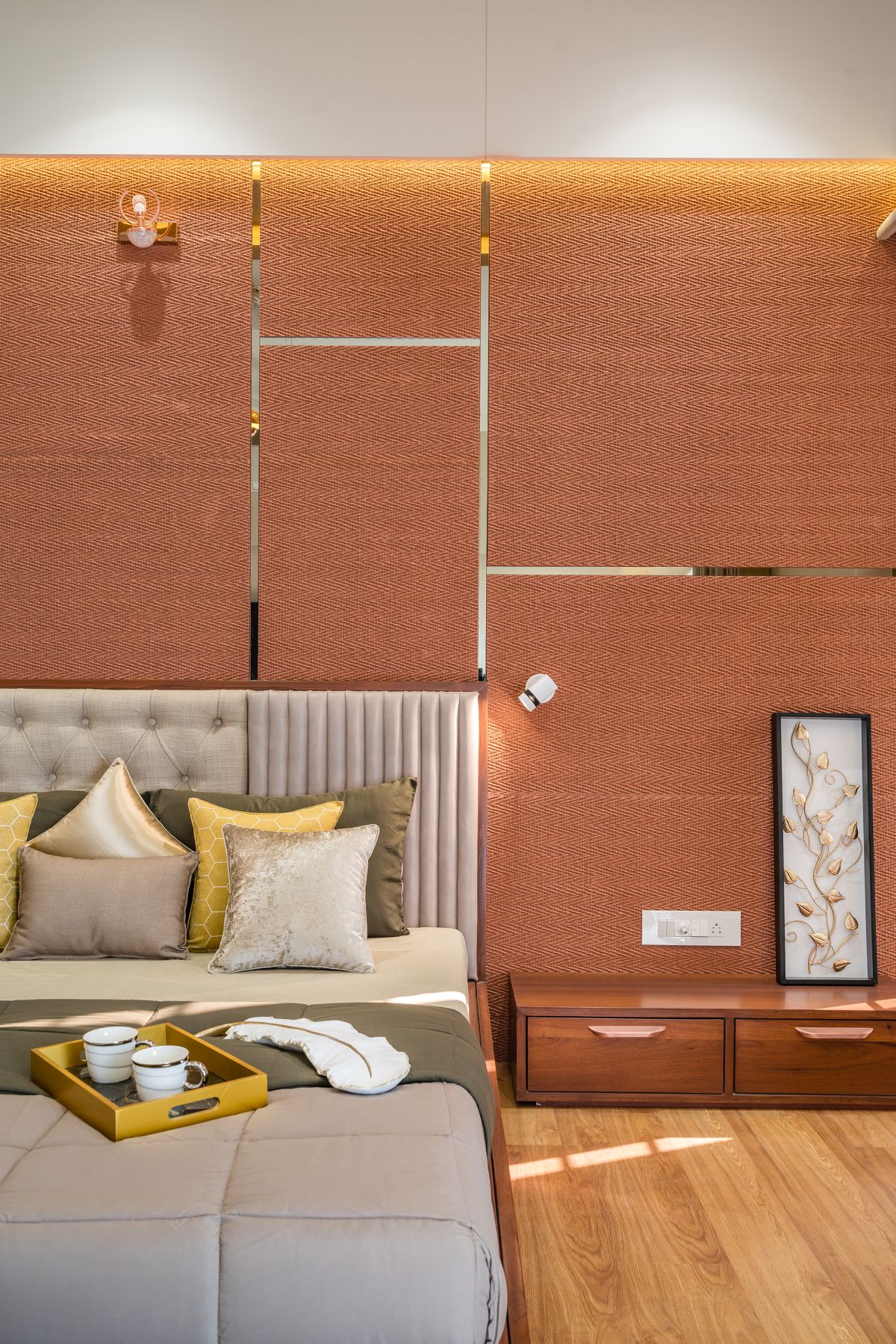
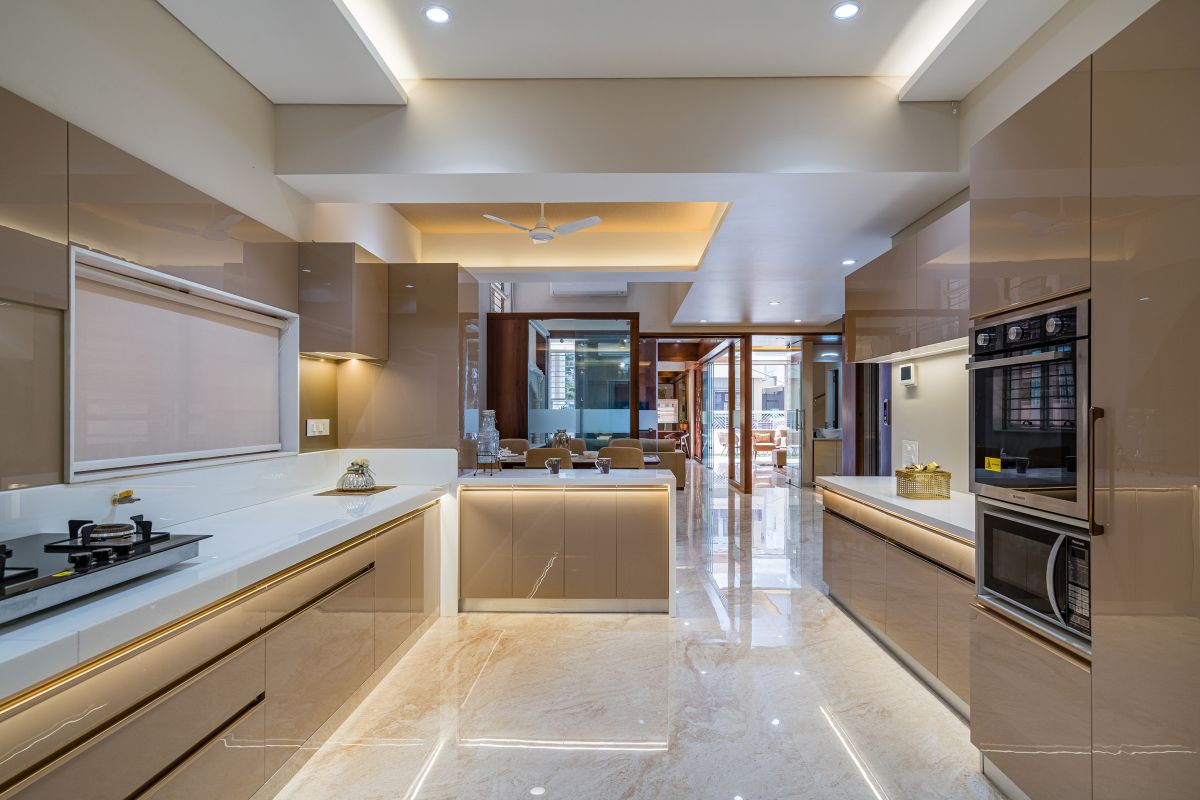
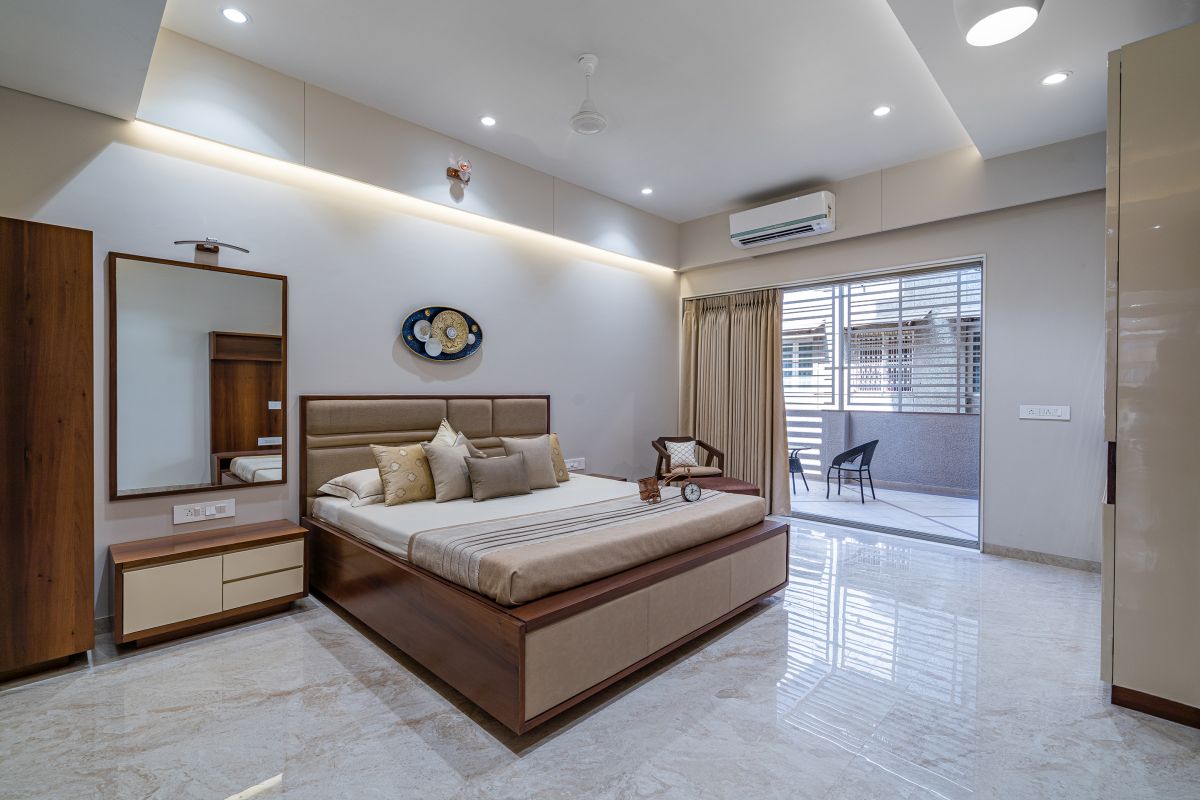
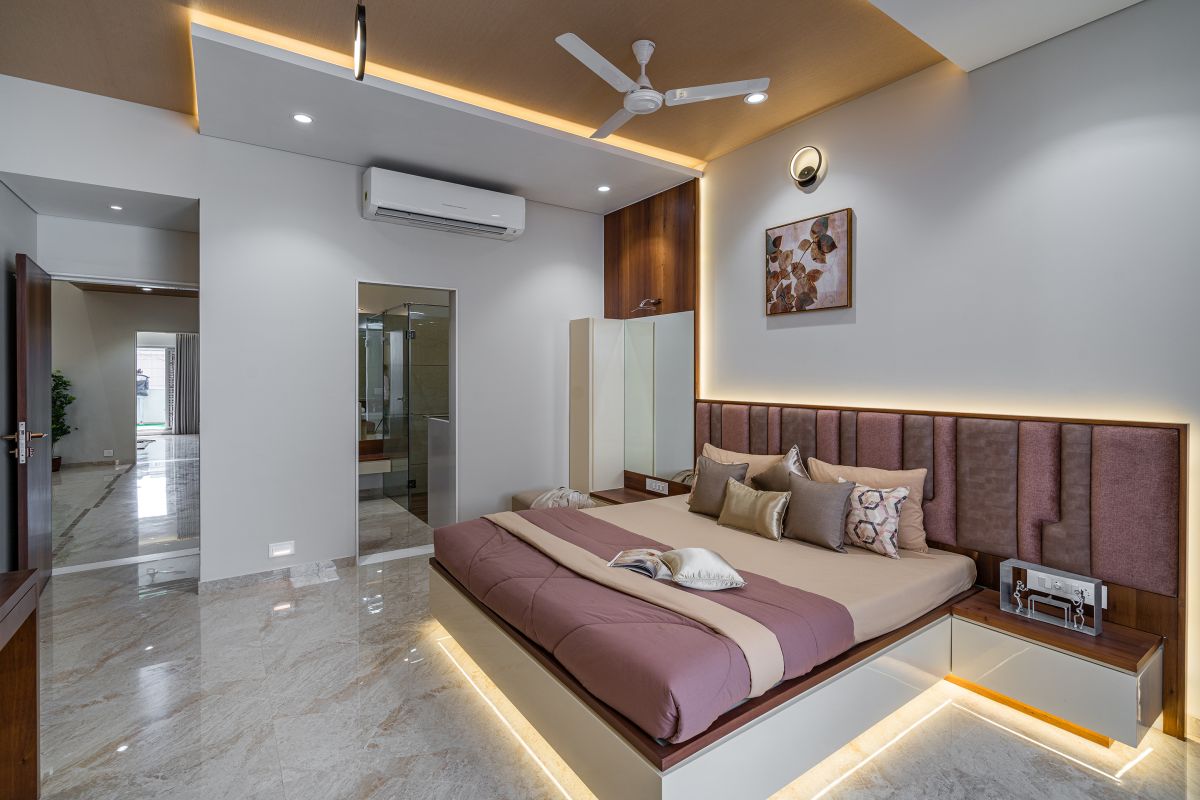
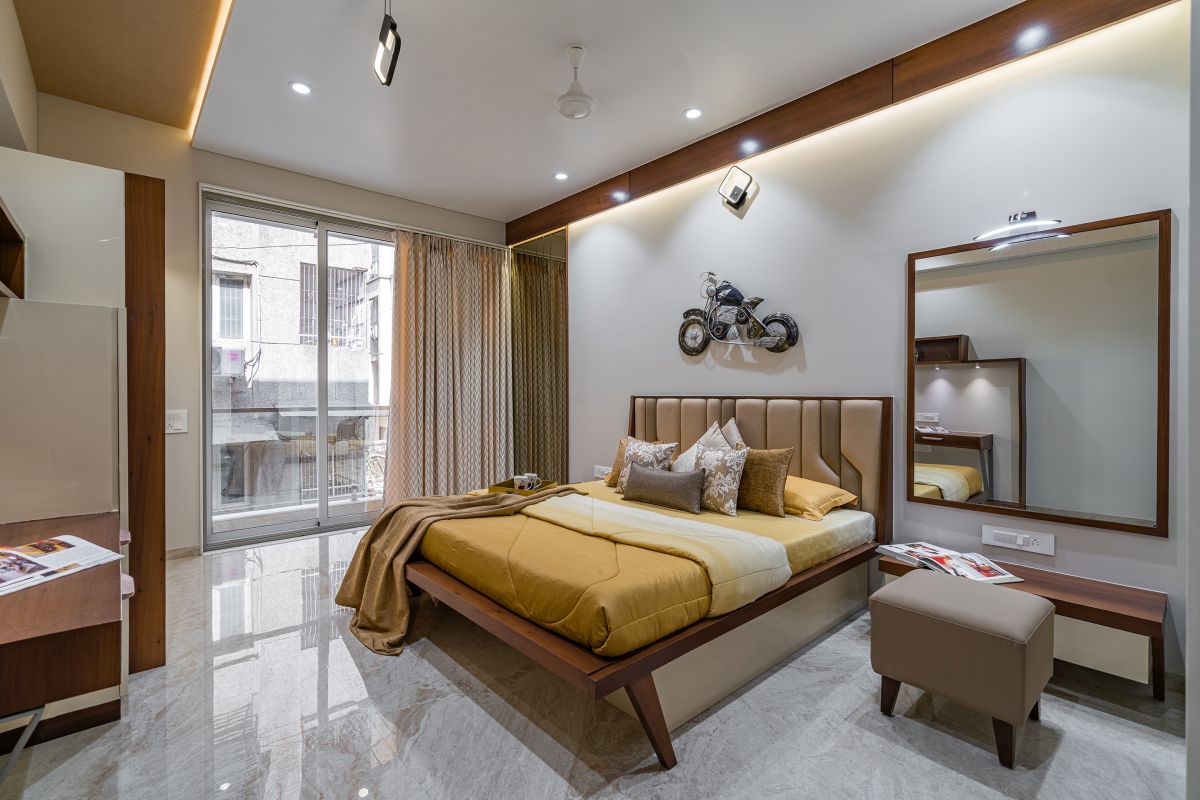
The first-floor passage leads to 3 bedrooms and overlooks the dining and puja.  A coherent and authentic interior has been developed, based upon a thorough understanding of the demands of its occupants. The interiors follow a subtle colour scheme, highlighting the luxurious Italian marble flooring, rich materials and exquisite décor details.
 

The Shaded House, at Ahmedabad, by Shayona Consultant 19


The second level encompasses the entertainment room and a huge-shaded terrace garden.
 

The Shaded House, at Ahmedabad, by Shayona Consultant 21


The terrace garden to the south-east façade elevates in the front, visually connecting all three levels. The screening in the ceiling bring a sense of ornamentation to the house, and consolidate the architectural language of the facade as the focal point of the project. It provides shelter from the sun and creates different light patterns throughout the day.


The Shaded House, at Ahmedabad, by Shayona Consultant 23


In a nutshell, The Shaded House stays true to its name and allows person within the house to experience cohesive, dynamic and regal spaces that deepen a connection with nature. Designed in a modified, mid-century modern style, this Shaded House in Ahmedabad has distinct elements that infuse a sense of drama into every space.

The Shaded House, at Ahmedabad, by Shayona Consultant 25


We feel elated and satisfied that we could make the dreams of our client come true through our architecture and interior design practice.


Drawings –


Project  Facts –


Project Name: The Shaded House

Architecture Firm: Shayona Consultant

Firm Location: Ahmedabad, Gujarat, India

Completion Year: 2021

Gross Built Area: 5200 sq. ft

Plot Area: 4000 sq.ft

Project Location: Paldi, Ahmedabad, Gujarat, India

Architect: Ar. Prashant Parmar

Photo credits:   Inclined Studio

Additional Credits :

Design Team: Ar. Harikrushna Pattani, Ms. Pooja Solanki, Ar. Hemang Mistry, Ar. Ashish Rathod, Ar. Vasavi Mehta

Shayona Consultant

3 Responses

Leave a Reply

Your email address will not be published. Required fields are marked *

This site uses Akismet to reduce spam. Learn how your comment data is processed.

Recent

Source - Deccan Chronicle

Wall As a Public Space
“To read public space only as a spatial condition, as a matter of square footage, zoning, or physical access, is to miss half the picture.”
—Reshma Esther Thomas

Reshma Esther Thomas examines how Hyderabad’s flyover pillars, painted with Cheriyal-style murals under the GHMC’s ‘City Art Scape’ initiative, reveal the paradox of managed public space. What appears to be beautification is actually cultural assertion in the wake of the 2014 bifurcation, bureaucratising a surface that once belonged to those without institutional power.

Read More »
Khazans in Slavador du Mundo, Bardez, Goa. © Kusum Priya (1)

The Map That Was Never Yours
“If publicness is reduced to what is legally accessible, then these landscapes were never public to begin with.”
—V.V. Kusum Priya

As part of our editorial: What makes a space public?, V.V. Kusum Priya argues that Section 39A of Goa’s 2024 Town and Country Planning Act this isn’t just a legal issue, and that it’s the erosion of an unrecognised but collectively sustained commons, and a question of what “public” really means and who benefits from the legislations surrounding this.

Read More »
Life on the public spaces in downtown Calcutta. Source - Wikimedia


“Appropriation of public spaces is the genesis of political movements, of ideological apparatus, and of endangering the city’s multi-dimensional fabric.”
—Dr. Seema Khanwalkar

Dr. Seema Khanwalkar, explores how the public spaces in India are dynamic, contested areas shaped by informal economies, migration, and social negotiation. She reveals how the transactional activities democratise ownership of these spaces, while the political and religious appropriation increasingly displaces this organic vitality, creating exclusion and anxiety. This shrinking of inclusive public space threatens urban social fabric, yet remains largely absent from city planning conversations, making it a far deeper crisis than mere encroachment.

Read More »
Sen Kapadia


“… people like Sen [Kapadia] don’t really leave. They become the questions we continue to ask.”
—A Tribute by Nuru Karim

Nuru Karim reflects on his relationship with Sen Kapadia through three transformative “states of being”—as a student, as a studio colleague, and as an independent professional. To capture Sen’s essence, Karim draws on three powerful metaphors: a mountain (commanding yet silent), a banyan tree (generous and sheltering), and a river (unseen yet ever-present). Together, these images paint a portrait of a man whose quiet depth left an indelible mark on all who encountered him.

Read More »
Sen Kapadia

Nirbhaya Nirgun
“Sen [Kapadia] found his own light early. He followed it without apology and without detour, and never let anyone dim it.”
—A Tribute by Pinkish Shah

Pinkish Shah’s homage to Sen Kapadia, celebrates him as fearless and formless in both life and work. Intellectually rooted in Louis Kahn and Sri Aurobindo, Sen pursued architecture that transcended form toward essential silence. Known for his courage, he maintained quiet, unwavering independence throughout his career.

Read More »
Prof Shireesh Atmaram Deshpande

“Professor Shireesh Deshpande chose the far more difficult task: to mould young minds into thoughtful, responsible, and rooted architects.”—A Tribute by Sarbjit Singh Bagha

Sarbjit Singh Bagha shares his tribute to Prof. Shireesh Atmaram Deshpande (1934–2026), a pioneering figure in Indian architectural education who passed away on 10 April 2026 at 91. Known affectionately as “Dada,” he spent nearly four decades at VNIT Nagpur, founding India’s first M.Arch. programme and introducing innovative pedagogy. He served as President of the Indian Institute of Architects (1992–1994). Choosing teaching over professional practice, he shaped generations of architects.

Read More »

Featured Publications

New Release

Stories that provoke enquiry into built environment

www.architecture.live

Subscribe & Join a Community of Lakhs of Readers

We Need Your Support

To be able to continue the work we are doing and keeping it free for all, we request our readers to support in every way possible.

Your contribution, no matter the size, helps our small team sustain this space. Thank you for your support.

Contribute using UPI

Contribute Using Cards