The Grey Matrix, at Mumbai, by Studio NACL

The Grey Matrix, at Mumbai, by Studio NACL

Located in the bustling area of Lower Parel, this 750 sq. ft. site with a 500 sq. ft. mezzanine, is situated in an industrial estate composed of narrow unkempt passages and minimal natural light penetration. Nestled amongst this raw development, the site was transformed into a vibrant office space for an event management company with an employee strength of 15, 2 director cabins, a conference room and a storage room. - Studio NACL
The Grey Matrix, at Mumbai, by Studio NACL

The Grey Matrix, at Mumbai, by Studio NACL


Located in the bustling area of Lower Parel, this 750 sq. ft. site with a 500 sq. ft. mezzanine, is situated in an industrial estate composed of narrow unkempt passages and minimal natural light penetration. Nestled amongst this raw development, the site was transformed into a vibrant office space for an event management company with an employee strength of 15, 2 director cabins, a conference room and a storage room.


Since the nature of work of the client required an office space that seemed corporate, yet quirky and could be occupied comfortably for long hours, these parameters defined the dominating framework for design. The client’s daily business involved numerous products and samples that required a sound system and space for storage; it was therefore a prerequisite to ensure that the office space was clutter-free at all times. The design, as a result, is a mix of modern and functional office spaces mixed with subtle rustic finishes such as wooden tiles with an antique washed-out look, distressed veneer on furniture and concrete texture on walls. In accordance with the theme, the bathroom is finished in an antique finish with rough stone cladding.


As one steps into the office, from the narrow and dull industrial estate corridors, the vibrancy and contrast of the space refreshes and welcomes the visitor. The design scheme explores colours and textures. By introducing varied textures within the same colour tones, the space is a mix of subtle variety and dynamism.  The subtle pops of blue add stimulating details to the space as well as reflect the brand identity. Since the space does not receive a lot of natural light, a palette of various shades of greys has been selected over darker colour palettes. Marmorino textured walls in grey, along with storage cabinets in grey back painted glass, along with the frosted glass all act in adherence to the decided colour scheme.


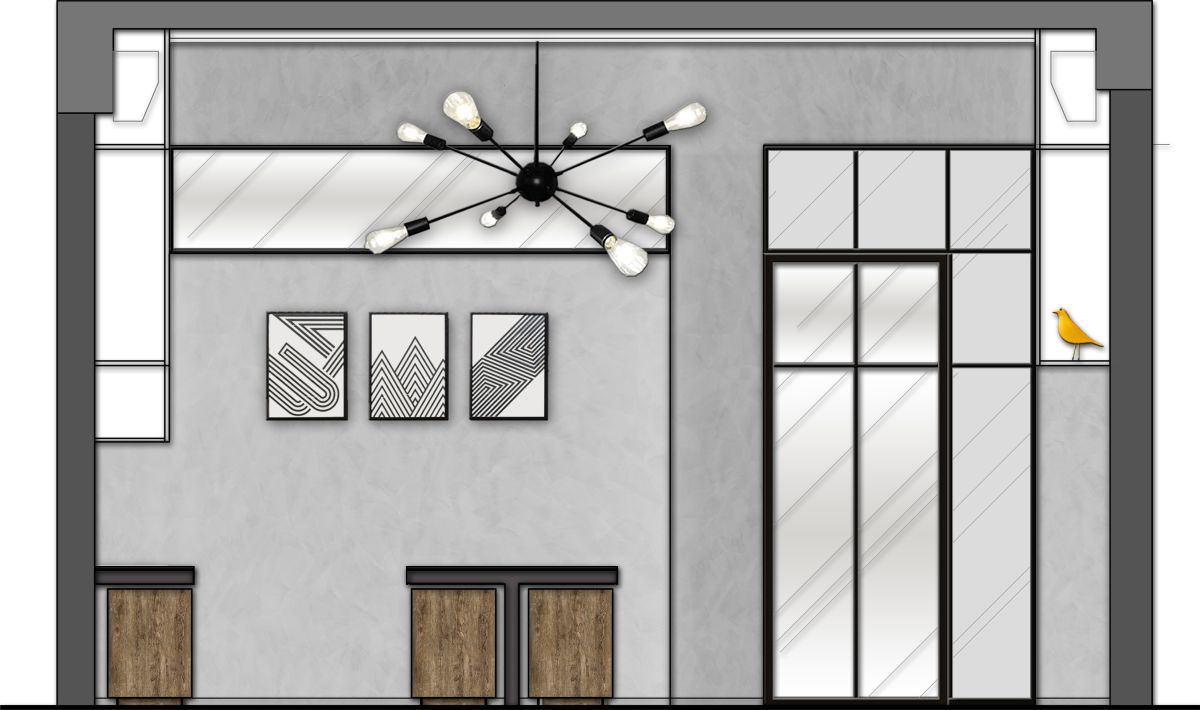
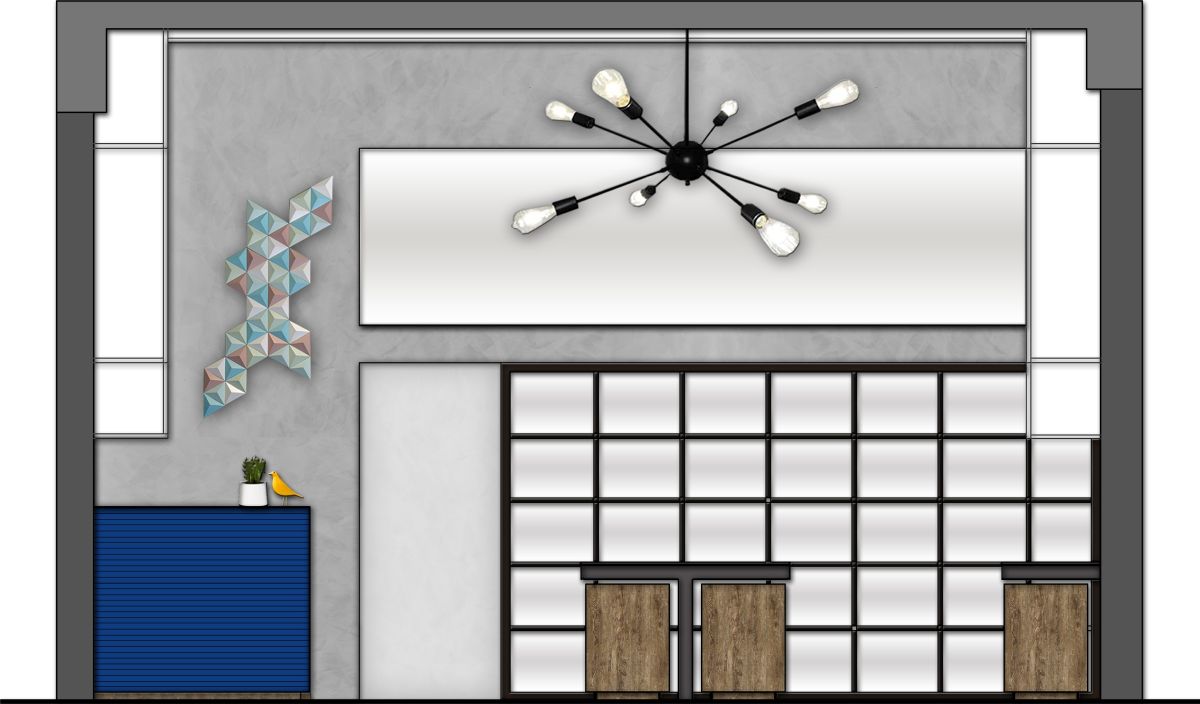
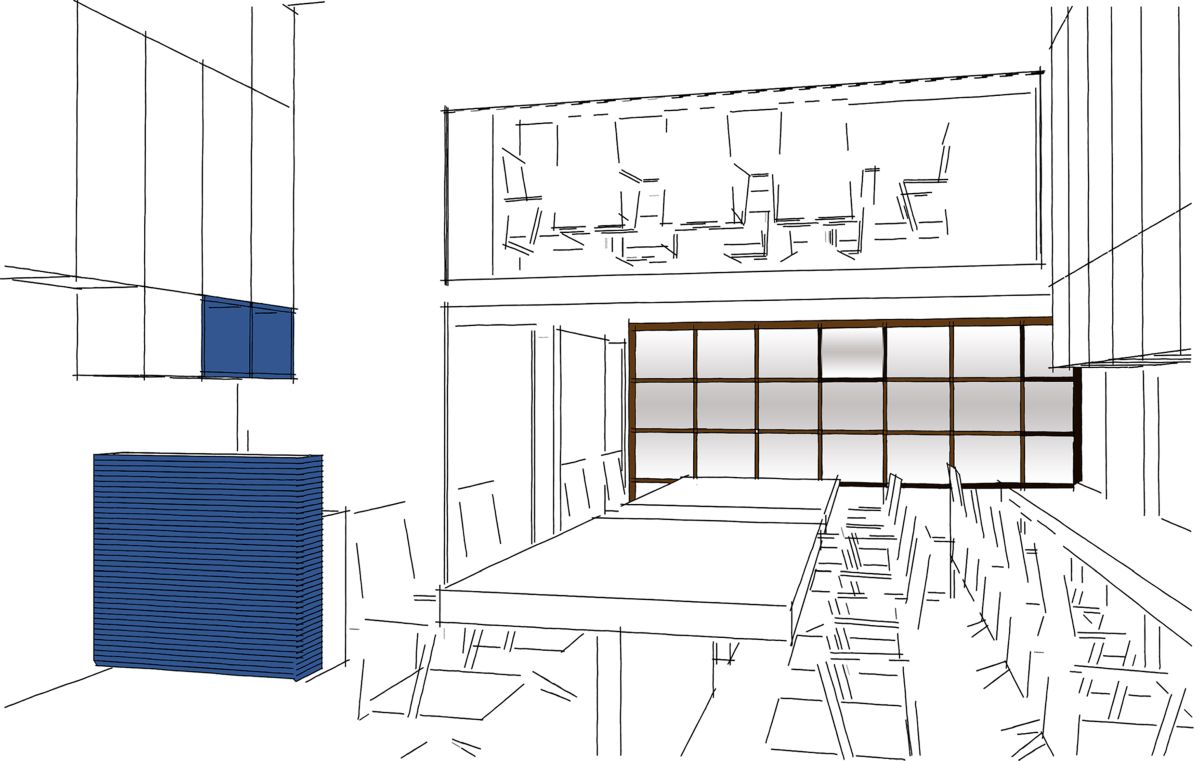
Linearity and a dominant monotone colour scheme forms the main elements of the design as well as the layout. Straight distinct lines not only demarcate zones, but also lead to the efficient utilisation of space by generating a grid-like partition system. The partitions have been clad with back painted glass, so that they double up as writing boards, and the storage units are located along the walls, with floor to ceiling height, seamlessly concealed with back painted glass as well, making the surfaces easy to clean as well as maximising the space available. This linearity is extended into smaller elements such as the slatted pattern reception table in accord with the overriding design theme.


As one enters the office, the mezzanine has been reduced by a third to create a double-height reception, a waiting area and the workstation space.  The space then narrows down as one moves into the private cabins and meeting rooms. The lobby becomes the introduction to the entire space as one can view the layout span in front of them. The spatial planning and layout ensure an efficient use of real estate by focussing on creating maximum central area for the office and minimal passage space. The mezzanine houses the conference room as well as the storage space, whereas the area below the mezzanine houses the director’s cabin and utility spaces like the bathrooms and the pantry.

Each space has its own character, while remaining consistent with the design scheme, from two-toned veneer table for the conference room to the bold blue sofa in the director cabin, or the bright quirky tiles in the bathrooms, or in the form of colour blocking patterns on wall storage and additional details. Customisation, as well, has been an essential element in the design process. A pastel-hued 3d form wall art for the reception area was crafted with MDF panels, designed bespoke for the site. Another instance of customisation in the project is the 8 ft wide chandelier crafted in metal that can be experienced from the conference room as well as the reception area.


Drawings – 


Project Facts –

Location: Mumbai

Completion date: January 2018

Title of Your Project.: The Grey Matrix

Select project category: Commercial Building

Project Status: Completed

Project Location: Lower Parel, Mumbai

Name of the Firm: Studio NACL

Name of the Principal(s): Natasha Aggarwal

Typology: OFFICE

Name of Client: VPLAN UNLIMITED

Name of Client’s Firm: VPLAN UNLIMITED

Site Area (sq ft & sq m): 1100 sft / 102 sqmt

Start Date: SEPT 2017

Completion Date: JAN 2018

Photographer: PULKIT SEHGAL

PRODUCTS / VENDORS

Glass  – Glass Kraft

Sanitary ware / Fittings  – Jaquar

Flooring – Belleza

Fixed furniture – on site

Sofa –NACL

Chairs – Star Decor

Air Conditioning – Mitsubishi

Studio Licht- led lights

NACL – Starburst chandelier

Basic paint – Asian paints

Textured paint–Micasa/ San Marco

CONSULTANTS

Electrical – Prithvi power net

Civil        – Manish Interior

HVAC    – Weather cool

Plumbing – Manish Interior

CONTRACTORS

Electrical – Prithvi power net        

Civil      –  Manish Interior

HVAC    – Weather cool

Plumbing –Manish Interior

Leave a Reply

Your email address will not be published. Required fields are marked *

This site uses Akismet to reduce spam. Learn how your comment data is processed.

Recent

Khazans in Slavador du Mundo, Bardez, Goa. © Kusum Priya (1)

The Map That Was Never Yours
“If publicness is reduced to what is legally accessible, then these landscapes were never public to begin with.”
—V.V. Kusum Priya

As part of our editorial: What makes a space public?, V.V. Kusum Priya argues that Section 39A of Goa’s 2024 Town and Country Planning Act this isn’t just a legal issue, and that it’s the erosion of an unrecognised but collectively sustained commons, and a question of what “public” really means and who benefits from the legislations surrounding this.

Read More »
Life on the public spaces in downtown Calcutta. Source - Wikimedia


“Appropriation of public spaces is the genesis of political movements, of ideological apparatus, and of endangering the city’s multi-dimensional fabric.”
—Dr. Seema Khanwalkar

Dr. Seema Khanwalkar, explores how the public spaces in India are dynamic, contested areas shaped by informal economies, migration, and social negotiation. She reveals how the transactional activities democratise ownership of these spaces, while the political and religious appropriation increasingly displaces this organic vitality, creating exclusion and anxiety. This shrinking of inclusive public space threatens urban social fabric, yet remains largely absent from city planning conversations, making it a far deeper crisis than mere encroachment.

Read More »
Sen Kapadia


“… people like Sen [Kapadia] don’t really leave. They become the questions we continue to ask.”
—A Tribute by Nuru Karim

Nuru Karim reflects on his relationship with Sen Kapadia through three transformative “states of being”—as a student, as a studio colleague, and as an independent professional. To capture Sen’s essence, Karim draws on three powerful metaphors: a mountain (commanding yet silent), a banyan tree (generous and sheltering), and a river (unseen yet ever-present). Together, these images paint a portrait of a man whose quiet depth left an indelible mark on all who encountered him.

Read More »
Sen Kapadia

Nirbhaya Nirgun
“Sen [Kapadia] found his own light early. He followed it without apology and without detour, and never let anyone dim it.”
—A Tribute by Pinkish Shah

Pinkish Shah’s homage to Sen Kapadia, celebrates him as fearless and formless in both life and work. Intellectually rooted in Louis Kahn and Sri Aurobindo, Sen pursued architecture that transcended form toward essential silence. Known for his courage, he maintained quiet, unwavering independence throughout his career.

Read More »
Prof Shireesh Atmaram Deshpande

“Professor Shireesh Deshpande chose the far more difficult task: to mould young minds into thoughtful, responsible, and rooted architects.”—A Tribute by Sarbjit Singh Bagha

Sarbjit Singh Bagha shares his tribute to Prof. Shireesh Atmaram Deshpande (1934–2026), a pioneering figure in Indian architectural education who passed away on 10 April 2026 at 91. Known affectionately as “Dada,” he spent nearly four decades at VNIT Nagpur, founding India’s first M.Arch. programme and introducing innovative pedagogy. He served as President of the Indian Institute of Architects (1992–1994). Choosing teaching over professional practice, he shaped generations of architects.

Read More »
View of the setting, Asiad. Credits: Meaningful Design Labs

Brutalist India | Asiad Tower, New Delhi

As part of Brutalist India series Bhawna Dandona writes about the Asiad Tower on Khel Gaon Marg in New Delhi, originally designed as a revolving restaurant, but now used as a venue for functions and weddings. The structure stands in close proximity to the Asiad Village and Siri Fort Complex and was designed by the Architectural Department of the Delhi Development Authority.

Read More »

Featured Publications

New Release

Stories that provoke enquiry into built environment

www.architecture.live

Subscribe & Join a Community of Lakhs of Readers

We Need Your Support

To be able to continue the work we are doing and keeping it free for all, we request our readers to support in every way possible.

Your contribution, no matter the size, helps our small team sustain this space. Thank you for your support.

Contribute using UPI

Contribute Using Cards