Karuna stories

Indian creatives launch “Karuna Stories”, an illustrated competition of stories, reflections and inspirations for navigating a changing world

Indian creatives launch "Karuna Stories", an illustrated competition of stories, reflections and inspirations for navigating a changing world
Karuna stories

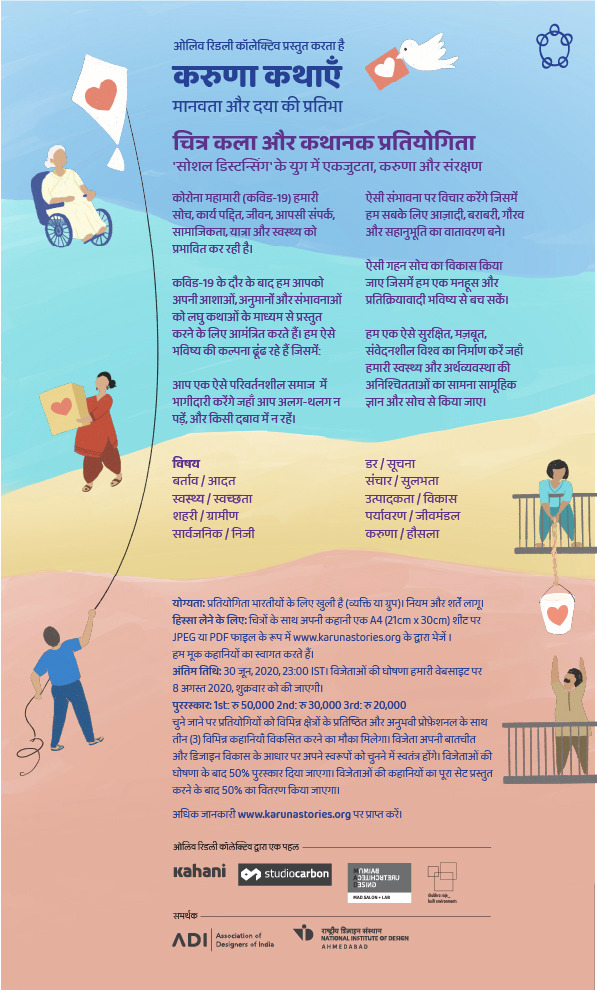
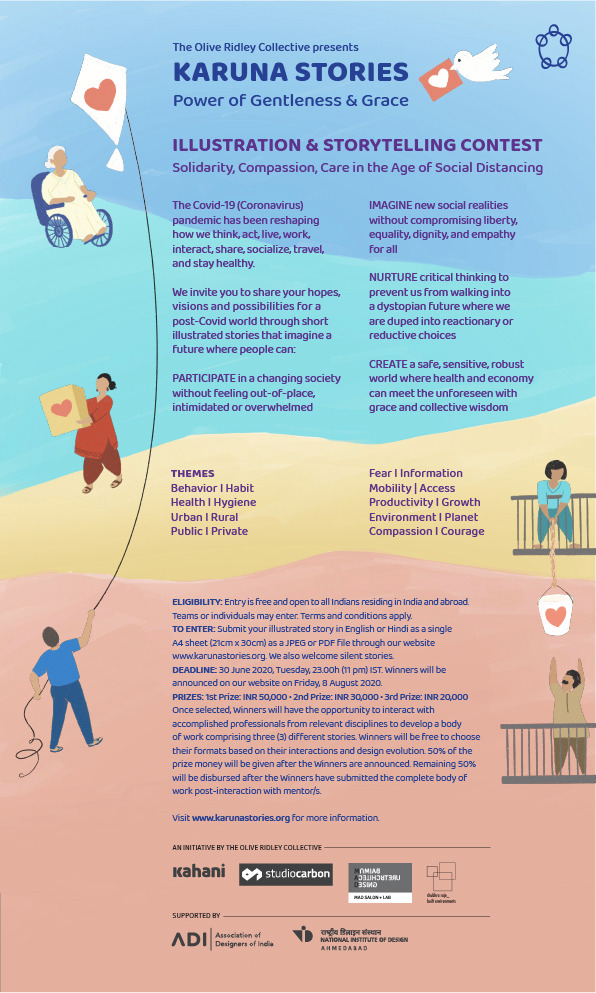
On 1st June 2020, the Olive Ridley Collective is launching a storytelling initiative, Karuna Stories: Power of Gentleness and Grace, to spread the message of compassion, solidarity and care.

Dr. Susmita Mohanty, spaceship designer and climate ambassador who conceived of the Collective and brought together the creative turtles for launching the Karuna Stories contest, says “The contest is a creative response to a perceived need for positive, compassionate messaging to ease psycho-socialspatial stresses and provide a humane countermeasure to discrimination, stigmatization, ostracization due to the pandemic.”

“The collaboration to create the Karuna Stories initiative has been spontaneous and generous, enabled by nothing more than our digital connections and common purpose,” says Ruchita Madhok, Director, Kahani and founding member the collective. “It has been a truly affirmative experience to join hands with such esteemed patrons, jury and partners to bring this project to life.”

Further information on Karuna Stories:
www.karunastories.org

Olive Ridley Collective:
The Collective was born out of a spontaneous convergence of creative minds during the Covid-19 lockdown with the hope of architecting a positive ‘new normal’ as we swim along towards our shared futures. After this debut endeavor, they plan to nest every year on an imaginary beach to design responses to contemporary issues.

Collective Members:
Kahani
Studio Carbon
MAD Salon + Lab
shubhra raje_built environments

Supported by:
Association of Designers of India (ADI)
National Institute of Design (NID), Ahmedabad

Contact:

Dr. Susmita Mohanty
Founder, Olive Ridley Collective
Curator, MAD Salon + Lab
mohanty.susmita@gmail.com ; +91 8105600355

Shubhra Raje
Founding Member, Olive Ridley Collective
Director, shubhra raje_built environments
shubhraraje@gmail.com ; +91 9099013352

Leave a Reply

Your email address will not be published. Required fields are marked *

This site uses Akismet to reduce spam. Learn how your comment data is processed.

Recent

Massing during construction, retaining the exposed concrete facade composition, cross columns and profiled beams. Archival collection of Tibet House, 1977. Accessed in 2026

Brutalist India | Tibet House, New Delhi

As part of Brutalist India series Bhawna Dandona writes about Tibet House in New Delhi which is a non-profit cultural centre dedicated to preserving Tibetan heritage, founded in 1965 at the Dalai Lama’s request. The current building’s foundation was laid in 1974, with architect Shivnath Prasad.

Read More »
Vivek Rawal

Architecture, Power, and the Poor | “As a profession, architecture lacks moral position and has become complicit in the neoliberal dispossession of the poor.”—Vivek Rawal

Vivek Rawal argues that architecture—as a profession—is structurally aligned with political and economic power rather than social justice. He critiques how architectural education and practice prioritise developers and real estate over communities, turning housing into a market commodity. Even movements like sustainability and participation, he says, often become tools for elite consumption rather than genuine empowerment. True moral reform, according to Rawal, would mean architects relinquishing control and enabling community-led design and housing decisions.

Read More »
The Chunli Guesthouse, Shanghai, China by TEAM_BLDG 1

The Chunli Guesthouse, Shanghai, China by TEAM_BLDG

The Chunli Guesthouse, Shanghai, China by TEAM_BLDG’s response to nature, memory, and the spirit of place. The design takes “Catching” as its spiritual core, emphasizing the relationship between the architecture and the surrounding rice field landscape.

Read More »
Gender. Hysteria. Architecture. | What Might Care Look Like If It Were Not Afraid of Women? 4

Gender. Hysteria. Architecture. | What Might Care Look Like If It Were Not Afraid of Women?

What kinds of spaces exist where women can breathe without being watched? If hysteria no longer exists as a diagnosis, why does its architecture remain? Aditi A., through her research study as a part of the CEPT Writing Architecture course, in the third and last chapter of this series follows the spatial logics that developed to manage hysteria, which continue in the contemporary environments of care safety, and everyday life. If the diagnosis has been discredited, what explains the persistence of its walls?

Read More »
Kirtee Shah on architecture profession at CEPT University alumni meet

“… the way architecture [profession] is perceived and practised, it needs to move from the pedestal to the ground.”—Kirtee Shah

In his presentation at the CEPT Alumni Meet, in January 2026, Kirtee Shah offers “something to think about” for the architects and planners regarding the future of architecture profession. He urges architects to relearn and refocus on service, sustainability, and inclusivity while addressing urban chaos, poor housing, rural neglect, and climate challenges.

Read More »

Featured Publications

New Release

Stories that provoke enquiry into built environment

www.architecture.live

Subscribe & Join a Community of Lakhs of Readers

We Need Your Support

To be able to continue the work we are doing and keeping it free for all, we request our readers to support in every way possible.

Your contribution, no matter the size, helps our small team sustain this space. Thank you for your support.

Contribute using UPI

Contribute Using Cards