FUnktion Design Studio - Madhusudhan Sridhar

An Architect’s Office – Funktion Design Studio at Bangalore by Madhusudhan Sridhar

Funktion Design is an expression of an interesting structural language. The main supporting structure is casted by three 9m x 8m concrete portals on which three steel portals form the framework supporting the steel deck roofs of the studio level and the meeting zone.
FUnktion Design Studio - Madhusudhan Sridhar

Funktion Design Studio at Bangalore by Madhusudhan SridharBuilding an office and studio for one’s own architecture practice is a challenging and an exciting prospect at the same time. When Funktion Design set out to build their own studio, they wanted to bring to the fore, a strong conceptual ideation and structural exploration that they have hallmarked in all their projects to date.

The layout accommodating Funktion Design is a South facing site, 40 feet x 40 feet in dimension and located in a bustling residential area of Sanjaynagar, Bangalore characterized by dense low rise housing with very little distance between adjoining buildings. The site is skirted by two voluminous Gulmohar trees along the road canopying at around 9-10m from the ground and offering their woody charm to an otherwise concrete neighbourhood.

The best light and ventilation is available in the upper reaches of these high-density sites. The design strategy therefore evolved as a response to this site context as well as a reinterpretation of the program of an architecture office typology.

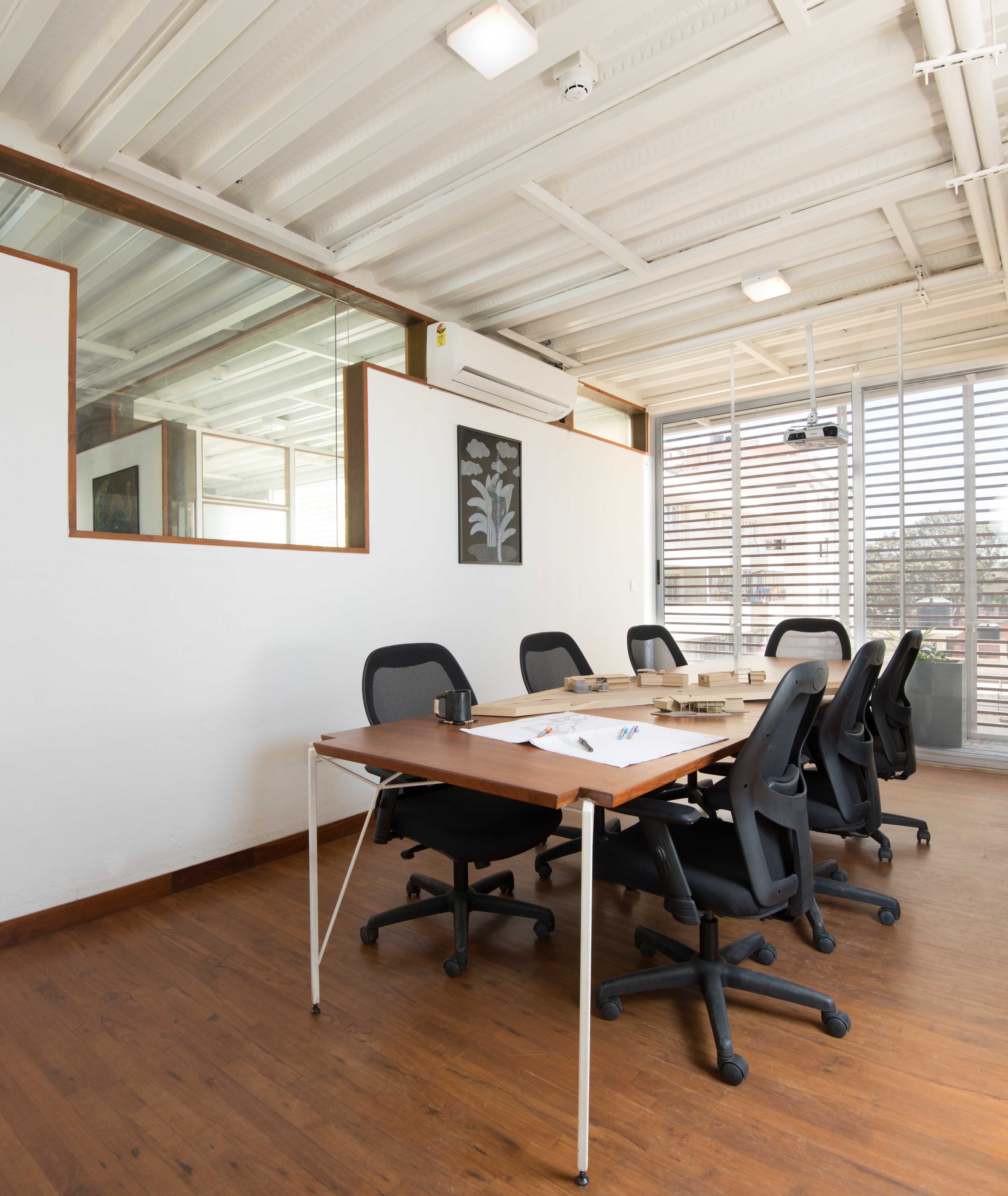
The office spreads across the top two floors of the building. The top most floor comprises of meeting rooms, conference hall and reception that essentially forms the public face of the studio; and the floor below embodies the studio workstations aligned fascinatingly in level with the Gulmohar canopy outside. These two floors are expressed as a large aluminum-clad box placed on a concrete portal at an 8m level and open out into long balconies (facing the road) with recycled teak wood louvers to cut off the harshness of the South Sun. At the level below, hangs a glass-walled re-adaptable plywood floor mezzanine suspended from the concrete portal, which currently is being used as an art gallery.  This social space still remains in pipeline for future expansion.

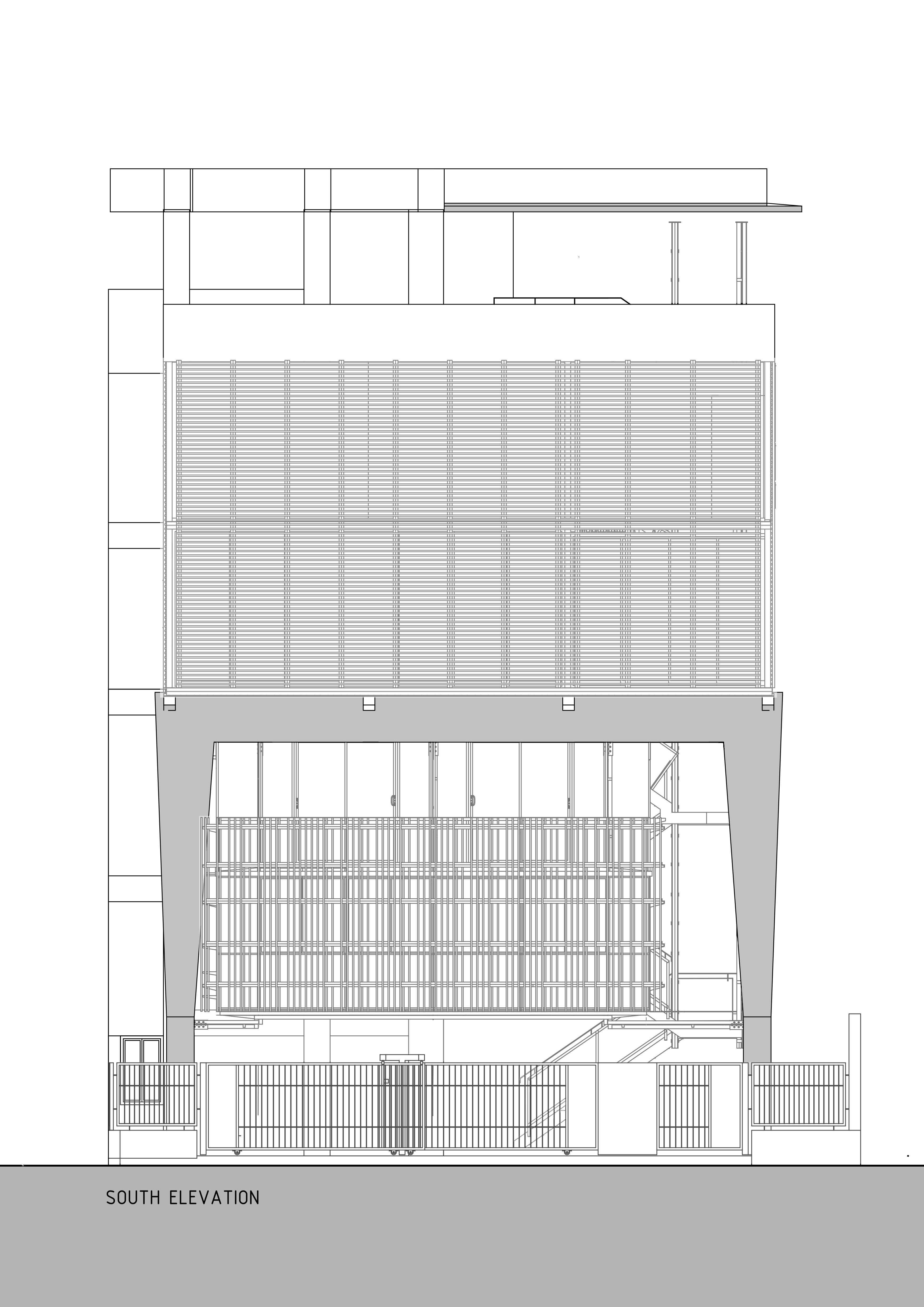
Funktion Design is an expression of an interesting structural language. The main supporting structure is casted by three 9m x 8m concrete portals on which three steel portals form the framework supporting the steel deck roofs of the studio level and the meeting zone. The mezzanine gallery suspended from the concrete portal is expressed to look like a translucent lantern covered with vertical wooded louvers that act as a climate screen.

The three large concrete portals reminisce the structural expression of brutalist masters of the 60s.  Widening at the top and tapering in all three dimensions gives the audience the impression of an animal’s limbs. The subtle changes in dimensions along the cross section render an ingenious delicacy to an otherwise large scale.

The material palate consists primarily of concrete, steel and wood. The use of recycled teak wood sourced from old demolished houses and the organic earthy finish of the concrete portals left in their raw form, expresses skilled workmanship and an intuitive execution process with very basic formwork and resources. The white painted steel deck roof and structural member emanate a constant rhythm through the interior spaces. All the interior cabinetry and wall inner cladding are polished plywood .The flooring has been done using green kota stone in the studio and recycled wood in the meeting areas complimenting other natural materials.

Drawings

Project Facts:

Project name: Funktion Design Studio
Architect’s Firm: Funktion Design, Bangalore
Project Location: Bangalore, India
Completion Year: 2017
Gross Built Area (square meters or square foot): 3000 sqft
Lead Architects: Madhusudhan Sridhar

Other participants
Design team: Monika Revankar, Pradhan Biddappa, Haridas
Structural Design:  Manjunath and Company
Fabricator: Jayanth
Contractor: Dalavai Infrastructure
Photo credits: Adarsha R

Leave a Reply

Your email address will not be published. Required fields are marked *

This site uses Akismet to reduce spam. Learn how your comment data is processed.

Recent

Source - Deccan Chronicle

Wall As a Public Space
“To read public space only as a spatial condition, as a matter of square footage, zoning, or physical access, is to miss half the picture.”
—Reshma Esther Thomas

Reshma Esther Thomas examines how Hyderabad’s flyover pillars, painted with Cheriyal-style murals under the GHMC’s ‘City Art Scape’ initiative, reveal the paradox of managed public space. What appears to be beautification is actually cultural assertion in the wake of the 2014 bifurcation, bureaucratising a surface that once belonged to those without institutional power.

Read More »
Khazans in Slavador du Mundo, Bardez, Goa. © Kusum Priya (1)

The Map That Was Never Yours
“If publicness is reduced to what is legally accessible, then these landscapes were never public to begin with.”
—V.V. Kusum Priya

As part of our editorial: What makes a space public?, V.V. Kusum Priya argues that Section 39A of Goa’s 2024 Town and Country Planning Act this isn’t just a legal issue, and that it’s the erosion of an unrecognised but collectively sustained commons, and a question of what “public” really means and who benefits from the legislations surrounding this.

Read More »
Life on the public spaces in downtown Calcutta. Source - Wikimedia


“Appropriation of public spaces is the genesis of political movements, of ideological apparatus, and of endangering the city’s multi-dimensional fabric.”
—Dr. Seema Khanwalkar

Dr. Seema Khanwalkar, explores how the public spaces in India are dynamic, contested areas shaped by informal economies, migration, and social negotiation. She reveals how the transactional activities democratise ownership of these spaces, while the political and religious appropriation increasingly displaces this organic vitality, creating exclusion and anxiety. This shrinking of inclusive public space threatens urban social fabric, yet remains largely absent from city planning conversations, making it a far deeper crisis than mere encroachment.

Read More »
Sen Kapadia


“… people like Sen [Kapadia] don’t really leave. They become the questions we continue to ask.”
—A Tribute by Nuru Karim

Nuru Karim reflects on his relationship with Sen Kapadia through three transformative “states of being”—as a student, as a studio colleague, and as an independent professional. To capture Sen’s essence, Karim draws on three powerful metaphors: a mountain (commanding yet silent), a banyan tree (generous and sheltering), and a river (unseen yet ever-present). Together, these images paint a portrait of a man whose quiet depth left an indelible mark on all who encountered him.

Read More »
Sen Kapadia

Nirbhaya Nirgun
“Sen [Kapadia] found his own light early. He followed it without apology and without detour, and never let anyone dim it.”
—A Tribute by Pinkish Shah

Pinkish Shah’s homage to Sen Kapadia, celebrates him as fearless and formless in both life and work. Intellectually rooted in Louis Kahn and Sri Aurobindo, Sen pursued architecture that transcended form toward essential silence. Known for his courage, he maintained quiet, unwavering independence throughout his career.

Read More »
Prof Shireesh Atmaram Deshpande

“Professor Shireesh Deshpande chose the far more difficult task: to mould young minds into thoughtful, responsible, and rooted architects.”—A Tribute by Sarbjit Singh Bagha

Sarbjit Singh Bagha shares his tribute to Prof. Shireesh Atmaram Deshpande (1934–2026), a pioneering figure in Indian architectural education who passed away on 10 April 2026 at 91. Known affectionately as “Dada,” he spent nearly four decades at VNIT Nagpur, founding India’s first M.Arch. programme and introducing innovative pedagogy. He served as President of the Indian Institute of Architects (1992–1994). Choosing teaching over professional practice, he shaped generations of architects.

Read More »

Featured Publications

New Release

Stories that provoke enquiry into built environment

www.architecture.live

Subscribe & Join a Community of Lakhs of Readers

We Need Your Support

To be able to continue the work we are doing and keeping it free for all, we request our readers to support in every way possible.

Your contribution, no matter the size, helps our small team sustain this space. Thank you for your support.

Contribute using UPI

Contribute Using Cards