coccoon-house-mansaram-architects1

Cocoon House, Trichy – Mansaram Architects – Neelam Manjunath

coccoon-house-mansaram-architects1

coccoon-house-mansaram-architects1

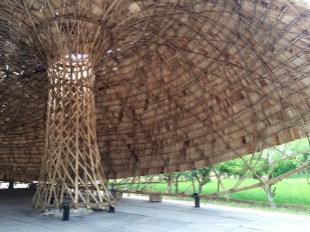
Cocoon is a space for teaching and exhibiting projects to visitors of Krishi Vigyan Kendra, Trichy. It is a unique project that qualifies as socially relevant because of the method in which it has been realized. Bamboo was required to be used for an unconventional form as it proved to be the most economically viable. In order to make the project a success a team had to be made consisting of the various stakeholders and consultants as this was a unique project that could not be done by conventional method. We were called upon as building design and construction consultants for the concept generated by students. We proposed to make this project successful by engaging the students and local artisans in a workshop format with skilled artisans. The result of this project connected the wide spectrum of participants of a project and made it a socially relevant one.

  • Concept:

Initial Concept Sketch developed by Aarhus School of Architecture, Denmark with Ar. Byoung Cho.

coccoon-house-mansaram-architects1

  • Design development and introduction to Bamboo as a building material:

Ar Neelam Manjunath from Mansaram Architects, Bangalore and artisans from CGBMT were called to conduct a Design-Build workshop of 3-days for the students of Aarhus School of Architecture and C.A.R.E. College of Architecture at Trichy to develop and modify the design to make it structurally possible.

All the construction systems were developed during the workshop and a mock up was erected.

  • Execution:

Students of C.A.R.E. College of Architecture and Aarhus School of Architecture completed the structure in 21 days under the guidance and help of artisans from CGBMT.

  • About the structure:

The free form of The Cocoon was achieved entirely with bamboo splits supported by a split-weave column  going up to 10 feet in height at the centre of the structure. The splits weave out to complete the entire span of the structure. The covering was done with locally available banana sheath plates.

  • Drawings:

Facts:

  • Project Area: 400 sq.ft.
  • Capacity: 40 persons
  • Utility: Multi use space acts as an exhibition area for Krishi Vigyan Kendra, Trichy
  • Key Collaborators:
    C.A.R.E. College of Architecture, Trichy;  Aarhus School of Architecture, Denmark; BCHO Architects; Manasaram Architects and Centre for Green Building Materials and Technology

Leave a Reply

Your email address will not be published. Required fields are marked *

This site uses Akismet to reduce spam. Learn how your comment data is processed.

Recent

Vivek Rawal

Architecture, Power, and the Poor | “As a profession, architecture lacks moral position and has become complicit in the neoliberal dispossession of the poor.”—Vivek Rawal

Vivek Rawal argues that architecture—as a profession—is structurally aligned with political and economic power rather than social justice. He critiques how architectural education and practice prioritise developers and real estate over communities, turning housing into a market commodity. Even movements like sustainability and participation, he says, often become tools for elite consumption rather than genuine empowerment. True moral reform, according to Rawal, would mean architects relinquishing control and enabling community-led design and housing decisions.

Read More »
The Chunli Guesthouse, Shanghai, China by TEAM_BLDG 1

The Chunli Guesthouse, Shanghai, China by TEAM_BLDG

The Chunli Guesthouse, Shanghai, China by TEAM_BLDG’s response to nature, memory, and the spirit of place. The design takes “Catching” as its spiritual core, emphasizing the relationship between the architecture and the surrounding rice field landscape.

Read More »
Gender. Hysteria. Architecture. | What Might Care Look Like If It Were Not Afraid of Women? 4

Gender. Hysteria. Architecture. | What Might Care Look Like If It Were Not Afraid of Women?

What kinds of spaces exist where women can breathe without being watched? If hysteria no longer exists as a diagnosis, why does its architecture remain? Aditi A., through her research study as a part of the CEPT Writing Architecture course, in the third and last chapter of this series follows the spatial logics that developed to manage hysteria, which continue in the contemporary environments of care safety, and everyday life. If the diagnosis has been discredited, what explains the persistence of its walls?

Read More »
Kirtee Shah on architecture profession at CEPT University alumni meet

“… the way architecture [profession] is perceived and practised, it needs to move from the pedestal to the ground.”—Kirtee Shah

In his presentation at the CEPT Alumni Meet, in January 2026, Kirtee Shah offers “something to think about” for the architects and planners regarding the future of architecture profession. He urges architects to relearn and refocus on service, sustainability, and inclusivity while addressing urban chaos, poor housing, rural neglect, and climate challenges.

Read More »

Featured Publications

New Release

Stories that provoke enquiry into built environment

www.architecture.live

Subscribe & Join a Community of Lakhs of Readers

We Need Your Support

To be able to continue the work we are doing and keeping it free for all, we request our readers to support in every way possible.

Your contribution, no matter the size, helps our small team sustain this space. Thank you for your support.

Contribute using UPI

Contribute Using Cards