Bridge Studio

CUBES – Multi Dwelling Residence, at Rajkot by Bridge Studio

Bridge Studio

Text: Bridge Studio Photography: © Radhika Pandit, Satyam Dave

CUBES - Multi Dwelling Residence, at Rajkot by Bridge Studio 1

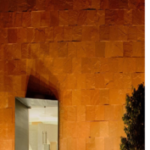
The word “CUBES” is derived from the form of the building itself. The architecture of ‘cubes’ is highly influenced by the work of legendary architect Ludwig Mies van der Rohe and reflecting his famous saying “LESS IS MORE”.

“CUBES” has a very simple rectangular form which is the amalgamation of four cubes where each cube holds one particular function. Living, dining and kitchen bounds within its form.

CUBES - Multi Dwelling Residence, at Rajkot by Bridge Studio 3
Plan

Eastern facade of the building is full of glass to allow morning sunlight within functional spaces. Sliding windows allow us to merge inner spaces with outer spaces (i.e. backyard deck with swimming pool) results into again flexible plan and multifunctional spaces. Southern facade has no opening to obstruct harsh sunlight. Western facade has 3′-6″ entrance within 14′-0″ high standing wall making a benchmark entrance which hides the surprised eastern opening on the other side.
All villas are detached from each other creating another access to the pool and garden without disturbing inner spaces and also it acts as service entry for the same during functions at villa.

Landscape area has trees bearing different kinds of fruits and vegetables. Its compound wall is avoided of masonry. It has bamboo fence with creepers all over so that one ends its vision with greenery from within.
The architecture of the project justifies the statement “Form follows function”. The project truly reflects the architect’s principles that the shape of the building should primarily base upon its intended function or purpose.

Leave a Reply

Your email address will not be published. Required fields are marked *

This site uses Akismet to reduce spam. Learn how your comment data is processed.

Recent

Folles de la Salpétrière, (Cour des agitées.) (Madwomen of the Salpétrière. (Courtyard of the mentally disturbed.))

Gender. Hysteria. Architecture. | “How Did a Diagnosis Learn to Draw Walls?”

Did these spaces heal women or teach them how to disappear? Aditi A., through her research study as a part of the CEPT Writing Architecture course, in this chapter follows hysteria as it migrates from text to typology, inquiring how architectural decisions came to stand in for care itself. Rather than assuming architecture responded to illness, the inquiry turns the question around: did architecture help produce the vulnerability it claimed to manage?

Read More »
Gender, Hysteria, and Architecture - The Witch Hunt. Henry Ossawa Tanner. Source - Wikiart

Gender. Hysteria. Architecture. | “When Did Care Become Confinement?”

Was architecture used by society to spatially “manage” women and their autonomy? Aditi A., through her research study as a part of the CEPT Writing Architecture course, examines the period before psychiatry, when fear had already become architectural, tracing how women’s autonomy was spatially managed through domestic regulation, witch hunts, informal confinement, and early institutional planning.

Read More »

A Modernist’s Doubt: Symbolism and the Late Career Turn

Why did acclaimed modernist architects suddenly introduce historical symbolism like arches, decorative elements, and other cultural references into their work after decades of disciplined restraint? Sudipto Ghosh interrogates this 1980s-90s symbolic turn as a rupture in architecture, questioning whether this represents an authentic reconnection with content and memory, or is it a mere superficial gesture towards absent meanings. Drawing from Heidegger’s analysis of the Greek temple, he distinguishes two modes of architectural representation, ultimately judging that this turn was a nascent rebellion against modernism that may have failed to achieve genuine integration of context, material, and memory.

Read More »
Ode to Pune - A Vision. © Narendra Dengle - 1

The City That Could Be: An Ode to Pune

Narendra Dengle, through his poem written in January 2006, presents a deep utopic vision for Pune—what the city could be as an ecologically sustainable, equitable city that balances nature with development. He sets ambitious benchmarks for prioritizing public transport over cars, preserving heritage, addressing slum rehabilitation humanely, and empowering local communities

Read More »

Featured Publications

New Release

We Are Hiring

Stories that provoke enquiry into built environment

www.architecture.live

Subscribe & Join a Community of Lakhs of Readers