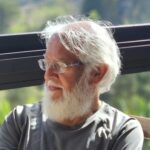
Cairo (1978)
The Cord
A flight of wide stone steps. Through the ages, its centre has flattened into a ramp. By the side, an ancient structure, the colour of sand, and ahead in the hazy heights, the citadel touching the sky. Turning left into a short lane, dusty and unpaved — urchins playing about in the nine o’clock heat. A little further, a massive wooden door. There is no knocker or bell, so I push, and it opens rather smoothly.
It is dark and cool. My eyes adjust; I am in a courtyard, a Thousand and One Arabian Nights in its details. I call out the name of Hassan Fathy; no one answers. There is an earthen pot in the centre and a low arch opposite. Through it, I emerge into another courtyard, cooler and less dark. By a stairway sways a slim white cord. I pull. Somewhere above a tinkling sound.
Bells, I had heard them all through my travels. In the remote islands of Yugoslavia, at the stroke of every hour, the electrically controlled bells in Ronchamp, France, low octave ones round the neck of Swiss cows, and the usually out-of-tune Big Ben. I pull again, and again the delicious sound.
Yesterday I was in Athens, in the library of Doxiadis, leafing through magazines and papers. I came across an article on bricks. It was simple and refreshing. The author was Hassan Fathy. I got his address from the librarian; it was in Cairo. Although Egypt was not on my schedule, I decided on impulse to visit it. I pull the cord again. Perhaps he isn’t at home, but I decide to linger awhile. There is a serenity about this courtyard which I want to soak in before facing the Cairo outside — chaotic, dusty, exuberant, abounding with life and people.
I pick up a piece of paper and address it to Fathy. I am a student in search of Architecture. I’m here for two days and will be leaving tomorrow evening. I am engrossed in writing and look up to find him next to me. I greet him in Arabic and spontaneously hand over the note. He smiles. Although nearing eighty, there is a childlike innocence about him. Immaculately dressed in earthy browns, it is his eyes that are dreamy and very expressive. I was wrong about leaving the next evening. I stayed for a month.
The Musicality
The Garden City is a modern zone in Cairo. On the map, it appears like a tangled mass of rope that some town planner forgot to pick up. Once inside, you lose all sense of direction. Fathy and I are heading for the Arab League’s Headquarters. What a mess, he tells me. These streets, like the car, are ambiguous; you can hardly tell the front from the rear. For town planning, look at the trees. See how the main trunk flows into branches, twigs, stems, and veins of the leaf— there is hierarchy, and you know where you are.
He pauses. Academic training is nonsense; schools turn students into machines with no imagination. It took me ten years to purge myself of it, he says. Again, the leaf, before it joins the twig, there is the stem — the stem is the transition; like the musician who moves from the mode to the melody — there is a system of connection. In fact, I’m trying to introduce musicality in the teaching of town planning in schools. A music composition has more to do with melodies than with scales; likewise, architecture is more to do with space than with shape — it is the space between the walls and not the walls themselves.
Music is important to Fathy; someone told me he is an able violinist. In the first few days, he said he had difficulty getting accustomed to the musicality of my voice — I suppose he meant my accent. One night after dinner, Fathy put a Brahms on the stereo. Western classical music was not out of place in the Arab setting. He then sat down and continued to work on a township he was planning around the oasis of El Kharga. He worked late into the night. I watched. I began to understand through his drawing what I had been unable to grasp in his words.
The Glass Bowl
We speed towards the ancient city of Alexandria in a black six-seater. Fathy has designed a house there, which I think he particularly likes. Perhaps that is why he wants me to see it. We pass a modern factory, a concrete box squatting uneasily in the desert sand. Fathy looks away — he does not like what he sees, and I understand. There were certain areas, however, where I tended to disagree with his viewpoint. To give an instance, there are many structures in the West which I have seen and for which I have regard.
I like Corbusier’s Ronchamp Chapel very much, and he does not [saying the roof presses in, expelling space]. Fathy also feels strongly about the car. The man behind the wheel, he says, is reduced to a mechanistic being. But I interrupted, were it not for the car, it would have been impossible for us to go all the way to Alexandria to see the house you’d designed and return the same day. Not so, he smiles. In that case, the house would never have been that far. It would be within a radius of half a day’s walk, and then we would be strolling through breezy lanes and trees instead of being confined in a machine for three hours.
The house, like all Fathy’s houses, is remarkably cool. The mud-brick dome is pierced with round holes that have coloured glass panels. When I climb to the top of the dome, I find them to be merely coloured glass bowls that were fixed inverted, covering the holes. I had seen them being sold in plenty by the streetside. From dusty pavements to the top of the dome — such transformations are characteristic of Fathy’s style.
The interior of the house is bare. Fathy is asking the caretaker what has happened to all the curtains, tapestries, and carpets. The man gives evasive answers — it is clear that he is behind it all. But Fathy does not accuse; only his eyes show his surprise. He is hurt. And so it has been throughout his life. If it is not the officialdom, it is the petty thief. When we leave, Fathy asks me what I think of the house. I also told him it needs to be looked after. And yet noble, he adds. When we reach the road, a short distance away, I can no longer see the house. It is hidden by a dune.
The Niche
Fathy’s diet is ascetic, but he dines like a king. The cutlery is a good example of Turkish silver craftsmanship. The translucent dishes and bowls, I think, are Alexandrian. Chicken broth with breadsticks. Followed by sweetened guavas. And a red sherbet from Sudan made of dried petals. We eat in silence, his cat Mish-mish at our feet. On the wall behind him is a niche with a lamp. The niche is covered by a hinged traditional wooden screen (mushrabeya) which diffuses the light.
When he needs more light, he simply opens the screen. Next to it is one of Fathy’s miniature paintings. My eyes are on it while I eat. I find it puzzling. It shows a dome and vaulted building as seen from the front, and yet the courtyard of the same building is as if viewed from the top. Both viewpoints in the same scene. Is that building in plan or elevation, I ask Fathy. He does not like my question. That is irrelevant, he says.
Through subsequent discussions, I began to understand. A perspective views the world from a particular standpoint and, in doing so, imposes its own order. Things appear big or small, important or trivial, depending on the relative position of the viewer. It is subjective. The miniature painting, on the other hand, is ‘realist’ in the sense that it strives to capture the essence of things and not merely their appearances.
A week later, Fathy gives me the keys to his house in Gourna, where I stay for some time before moving deeper into the Valley of the Dead. There, I come across the ramped Temple of Deir El Bahri with a backdrop of a sheer rise of limestone mountains and the intense blue sky above. In its colonnade, I notice a bas-relief. It shows Queen Hatshepsut’s ship as viewed from the side, with a row of oarsmen dipping their oars in the water, with its variety of fish swimming in it all shown as if viewed from above. Both viewpoints in the same continuous scene.
The Twilight
It is one of my last meetings with Fathy, and he is rather silent. The sun begins to set. Come, he says, “I shall show you my piece of sky.” The sight from his terrace is stunning. The house is at a height, and we stand level with the top of the gigantic ancient mosques. The sun’s rays are bursting from behind a minaret. The Earth must meet the Sky, he says, the body with the soul. Look at the cresting running along the length of the wall. The shape of their Earth-mass is a replica of the shape of the sky-void between them.
The shape itself is that of a tri-foil lily (‘brides of the sky’, the Arabs call them). With the cresting, the contact is made on an individual level; with the minaret, it is on a community level. The sky was now a spreading red, and the silhouette of the mosques and minarets stood defined, dark and powerful. See how the minaret accelerates your vision upwards. It is divided into sections that rhythmically shorten the higher you go, like an accelerando in music. And the sections keep getting narrower, and their shapes also change — from square to octagonal to cylindrical, adding to the acceleration. Fathy talked on till twilight merged into darkness and the stars gathered their intensity.

Mumbai (1981)
Hassan Fathy visited Mumbai (then Bombay) in October 1981 after receiving the first Aga Khan Chairman Award for Architecture. He stayed at the heritage Taj Mahal Palace Hotel.
Three Men
Working with stone and chisel. When asked what they are doing, the first replies: I’m making a living; the second: I’m dressing stone; the third: I’m building a cathedral. A question of attitudes, Fathy says. We sip coffee at the Sea Lounge at the Taj, the pianist striking the chords of Yesterday. Apt.
Frozen Music
That is how Goethe, I think, defined Architecture, he says. How true. The eye, after all, does not see more than one point in any figure at any one time. When you see a line, the visual experience is sent by the eye point by point to the brain, where the image of the line is constructed. It happens so fast you think it is instantaneous. Likewise in music. The melody is sent note after note, and the ensemble composes this melody in the brain. Thus, rhythm and time create a moving architecture that reads like a musical composition.
The Relative and the Absolute
In music, the most stable and the least changeable part is the mode. The musical mode scale to the overall musical composition: The rise of the step, to architecture. The elements in St. Peter’s, Rome, are built for giants. But the steps leading to it are human: the steps set the scale. Rarely do you find both the relative and the absolute in harmony.
I found it in the Taj Mahal at Agra. I found it in Chisti’s Tomb at Fatehpur Sikri more than in its palaces. He pauses. I did not find it in the Mughal Hotel [Mughal Sherton, Agra] where I stayed, he says. It does not quite fulfil both these aspects. And here, he chuckles, with the lobby in the new building and my room in the old Taj, I always get lost.
Romeo and Juliet
In New York City, a thought occurred. If Juliet stood on the 40th-floor balcony, Romeo would be unable to prop a ladder and serenade her. Multistoreys are a necessity there, but why transplant them to the desert? And then you also have to import an air conditioning plant to cool down the greenhouse effect. The desert is the home of the cactus, he says, its form being the result of the climate. You cannot grow roses in the desert. To be contemporary is to be appropriate.
While with Doxiadis in Athens, I had designed a folded slab of alternating tetrahedra that acts as a wind catcher out of bamboo fishing rods with chicken mesh covering sprayed with cement. It could take a ton per square meter, and its thickness-to-span ratio was 1:1200. He picks up the article on Laurie Baker (Inside/outside, 10th issue). I like, he says, the way he has used structural principles while avoiding mechanical repetition. This is contemporary. Engineering has to be used, not bowed to. Technology has to be humanised.
Self-portrait
That is what a house, he says, is for the owner: No two houses can be repeated, as no two individuals are. Every architect must break their previous record. Housing colonies are like the works of a painter who can only paint a single portrait. And variety in housing need not mean dissonance. There is harmony in village architecture.
Symbols
Everything in creation may be taken as a symbol. It is through symbols that you understand. It is through symbols that you communicate. Symbols are forms abstracted. Forms conciliate the forces acting on themselves. Principles of creation command these forces. Fathy pauses. I stir my third cup of coffee. In India, he says, the elephant was considered a cosmic symbol; cosmic because it is an animal with a spherical structure symbolising the sky, carried by four pillars symbolising the earth.
This evocative structure is a model of transition from the square to the circle, the cube to the sphere, the earth to the sky. Hence, the elephants are carved at the base of many temples. In ancient Egypt, every natural form, be it a mountain, a plant, or man himself, was supposed to be a microcosm incarnating some principle of creation which they called ‘Neter’. The temples were built by projecting the Neters onto the design.
In the Mosque, space is felt as two-directional: vertically up to the sky. and horizontally towards Mecca. The upward motion of the dome symbolises the Sky. To add to its upward motion, the dome is often covered with plant patterns. The cactus, with ribs, is chosen for its spherical form. Hence, the ribbed dome. The plant is considered to be a symbol of the will to grow. Shooting against gravity, breaking even rock. The plant is the longing. So is the minaret. It reflects the vertical dimension of man’s otherwise two-dimensional material existence. It represents the spirit of aspiring for the sky. The Qutb Minar in Delhi has taken the form of the cactus Acquisitomb Hiyamaal.
The music stops. There is a pause, and it starts again. Sounds of Silence. The architect has to remember, Fathy continues, that wisdom belongs to all time. It is present today as it was yesterday. It can be realised by anyone who desires it and deserves it.
The Three Men
Something moves me to wonder: A question of attitudes — Yes; was there anything more to it, man, that? Fathy’s eyes twinkle—the corners crinkle into a smile. When man shapes stones, he says, he does not add —he removes. He removes the superfluous and reveals the essence. And then every stone is significant.

Note: Articles originally appeared in Inside Outside Magazine” “The Visionary” (1980) and “Glimpses of the Essence” (1982), both originals available on the author’s Academia page (tiny.cc/taj). These are student essays, and the author is grateful to Sean Mahoney, the founding editor of Inside/Outside, for commissioning them while the author was an architectural student at the Bandra School of Art, Bombay.