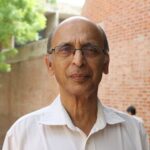
The inevitable has happened. Shirish Patel passed away at the age of 92, on December 20, 2024. He had a professional practice in civil engineering but his interest and contribution spanned across housing and slums, urban planning and governance. He is credited with designing the first fly-over at Kemp’s Corner, introducing innovative construction practices in Sector 1 in Vashi, and an iconic arched pedestrian crossing on Sion Panvel Highway. Because of his interest in solar energy, he even developed a solar cooker—for application in large kitchens—in association with ICT, Mumbai.
In 1965, Shirish Patel, with Charles Correa and Pravina Mehta, wrote an article in Marg magazine articulating the need to reorient Mumbai’s northerly growth eastward across the harbour on the mainland. Shirish Patel and Charles Correa relentlessly pursued the idea, until CIDCO was established in 1970 as the planning and development agency for the area across the harbour that came to be known as Navi Mumbai later.
Urban planning and development were usually seen as the domain of architects and engineers. But Patel visualized it right in the 1970s as a multi-disciplinary venture. Mr. J.B. D’Souza (the then Managing Director of CIDCO) and Er. Shirish Patel appointed a multi-disciplinary advisory Planning Team comprising luminaries like Dr. M.S. Gore (the then Director of TISS), Dr. Kirit Parikh (ISI), Dr. P.B. Medhora (then with ICICI), K.P. Battiwala, Vijay Tendulkar (a celebrated Marathi author and playwright), and of course Charles Correa.
CIDCO staff was also multi-disciplinary, belonging to fields like architecture, urban planning, engineering, economics, statistics, operation research, and social work. Patel was the principal author of the first Development Plan of Navi Mumbai prepared in 1973. It distinctly stands out amongst the Development Plans that are routinely prepared, even today.
However, in 1975 Er. Patel withdrew from CIDCO but continued to write about urban issues. He had been a regular contributor to EPW (Economic and Political Weekly). He wrote on wide-ranging subjects—slum rehabilitation, governance of Mumbai by a directly elected mayor, rent control, rational relation between FSI, and density and space for public purposes.
He was against the indiscriminate use of FSI as an incentive to provide free resettlement either for slum dwellers or the tenants of rent-controlled buildings. Terming the Dharavi Redevelopment Project a ‘sophisticated land grab’, he sought alternative solutions through a design competition. Although, it had no impact on the authorities.
Shirish Patel fought two PIL (Public Interest Litigation) battles. The first was against the policy of chawl redevelopment, in which he had limited success in the Bombay High Court but lost in the Supreme Court. The second was against the redevelopment of Worli BDD Chawls, in which the Bombay High Court did not accept the petitioner’s argument.
In both cases, Er. Patel believed that courts would substantively consider the interests of the affected citizens. However, the courts took a procedural view concluding that the government had not violated the procedure laid down in the law and refused to consider the substantive aspects of the health and safety of the citizens.
In contrast, he was very impressed by the Sites and Services project at Charkop and other places implemented under the World Bank-funded Bombay Urban Development Project during the late 1980s. He enthusiastically invited many to visit this project to convince them of the merits of that approach. He, then, pursued ‘Inclusionary Housing’ and ‘Community Land Reserves’ as two approaches patterned after US practices that he believed would be useful in the Indian context too.
Er. Patel also showed interest in understanding how economics can help analyse urban problems and propose policies to address them. But then, he perhaps got disillusioned with classical economics and its approach to cities. He argued that land should be treated as commons, instead of ‘soap cake that is naturally subject to market supply and demand.’
He was also keen on building institutions. He devoted himself to developing an institution to educate urban practitioners, resulting in his setting up of the Indian Institute of Human Settlement (IIHS) in Bengaluru. He also attempted to forge a collaboration between TISS, IIT Bombay, and New School in New York, which was unsuccessful.
One of his last urban projects was ‘6 Metros’—a two-volume book of the comparative study of 6 metropolitan cities—which he co-authored with Oormi Kapadia and Jasmine Saluja. In this book Er. Patel put together all his latest ideas about urban and housing.
But above all, he was a humanist who aspired to have a city that was ‘just and fair’ to all.