


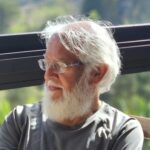
(right) Photograph of Hassan Fathy, 1976. Photograph by Martin Lyons
I dropped out after the first year of architecture, deciding, with all the impetuousness of youth, that as my teachers had not practised architecture, henceforth monuments would mentor me and embarked on a rather ambitious architectural expedition abroad, convincing my parents that by funding the trip myself, I would only need their blessings. Muslims follow a millennium-old tradition of travelling to seek knowledge, so getting permission wasn’t difficult. I left home in Mumbai (then Bombay) and worked in a furniture factory in Sharjah until I made enough to set off, beginning with Serbia and Croatia, then part of Yugoslavia.
Two years, nine countries, and after a month cycling across Scotland, I found myself in Gaudí’s Grand Basilica in Barcelona. While fasting (I, then, didn’t know that travellers were exempt during Ramzan), the Sagrada Familia Church appeared even more hallucinatory. It was there that I came face-to-face with the turtle whose situation left me bewildered. Why, in heaven’s name, did Gaudí have the weight of the monumental circular column come down on the back of a turtle? Intuitively, I felt it was the key that would decode architecture. As I continued backpacking in Europe, I would ask that question of people I came across. None of them had an answer; most thought the question trivial.
Reaching Athens, I visited the library of Doxiadis. He was the founder of Ekistics, the science of human settlements and had designed Islamabad as well as reoriented Riyadh’s axis to Mecca. In his library, I came across an article on the nature of bricks. Even as a bibliophile, I had never read anything as poetic on that prosaic block. The author was Hassan Fathy (hadn’t heard of him then). Turns out he was an architect’s architect; well-known amongst his peers and a key participant in The Delos Symposium, an annual cruise attended by the likes of Bucky Fuller, Arnold Toynbee, Vikram Sarabhai, Marshall McLuhan, Kenzo Tange, etc.
The librarian was surprised at my ignorance. “With the publication of Architecture for the Poor in the 70’s,” she said that Hassan Fathy, the father of sustainable architecture, became a celebrated architect in the Islamic world and lived in Cairo, Egypt.
I decided to pay him a visit and made my way to Syntagma Square in Athens, with its confluence of travel agencies. In those days, it was easy to reroute your air travel if you had a full-fare ticket, were familiar with IATA rules, and were tenacious. My air ticket bulged with a rerouted agenda as airlines played catch-up with the impulsive itinerary of an opulent backpacker.
Landing at Cairo airport, past midnight, the Egyptian authorities asked for my address. I gave Hassan Fathy’s. The Visa form asked for my reason to visit, and I wrote, “To see the Pyramids and Hassan Fathy.” The officer asked me, “Who is Hassan Fathy?” He appeared bored at my response while searching for a space in my passport crowded with visas (an Indian required a visa to each European nation separately in those pre-European-Union days). Once through immigration, I met another backpacker, and we took a bus to Tahrir Square and walked to the youth hostel by the Nile.
In the morning, I located Hassan Fathy’s medieval house, a short climb from the monumental Sultan Hassan Madrasa with the tallest minaret in ‘A City of a Thousand Minarets.’ When I met him, he was 78, and I was 22.
On the very first day, I tested him with my turtle question. “Hassan Bey,” as I went on to call him, looked at me with his eyebrows raised, expressing his surprise that I didn’t know the answer to why Gaudí had that domical turtle on the square base of the gigantic column supporting the monumental shaft. Seeing my blank look, his face softened into a smile.
“The back of the turtle,” he answered without hesitation, “is a hemisphere of the heavens with its four feet anchored to the four corners of the Earth. Hence, the turtle is a cosmic form in transition from Earth to Heaven, from the earthly square of the column’s base below to the circular shaft above. Going from the square to the circle was a cosmic manoeuvre.”
I thought: “He’s the man!”
Leonardo da Vinci’s mentor Verrocchio, too, had turtles supporting the stone sarcophagus of the Medici in the Old Sacristy of San Lorenzo that I recalled from my days in Florence. Decades later, those turtles grounded my interpretation of Leonardo’s Vitruvian Man (the most famous line-drawing in the world had a man inside the square and the circle).
Hassan Bey’s answer convinced me to linger and learn architecture from him, restoring my faith in mentors over monuments. In our youth, when we embark on a pursuit, wise elders demonstrate to us that a life of professional excellence and integrity is indeed possible in a tumultuous world.
Fathy’s head was in the heavens, heart in the right place, and feet planted firmly on earth. His transnational approach, opposite to Doxiadis’, was inductive, beginning with a detail while working simultaneously at various scales and upward to get a sense of the whole, working with self-construction rather than prefabrication. He was the foremost adobe builder, pioneering a poetic sustainability, an exponent of Islamic Architecture.
Subsequently, he became a celebrity, winning the first Chairman’s Award of the Aga Khan Award for Architecture (there have only been three other winners since) and the first UIA Gold Medal, ‘the most prestigious distinction attributed to an architect by architects.’ But when I met him, I had him all to myself, with each day ending with us dining together.
When I returned to complete my studies in India, it was with the conviction that we dwell between Earth and Heaven, and architecture endeavours to bridge the gap. My second-year design for rural housing was incongruously Bucky meets Fathy with a geodesic dome of bamboo resting on adobe walls. The geodesic was merely to span what adobe could not, and it was veiled (sacrilege!) with army-surplus-discards waterproof tarpaulin while some walls had arched openings (frowned upon those days).
Neither Bucky nor Fathy would have approved, though they would consent to the geometry of scaled proportions unifying the scheme of diminishing courtyards as the dweller moved from public to private. But Fathy’s exquisite colourful renditions (he being a miniature artist) did not dislodge my manner of bare black-and-white line-drawing architecture that eschewed all colour and even skiagraphy.

One evening in Mumbai, as a young architect, I was doing ablutions in the courtyard tank of the city’s Jama Masjid. Wudu or wazzu, the unchanged ritual of purification that Muslims have been performing before prayers for over a millennium, is a sensuous sequence of washing hands and arms, then face, mouth, and nostrils, wiping the head and nape of the neck with wet hands, and finally washing the feet. I had taken out my spectacles to wash my face, and the world began to blur.

As each wash is performed three times, I would pause, face dripping with cool water and gaze at sunlight bouncing from the rippling surface as the shimmering water subsided. Seeing a rocky outcrop, a tiny island at a distance, with some dark rocks. I thought I saw a rock move. Squinting my eyes, the rock stirred! So, I quickly put on my spectacles and then noticed, to my delight and amazement, that they were not rocks but denizens of the ancient tank of water, which was even older than the two-century-old Mosque.
The ‘rocks’ were dark turtles sun-bathing. As I continued to wash myself, verses began to formulate in my mind as drops were dripping from my hands and face.
Turtle
My pillars anchor
The four corners of Earth
My back supports the sky
My head remains outside
Wise eyes navigate
Turning pillars into limbs
That lurch from point to point:
When Earth and sky migrate.
When times are bad, I retract
Limbs and head, touchdown,
The core sans appendages
The microcosm is motionless
Awaiting merciful times
And compassionate spaces.
My movements and my waiting
Are otherwise indistinguishable.
I dwell on the back of another
That collapsed long ago
But continues to hurtle along
The momentum is unrelenting.
Upon my back, within grooves
Where pieces of sky interlock
Within fissures of fabrication
Lurk turtles in the valleys.
Whatever the frame of reference
Whatever the plane of existence
Wherever meet Earth and Sky
Wherever conjoin walls and domes
Wherever squares transform into circles
Cubes to spheres, hypercubes to
Hyperspheres, you will encounter micro-
Turtles, turtles and hyperturtles.
To have faith is to understand,
That reasoning is made of turtles
That if you look deep within yourself
Or outward as far as the eye can see
Your gaze will always return in wonder.
That is the way of turtles
In a universe made of turtles
It is turtles all the way.
Strange are the ways of an oral poet—working hard at capturing a poetic moment with a poem that begins to formulate in the head (as in ancient times, sans paper), ready for recall amid everyday conversation or formal readings, not from memory (that entails memorisation) but from the mind where it is ever-present.
Thus, the Turtle poem has been recited in different parts of the world for over two decades. The last time was in an architecture office in Nashik, where a turtle sculpture sitting on a square base elicited a spontaneous recital in the company of architects. Only now, after over two decades since its inception, is the poem published. That is the way of oral poets.

A Final Flashback:
Three years after graduating, while designing a twelve-thousand-square-foot house in the desert kingdom of Oman, I recalled my time in the desert of Sharjah, where I used to withdraw on weekends and at times after work in the furniture factory. Whether you stood still or you moved (face and head wrapped to keep away the blistering sun and sirocco), you were always at the centre of the world with a dome of the heavens above and the complete circle of the horizon encircling you and your four body-directions. All was sand and sky; in the desert, you value shade.


The entrance door to the large house, which transits you from the sun outside to the shade within, was resolved via a square rotating within a circle. The glass appeared dark from the outside. Stepping into the dark interior, the glass reversed, and a star filtered the desert sun. You were at home, dwelling in the shade.
Last month, while giving a talk at Cornell University on the Dome of the Rock in Jerusalem, I realised my youthful entrance resolution was akin to the seed geometry of the millennium-old monument that was dedicated to an ascent from Earth to Heaven (another interpretation, a descent from Heaven to Earth).
Wherever the turtle is on Earth, when it withdraws its four limbs and neck into its encircling shell, it is home. On Earth to be at home is to be in heaven, wherever on Earth that home may be and whenever that home endeavours heavenwards.




3 Responses
I was privileged to have befriended Masud in the same architecture school. We were batchmates and recall most of the contents in this article authored by him – first hand.
Thank you for the walk down memory lane! I think everything i knew about Fathy or was inspired to read about was because you talked about him in our talks and lectures, Prof Taj.
Happy New Year! Warm regards,
Kanan.
Monuments over mentors….Mentors over monuments – wonderful read (as usual), great way to begin the year (for me), Thanks!