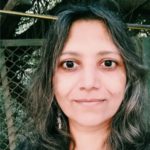
Rhiti Chatterjee Bose had a conversation with Tikuli Dogra, an artist from Delhi. Here’s what she got to know:
First of all, tell us something about yourself, where are you from, about your family, your childhood, if you have any other profession.
I’m an author based in Delhi. I was born in Nainital and we shifted base wherever my mother was posted, finally settling here. You can say, we are an example of “national integration” as a family. Parents from Maharashtra and Uttarpradesh, in-laws from Himachal and now my daughter-in-law is a Sikh girl. I think it’s wonderful to have this colourful family.
Nothing exciting about my childhood. In fact, some traumatic memories that shaped me into who I am. Except for a few good things that initiated my love for outdoor and reading, everything is gathered at different stages of the journey called life. I don’t have any regular profession.
How did you start painting? What pulled you to this art form?
I always loved art in some form or the other but serious interest began a few years ago when I was battling poorly with my anxiety at multiple levels. My elder son is an artist among other things and was doing his course in animation and making digital art. I was fascinated and wanted to try. He taught me the basics and for hours I immersed myself in that. This was the start but my eyes were getting strained by excessive screen time so when he shifted to acrylic on canvas, I too did a few of his old canvases. This was the time I realized there was a calling here. I love watercolours so began painting on whatever paper I found. Slowly I gathered the courage to buy the proper material required and also began experimenting with traditional art forms like Madhubani, Warli, Gond etc. Now I do different forms with pen and ink, watercolours and looking forward to some experiments in fabric sketching. Art has opened a whole new world for me.
How did you teach/train yourself?
My son initiated me into it and I keep asking him for guidance from him but there are excellent tutorials on YouTube/Instagram and artist support websites that are free and very good. Some artists I have connected with are generous with help in technique etc. These are my learning resources. I’m still learning every day.
What influence has art had in your life?
For a long time, I’ve been struggling with issues, mentally, physically and emotionally. Art keeps me sane in hard times and at others, it helps me channelize my energy both negative and positive. I’m not saying it has cured me of everything but it certainly has helped me in focusing on the right stuff. Sometimes one doesn’t wish to write. Words have their own burden but colours are fluid. It’s a different sort of high, calm and serene.
How do you see yourself as an artist in the future, what are your plans?
No plans as such but if my work sells it would certainly help me financially. Even a little counts at this stage. I’m doing it for my pleasure and learning mostly but I’m also open to making it into a profession.
Tell us something about the style of your paintings, the genre and why did you choose to pick this style?
I do a lot of styles and it depends on my current situation and mood. Mostly I prefer watercolours. They are forgiving and challenging at the same time. I’m also loving the one line continuous drawings or simple minimalist pen drawings. I think I will focus on this style for now and do colours to fill in the empty spaces like Kintsugi.
Any advice for future aspiring artists?
Just open yourself to whatever your heart longs for. Fearless Artist is a term a learned from Artist Angela Fehr whom I follow on Instagram. She has an excellent approach for upcoming artists and it’s very encouraging. Don’t be judgemental about your work and just let it flow. That’s what I do. Nothing needs to be perfect. Let it heal you. You don’t know how much comes up from within when you dip your brushes in colour.