PRESTIGE UNIVERSITY, INDORE, INDIA by Sanjay Puri Architects

Sanjay Puri Architects designs a Green-layered-Terraced Presitge University at Indore

PRESTIGE UNIVERSITY, INDORE, INDIA by Sanjay Puri Architects 1

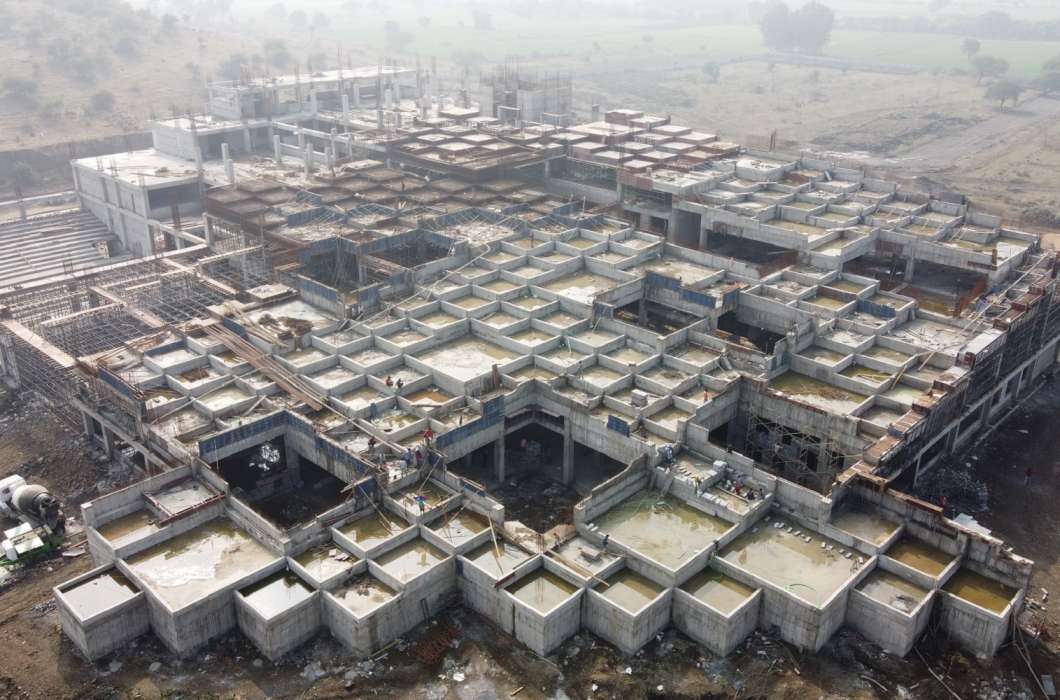
Situated within a 32-acre university campus, the main administration offices along with an auditorium, seminar halls, library & cafeteria form the functions of this building.

As opposed to creating an imposing edifice, the building gradually steps up from the approach direction belying its 20-meter height.

Stepped up from the northern direction, the entire terrace of the five-level building is accessible to the students and faculty of the university transforming it into an open auditorium amidst the landscape.

The multiple functional spaces within are interspersed with naturally lit landscaped courtyards allowing indirect light to infuse the internal volumes at each level.

The north lighting & courtyards are imbibed from traditional Indian architecture creating an energy-efficient sustainable building with minimal dependence on artificial lighting and air conditioning. This is in response to the climate of the city that varies from 30°C to 40°C for 8 months of the year.

Varied sectional volumes punctuated by landscape create different experiences in each part of the building. A continuous diagonal indoor street in addition to the numerous open courts facilitates natural ventilation within the internal spaces.

The common facilities like the food court, an auditorium, and the administrative offices are located on the ground floor for easy access. The various library components are located on the first floor connected by a bridge over the diagonal indoor street cutting across the building. The common classrooms occupy the second floor deriving light and ventilation from the various sectional volumes and open courts. These open courts act as the spill-over area for recreational activities. The third floor houses the tiered classrooms. The fourth-floor houses all the administrative and faculty-related facilities.
The east, west, and south sides of the building are enveloped with a ventilated brick screen to mitigate heat gain in response to the climate.

The Prestige University is contextual to the climate of its location creating an energy-efficient building that in addition to housing numerous activities, also becomes a large open public space with accessible ground floor and landscaped roof.

The building is a series of interactive spaces of different scales fostering engagement at various levels amongst the users as well as integrating functional and open landscaped areas intrinsically.

PROJECT DETAILS

Project Name: PRESTIGE UNIVERSITY

Location: INDORE, INDIA

Category: UNBUILT CATEGORY – EDUCATIONAL

Client Name: PRESTIGE EDUCATION SOCIETY

Completion Date: WORK IN PROGRESS

Gross Floor Area: 3,30,000 SQ.FT. (30,685 SQ.M)

Costs: 82.50 CR INR (1,08,33,880 USD)

Completion Date: June 2022

Architects: Sanjay Puri Architects

Design Team –Sanjay Puri, Ruchika Gupta

Leave a Reply

Your email address will not be published. Required fields are marked *

This site uses Akismet to reduce spam. Learn how your comment data is processed.

Recent

Folles de la Salpétrière, (Cour des agitées.) (Madwomen of the Salpétrière. (Courtyard of the mentally disturbed.))

Gender. Hysteria. Architecture. | “How Did a Diagnosis Learn to Draw Walls?”

Did these spaces heal women or teach them how to disappear? Aditi A., through her research study as a part of the CEPT Writing Architecture course, in this chapter follows hysteria as it migrates from text to typology, inquiring how architectural decisions came to stand in for care itself. Rather than assuming architecture responded to illness, the inquiry turns the question around: did architecture help produce the vulnerability it claimed to manage?

Read More »
Gender, Hysteria, and Architecture - The Witch Hunt. Henry Ossawa Tanner. Source - Wikiart

Gender. Hysteria. Architecture. | “When Did Care Become Confinement?”

Was architecture used by society to spatially “manage” women and their autonomy? Aditi A., through her research study as a part of the CEPT Writing Architecture course, examines the period before psychiatry, when fear had already become architectural, tracing how women’s autonomy was spatially managed through domestic regulation, witch hunts, informal confinement, and early institutional planning.

Read More »

A Modernist’s Doubt: Symbolism and the Late Career Turn

Why did acclaimed modernist architects suddenly introduce historical symbolism like arches, decorative elements, and other cultural references into their work after decades of disciplined restraint? Sudipto Ghosh interrogates this 1980s-90s symbolic turn as a rupture in architecture, questioning whether this represents an authentic reconnection with content and memory, or is it a mere superficial gesture towards absent meanings. Drawing from Heidegger’s analysis of the Greek temple, he distinguishes two modes of architectural representation, ultimately judging that this turn was a nascent rebellion against modernism that may have failed to achieve genuine integration of context, material, and memory.

Read More »
Ode to Pune - A Vision. © Narendra Dengle - 1

The City That Could Be: An Ode to Pune

Narendra Dengle, through his poem written in January 2006, presents a deep utopic vision for Pune—what the city could be as an ecologically sustainable, equitable city that balances nature with development. He sets ambitious benchmarks for prioritizing public transport over cars, preserving heritage, addressing slum rehabilitation humanely, and empowering local communities

Read More »

Featured Publications

New Release

We Are Hiring

Stories that provoke enquiry into built environment

www.architecture.live

Subscribe & Join a Community of Lakhs of Readers