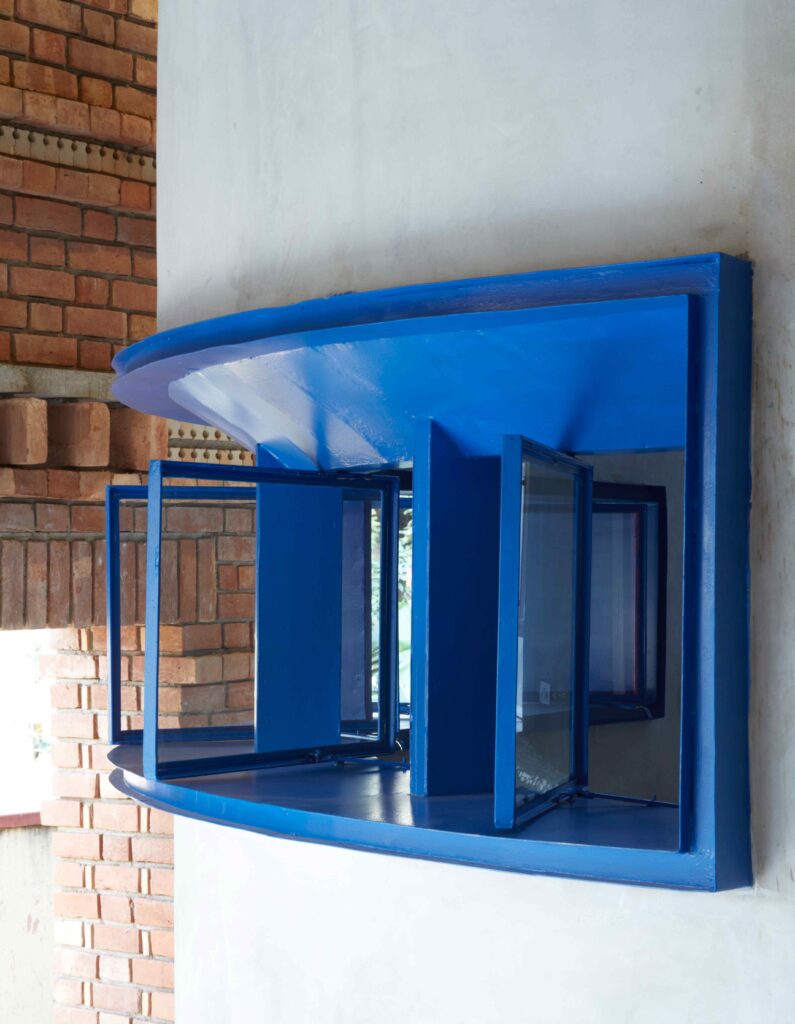
Gallery House, Bansberia, West Bengal by Abin Design Studio, Architects in Kolkata

The client's brief called for a garage structure with staff quarters, but for Abin Design Studio, Gallery House was a project with the potential to serve its local community. Inspired by the way the building was shaping, the client embraced the suggestion of providing a community hall and a multipurpose room, instead of the initial plan of having a garage built.
Gallery House, Bansberia, West Bengal by Abin Design Studio, Architects in Kolkata 1

The client of Wall House procured a parcel of land across the street from his home as a parking lot for his vehicles. ADS (Abin Design Studio) was approached to provide a garage structure with staff quarters above. Given its simple program, ADS convinced the client to use this opportunity for doing a lot more and think of how it could give back to the community.

Gallery House, Bansberia, West Bengal by Abin Design Studio, Architects in Kolkata 3

The Gallery House was then planned as a garage on the ground level with a multi-purpose activity space on the upper level intended to be used by the neighbourhood as well. Encouraged to maximise the public utility of this building, its design was conceived to extend into the street, both visually and physically.

Gallery House, Bansberia, West Bengal by Abin Design Studio, Architects in Kolkata 5

The building was designed on a site of area 330 square meters to serve the local community in the peri-urban locale of Bansberia, West Bengal.

As a decision to introduce another architectural expression to the community, the building took cues from Bengal’s terracotta temples. Exposed brick masonry walls inlaid with ceramic blocks define the building’s character as a contemporary expression of inspiration. Collaborating with a ceramic artist, rejected ceramic blocks produced for industrial use, were collected. Terracotta bricks were procured from a river-side brick field located nearby. These two were combined, using locally prevalent finesse of building masonry.

Inspired by the way the building was coming up, the client decided to let go of his initial requirement of a garage and embraced the suggestions of re-purposing the ground floor as a community hall while the upper floor houses a multipurpose room, a sitting area and a pantry. The multipurpose room was to be used primarily for providing tuition classes and yoga sessions to the local community. At night, this space functions as a dormitory for resident staff. The client enjoys a sense of pride and joy of ownership seeing the space put to good use.

Gallery House, Bansberia, West Bengal by Abin Design Studio, Architects in Kolkata 15

Every year this locality holds a festive procession along the narrow, winding neighbourhood lanes, as a part of a cultural celebration. Reciprocating this, the building steps down towards the street forming a gallery for the onlookers to sit, who gather at the street-side during this event. Through judicious planning and play of voids in volume, the integral space of the building was shared with the neighbourhood people as a humane gesture of giving back to the local community, without disrupting the privacy and security of inner functions.

Images

Drawings

Location: Bansberia, West Bengal, India
Area: 380 sq.m
Status: Completed January 2020

Team:

Principal designer: Abin Chaudhuri
Design team: Sohomdeep Sinha Roy, Qurratul Ain Maryam
Structure: Soma Kazi
Project Coordination: Debjit Samanta, Debkishor Das, Dipankar Mondal
Collaborator: Partha Dasgupta (ceramic artist)


Gallery House, Bansberia, West Bengal by Abin Design Studio, Architects in Kolkata 47

Leave a Reply

Your email address will not be published. Required fields are marked *

This site uses Akismet to reduce spam. Learn how your comment data is processed.

Recent

Gender, Hysteria, and Architecture - The Witch Hunt. Henry Ossawa Tanner. Source - Wikiart

Gender. Hysteria. Architecture. | “When Did Care Become Confinement?”

Was architecture used by society to spatially “manage” women and their autonomy? Aditi A., through her research study as a part of the CEPT Writing Architecture course, examines the period before psychiatry, when fear had already become architectural, tracing how women’s autonomy was spatially managed through domestic regulation, witch hunts, informal confinement, and early institutional planning.

Read More »

A Modernist’s Doubt: Symbolism and the Late Career Turn

Why did acclaimed modernist architects suddenly introduce historical symbolism like arches, decorative elements, and other cultural references into their work after decades of disciplined restraint? Sudipto Ghosh interrogates this 1980s-90s symbolic turn as a rupture in architecture, questioning whether this represents an authentic reconnection with content and memory, or is it a mere superficial gesture towards absent meanings. Drawing from Heidegger’s analysis of the Greek temple, he distinguishes two modes of architectural representation, ultimately judging that this turn was a nascent rebellion against modernism that may have failed to achieve genuine integration of context, material, and memory.

Read More »
Ode to Pune - A Vision. © Narendra Dengle - 1

The City That Could Be: An Ode to Pune

Narendra Dengle, through his poem written in January 2006, presents a deep utopic vision for Pune—what the city could be as an ecologically sustainable, equitable city that balances nature with development. He sets ambitious benchmarks for prioritizing public transport over cars, preserving heritage, addressing slum rehabilitation humanely, and empowering local communities

Read More »
(left) Turtle Poem 1999 & Calligraphy 2006, by H. Masud Taj. © H. Masud Taj. (right) Photograph of Hassan Fathy 1976, © Martin Lyons

“Hassan Fathy’s head was in the heavens, heart in the right place, and feet planted firmly on earth.”—H. Masud Taj on his Turtle poem & Hassan Fathy

H. Masud Taj elucidates how, as a young architecture student, he dropped out of his institution to travel and learn from monuments, discovering in Gaudí’s Sagrada Familia a turtle column that catalyzed an inquiry, hearing Hassan Fathy’s explication of the turtle in Cairo, ultimately crystallizing in Taj’s poetic meditation on dwelling.

Read More »
Education Authority Bill - Viksit Bharat Shiksha Adhishthan Bill - Architecture Education, A. Srivathsan

Education Authority Bill: Its Implications for Architecture Education

A. Srivathsan in his preliminary overview of the new Viksit Bharat Shiksha Adhishthan Bill, notes that the bill could transform architectural education. The VBSA Bill proposes restructuring India’s higher education regulation, by dissolving UGC and related authorities, creating three new councils for regulation, accreditation, and standards.

Read More »

Featured Publications

New Release

We Are Hiring

Stories that provoke enquiry into built environment

www.architecture.live

Subscribe & Join a Community of Lakhs of Readers