


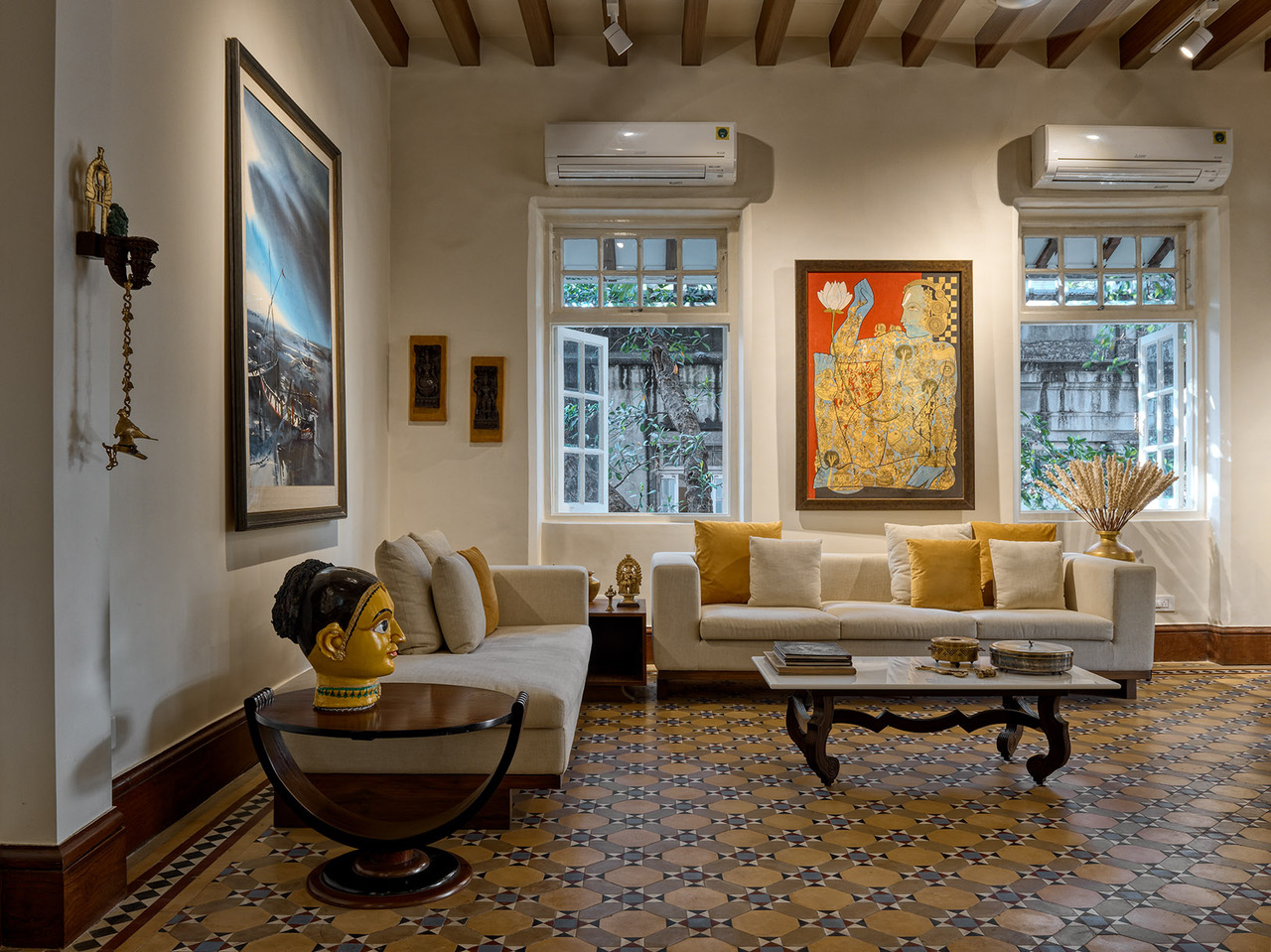
The Bombay house is a unique typology that has existed since the colonial times. The space is restored and redesigned to its true time but creating opportunities and interactions for today’s use. A unique blend of time and function. The sequence of spaces within the house forms a loop. One enters the house in a library and then moves through a verandah to reach the living spaces. A passage from the living room leads to the bedrooms and the kitchen. Through the bedroom one again reaches the verandah that completes the loop. The design interventions intersect within this sequence enhancing the experience and creating opportunities within the house.


The house is a composition of common areas and private units. The common areas come to life during morning tea, evening parties and gatherings after which everyone disperses into their own private spaces, very similar to the way a city behaves. Each space is defined by a unique flooring pattern, inlaid with small pieces of different colored tiles. The more public spaces, like the living room and verandah have a heavy and intricate pattern while the flooring pattern in all the bedrooms is simple as it occupies more furniture.


Library and Verandah
One enters the house in a library with two bookshelves, one of which stops at the sill level, sitting perpendicularly along the walls, while the window on the third wall frames the bungalow on the opposite street. At the center of the room is an ornamented oval table that folds compactly when required. The library and verandah are placed linearly, in a way that when the doors between the library and verandah open the entire space reads as one long verandah with quaint furniture which is pushed at the end of the verandah with the foliage of trees peeking in through the back. Due to the serenity of the street below and the light that enters the verandah, the space populates with activities like morning, afternoon tea, reading and resting throughout the day.


Living Room and Passage
The verandah opens into the living room, a large undivided space that is occupied for parties and work meetings. The furniture is a mixture of antique and contemporary, however the colors are kept to a minimum with ochre yellow and white, allowing the flooring to get better visibility. The main spine of the house is the passage that connects perpendicularly, into the bedrooms and then opens onto private balconies.


Daughter’s Room
One enters the room in an L-shaped integrated wardrobe and a bed unit, where the wardrobe forms a lobby between the sleeping space and the passage. As a result, the bed is pushed towards light facing the verandah. The double shutter door of the verandah with louvers controls the light entering the room. The L-shaped cupboard is designed to dismantle the idea of a regular wardrobe and make it more ergonomically sound. It is divided such that the top half caters to vertically openable compartments for hanging ironed clothes and folded garments, the bottom drawers for napkins, linen, sportswear and an extension as a small bedside table. The L shape in plan allows for a small private dressing area to be formed, while the height of 1.5 meters provides for a makeshift counter as the top of the cupboard, thus allowing for a spacious room.


Brother’s Room
The brothers room functions as a place for living, study and a work area, hence the furniture is also set up accordingly. This bedroom has a private attached balcony and bathroom. The bed is pushed towards the center of one of the walls and a study table occupies the wall along the balcony for ease of working and having tea or coffee. An existing metal cupboard and a fridge are encased within a wooden cupboard to blend into the theme of the other house furniture.


House as a reflection of the city’s urban form
Historically if we observe the Pols of Ahmedabad are walled settlements with different clusters of houses. Just like the city, the clusters have an organic arrangement of the houses which are all internally linked. (fig 1.1, 1.2 , 1.3) Jaipur follows a grid iron pattern which is translated from the scale of the city to the smallest unit of the home. The traditional havelis follow the grid where the central square forms a courtyard. (fig 2.1, 2.2 , 2.3) In the case of Madurai, the Meenakshi temple at the heart of the city becomes the anchor point around which the city gets built in a concentric pattern. The similar pattern is seen in the traditional houses that have layers of spaces from the outer verandah, living areas and central courtyard. (fig 3.1, 3.2 , 3.3) During the British colonial era, Bombay was planned within the Bombay Fort, with linear streets in a grid pattern. The streets continue into the house in the form of the verandah and the passages with branching rooms, much like a dwindled city embedded inside each home. (fig 4.1, 4.2 , 4.3)


Diagram –


Project Facts –
Project name: The Bombay House
Architecture firm: RC Architects
Architect: Rohan Chavan (Principal RC Architects)
Location: South Mumbai
Project Completion Year: January 2021
Project Area: 3000 sq.ft (278 sq.m)
On-site Documentation team: Prachi Kadam, Mayuri Mistry, Priya Anandani
Publication drawings: Nikeita Saraf, Rahul Ciby
Photographer: Hemant Patil
Contractor: Creation Design



2 Responses
Exquisite work. Ver accomplished architects & designers. How can one visit the location. Is there a video?
Please inform the project cost of all the work carried out in this house. Thanks
Hi Jayant, Thank you for your feedback. We do not have a video of it, for other details you can reach me on 9890322501.