For a constantly developing city like Vadodara, it was important that, we as architects strive our best in producing buildings that can be at par to the city’s pride and development.
Located in the Vadodara’s newly developing area, Kalali, this project is targeted to be the state’s first high end project providing the users with newest technologies to ease their everyday routine and bring the best of both world’s luxury + nature living. It addresses the client’s need in making a building that stands as an iconic landmark for the city. Continuous diligence in making a grand building came after some real research on the need of users, discussions with clients and the team. The form started to shape well after a process of about six months of constant refinement and research, the form is a perfect fusion of state of the art sculpting and functionality, while trying to redefine the meaning of architecture in its pure form. The structure does perfect justice to its name as it plays with curves and visual imaginary. The project stands bold and has redefined all possible norms that an ultra-luxurious residential space could be
SITE:


This project has a unique form of housing resort homes. The site covers a large area of 2.5 lakh sq. ft. with the tower sitting right at the entrance, covering only 15% of the total area, overlooking the entire campus. The site also accommodates a beautiful artificial lake covering the central footprint of the site, individual cottages owned by the house holders are sited along the periphery facing the lake. This provides the individuals with a leisurely time to unwind and relax on the lake developed. With restricted vehicular movement most of the property can only be accessed by foot and helps maintain a healthy environment.
DESIGN PROCESS:
-

-

Inspiration -

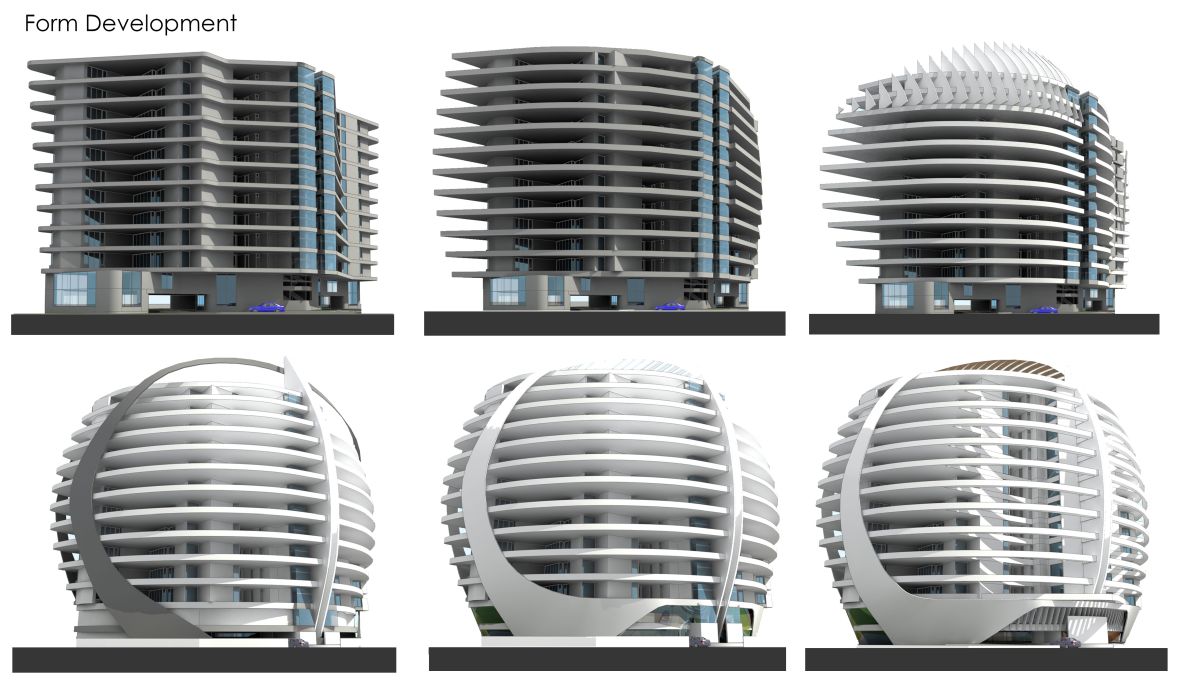
Form Development


The unique form and alignment of the building is developed by considering various factors like the sun movement, wind direction in mind. The form of the basic slab plates and the structural form is inspired by the profile of a professional mic and reflects the fluidity of the lake and landscape around the building. The plan is inspired from fluttering of the wings of a butterfly such that it offers a peninsular views of the tactfully designed landscape and beyond, for each of the apartment.
PLANNING:
The tower has huge spaces that lets one experience the splendour right from the entry. The reception at the entrance also acts as a help desk. The play of double height spaces that occur at the amenities placed on the floor above, adds to the drama of the interior, as the form does for the exterior. The pool, designed within the building footprint faces the lake, which creates a sense of infinity pool as it makes an infinite visual connection towards the lake.


Distinct care has been taken in designing the individual units that it has a proper ventilation benefits. A good interplay of spaces is created in the internal planning of units, as most of the rooms get major openings lined along the surface while a few common spaces have a warm enclosure.
Moreover, systems working on natural energies are integrated like the solar water heater and rain water harvesting plants. The sewage treatment plant is also provided in order to release environmentally safe waste.
INTERIOR:
As one drives through the entrance you reach the foyer of the building. This floor has a help desk /reception and lounge spaces. A floor above has a massive recreational zone inclusive of a gym, spa, cafe and a serene infinity pool facing the lake.


In an attempt to give maximum advantage and considering the sun movement and wind direction the layout of the individual unit derived is an attempt to give maximum view and ventilation for almost all the usable spaces within with all the services facing the west.
The internal spaces are all well connected and are rather exaggerated in dimension, enough to cater to all the requirements of a modern upper class family.
All the four bedrooms are well equipped with individual walk-in closets and large bathrooms.
The large formal living area opens to a deck that in turn runs all around the entire house. Connected to the living area is the dinning, family space which further opens to a deck with a splash pool tucked cleverly between 2 bedrooms giving a sense of privacy as well as openness.
The form being so dynamic, all challenges are resolved as to the traditional building construction techniques. Innovations in building construction techniques are thus explored even more.


Drawings: