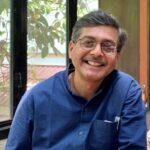
That was Kumar Gandharva singing Kabir’s Nirbhaya Nirgun.
Fearless Formless
Two words. And somehow, everything about Sen.
—

Fearless. Formless. I chose those words carefully, but I’ll admit Sen would have been suspicious of them. He was wary of binaries—the neat labels that flatten what is actually alive and contradictory in a person. And with Sen, more than most, the architecture and the man were the same thing. You couldn’t really get to one without the other.
My experience of knowing Sen was that his work always had two sides to it. There was the visible one—the seductive images, the powerful drawings, the striking, distinctive visual vocabulary, which drew immediate attention and sometimes even confusion and criticism. And then there was everything underneath—the register that actually drove the work. The deeper questions that come before you even pick up a pencil, and that stay long after the building is done.
You can sense this even in the early work where the tectonic decisions are deliberate, but they are never the argument. The form was never the point. And in his later projects. NID Gandhinagar, Museum of Contemporary Art in Budapest, the Guggenheim Helsinki competition, you sense he was getting somewhere—something closer to silence, where the building stops announcing itself and simply becomes a presence you inhabit.
Two Gurus anchored this search. Louis Kahn. And Sri Aurobindo.
Most of Kahn’s inheritors took what was most visible in his work. Sen, on the other hand, picked up from where Kahn was headed, not where he had already been. A late Kahn unbuilt project—the Dominican Motherhouse—is where Kahn’s architecture starts reaching toward something lighter, less resolved. Sen recognised that reaching. And he continued that journey.
What drew him to Aurobindo was something similar—this insistence that what we see is never the whole story. That the visible world is always pointing beyond itself. Sen held both Kahn and Aurobindo close because they were, for him, saying the same thing from different directions—that to arrive at the truly essential, form itself must eventually fall away. That formlessness was not an absence. It was the destination.
—
And then there was the fearlessness. Which was, in some ways, the precondition for all of it.
I have not known anyone quite like Sen in this regard.
He grew up in a large joint family in Kalbadevi and was, by his own account, already pushing back against elders and expectations from early on. At the Sir JJ School of Architecture, he was the student questioning the dogma, not out of arrogance but out of a genuine inability to accept what couldn’t be justified.
In the early 60’s, as a young architect, Sen was working as part of B.V. Doshi’s team on the IIM Ahmedabad project, which Kahn was developing. Sen reportedly pointed out that the buildings were facing the wrong way, that the orientation was fighting Ahmedabad’s climate rather than working with it. He suggested the scheme should be flipped.
Think about that for a moment.
A young Indian architect telling one of the greatest architects of the twentieth century that he had it wrong.
Kahn’s response was initially dismissive. And then, quietly, he incorporated the suggestion.
This pattern—of holding his ground with complete equanimity, without aggression and without concession—repeated itself across decades with clients, with contractors, with institutions. His artistic and ethical independence wasn’t a position he defended. It was simply the ground he stood on. He had no interest in rules that couldn’t justify themselves, in architecture or in life.
He found this spirit wherever he looked—in the Art of his dear friend Tyeb Mehta, in John Cage’s systematic dismantling of musical convention, and in the philosophers and writers he returned to throughout his life. To question, break, and remake—not as provocation, but as discipline—was for Sen what it genuinely meant to be a thinking person in the modern world.
That same fearlessness carried him through the last few years when life made its hardest demands. He faced it the way he faced everything—with his head up, without complaint, without performance. Those of you who came to the book launch may understand. What sustained that dignity was, in no small part, Ashaben—whose quiet, patient and steadfast presence through it all must be deeply acknowledged here, with gratitude.
—
In many of our meetings over the years, he would push me. Be more fearless in your work. I would listen, and quietly wonder—can fearlessness be learned? Or were some people, like him, simply born with it?
One day, out of a mixture of frustration and genuine curiosity, I asked him directly.
And he told me this story.
The Buddha was on the verge of Nirvana. His disciples were inconsolable. Ananda, his closest disciple, came to him and said, “Without you, who will guide us? Who will show us the light?” The Buddha heard him and smiled, and then said:
‘Aatma deepo bhav’.
Be your own light.
I will end by quoting Kabir again, who says it another way
“like oil in the sesame seed, and fire in the flintstone, your enlightenment is already inside you.”
Sen found his own light early. He followed it without apology and without detour, and never let anyone dim it.
I think that’s all he would have asked of any of us.