Unity One, at Rohini, New Delhi, India, by GPM Architects & Planners

Unity One, at Rohini, New Delhi, India, by GPM Architects & Planners

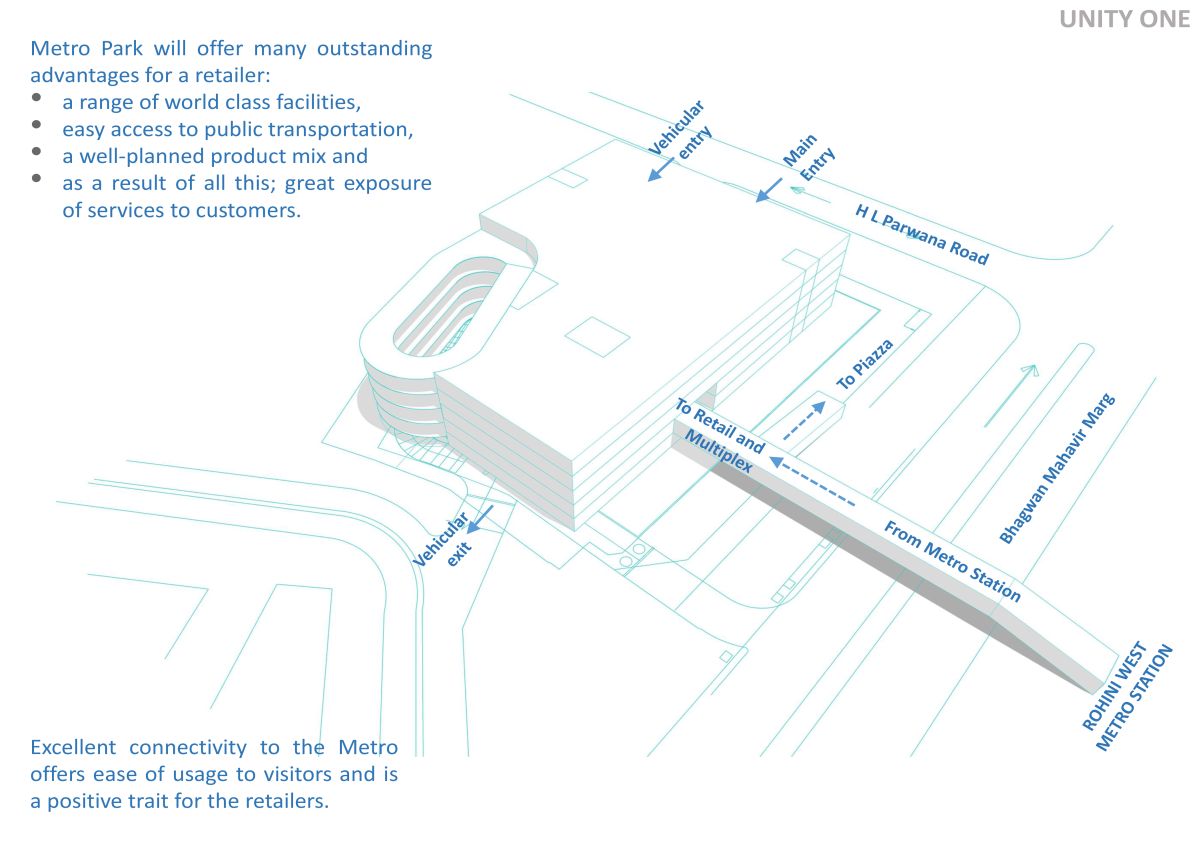
One of the first malls in India to be connected via a Metro Station at the Concourse Level, it is the first building in India to have a Solar Carport on its Rooftop. A very popular retail destination in North Delhi, Unity One offers the right mix of Cinema, Retail, Food and Entertainment to all its patrons. - GPM Architects & Planners
Unity One, at Rohini, New Delhi, India, by GPM Architects & Planners

Project Text Pointers – Unity One, Rohini is a boutique retail destination that has been developed in collaboration with DMRC. The design brief was to create a successful model for a Multi-Level Car Parking facility, and create an interesting mix of activities, that would encourage people to use the parking facilities and hence increase the footfall in the commercial areas for effective financial viability.

One of the first malls in India to be connected via a Metro Station at the Concourse Level, it is the first building in India to have a Solar Carport on its Rooftop. A very popular retail destination in North Delhi, Unity One offers the right mix of Cinema, Retail, Food and Entertainment to all its patrons. The development is envisaged to be Rohini is an ideal example of how an efficient infrastructure system can be a lucrative development model for any developer entity; and a profitable partnership between government and private developers.

Key performance attribute (thermal control, acoustics and wind resistance, Fire Safety)

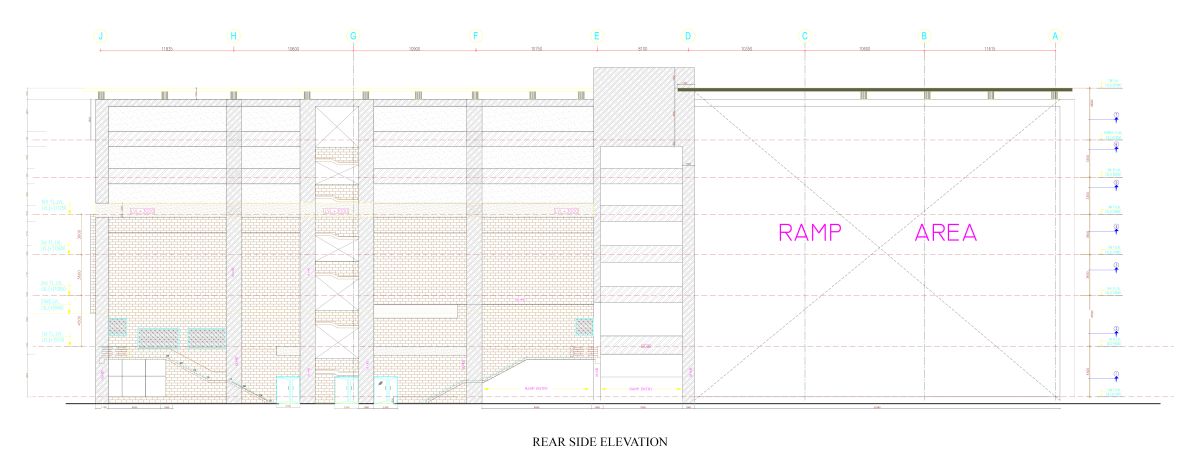
The first in the country, a Solar Carport has been installed on the rooftop and is connected through the ramp and has significantly helped in utilization of the space; it has also reduced the solar heat intake of the structure, thereby reducing energy consumption.

Innovative Technology Used

One of the first malls to be connected via a Metro Station at the Concourse Level, it is the first building in India to have a Solar Carport on its rooftop.

Efficient Utilization of Resources

A boutique retail destination, Unity One is a unique typology of space, developed in partnership with DMRC. A successful model for a Multi-level car parking facility, the building is an interesting mix of activities, which encourage people to use the parking facilities, hence increasing the footfall in the commercial zone for an effective financial viability.

The idea of integrating a retail and entertainment destination with a major transportation hub by providing assorted parking facilities has been welcomed by the users; the model has successfully been able to create a typology which promotes efficient utilization of space and resources by punching multiple utilities in one single building.

Specific features provided in the project with respect to protection and enhancement of the environment.

The incorporation of the Solar Carport has substantially reduced its dependence on the external power grid, thereby reducing the load on the city. This building, owing t the extensive use of sustainable measures has received the IGBC Platinum rating recently.

Challenges faced in the implementation of the project.

This being a first-time initiative, there were apprehensions related to user comfort and acceptability. No challenge was faced during design and construction. Once open, the apprehensions vanished as the users have taken this initiative in a very positive and appreciative manner.

Infographics –

Introduction_ Context, Location, Urban Intervention, People Related, Impact on the city + zooming into local/specific context

Description_ Architectural Description from overall approach _zooming in_ project details, Spatial Planning

Highlight Features_ Architectural Description of Unique features + Details

Interiors_ Approach to project + Specifics if any

Landscape_ Approach to project + Specifics if any

Systems_ HVAc/ Water/ waste Management etc + specifics if any

Conclusion_ Overall point made _ Urban relevance + Project success

Drawings –

Rendered working Drawings

Project Facts –

Name of the project – Unity One Multilevel Car Park & Retail Multiplex Complex

Architectural firm – GPM Architects & Planners

location: Rohini, Delhi

Client  : Unity Buildwell Ltd.

Design team : Gian P Mathur, Amit Singhal, Mitu Mathur

Consultants  :

a) Plumbing & Fire fighting : Soni Consultants

b) HVAC     : Armstrong Engineering Services

c) Electrical     : S. S. Consultants

Built-up area: 35671 Sq.m. (28,113 sqm (554 ECS) in Basement & 2nd floor to Terrace floor

Cost of project: 56 crore

Year of completion: 2015

Built-Up Area (sqft&sq m): 35671 Sq.m. (28,113 sqm (554 ECS) in Basement & 2nd floor to Terrace floor

Start Date: March 2013

Completion Date: January 2017

Cost of Project: 56 Crore

Photographer: Ranjan Sharma Photography

Rendered Presentation Drawings

Leave a Reply

Your email address will not be published. Required fields are marked *

This site uses Akismet to reduce spam. Learn how your comment data is processed.

Recent

Source - Deccan Chronicle

Wall As a Public Space
“To read public space only as a spatial condition, as a matter of square footage, zoning, or physical access, is to miss half the picture.”
—Reshma Esther Thomas

Reshma Esther Thomas examines how Hyderabad’s flyover pillars, painted with Cheriyal-style murals under the GHMC’s ‘City Art Scape’ initiative, reveal the paradox of managed public space. What appears to be beautification is actually cultural assertion in the wake of the 2014 bifurcation, bureaucratising a surface that once belonged to those without institutional power.

Read More »
Khazans in Slavador du Mundo, Bardez, Goa. © Kusum Priya (1)

The Map That Was Never Yours
“If publicness is reduced to what is legally accessible, then these landscapes were never public to begin with.”
—V.V. Kusum Priya

As part of our editorial: What makes a space public?, V.V. Kusum Priya argues that Section 39A of Goa’s 2024 Town and Country Planning Act this isn’t just a legal issue, and that it’s the erosion of an unrecognised but collectively sustained commons, and a question of what “public” really means and who benefits from the legislations surrounding this.

Read More »
Life on the public spaces in downtown Calcutta. Source - Wikimedia


“Appropriation of public spaces is the genesis of political movements, of ideological apparatus, and of endangering the city’s multi-dimensional fabric.”
—Dr. Seema Khanwalkar

Dr. Seema Khanwalkar, explores how the public spaces in India are dynamic, contested areas shaped by informal economies, migration, and social negotiation. She reveals how the transactional activities democratise ownership of these spaces, while the political and religious appropriation increasingly displaces this organic vitality, creating exclusion and anxiety. This shrinking of inclusive public space threatens urban social fabric, yet remains largely absent from city planning conversations, making it a far deeper crisis than mere encroachment.

Read More »
Sen Kapadia


“… people like Sen [Kapadia] don’t really leave. They become the questions we continue to ask.”
—A Tribute by Nuru Karim

Nuru Karim reflects on his relationship with Sen Kapadia through three transformative “states of being”—as a student, as a studio colleague, and as an independent professional. To capture Sen’s essence, Karim draws on three powerful metaphors: a mountain (commanding yet silent), a banyan tree (generous and sheltering), and a river (unseen yet ever-present). Together, these images paint a portrait of a man whose quiet depth left an indelible mark on all who encountered him.

Read More »
Sen Kapadia

Nirbhaya Nirgun
“Sen [Kapadia] found his own light early. He followed it without apology and without detour, and never let anyone dim it.”
—A Tribute by Pinkish Shah

Pinkish Shah’s homage to Sen Kapadia, celebrates him as fearless and formless in both life and work. Intellectually rooted in Louis Kahn and Sri Aurobindo, Sen pursued architecture that transcended form toward essential silence. Known for his courage, he maintained quiet, unwavering independence throughout his career.

Read More »
Prof Shireesh Atmaram Deshpande

“Professor Shireesh Deshpande chose the far more difficult task: to mould young minds into thoughtful, responsible, and rooted architects.”—A Tribute by Sarbjit Singh Bagha

Sarbjit Singh Bagha shares his tribute to Prof. Shireesh Atmaram Deshpande (1934–2026), a pioneering figure in Indian architectural education who passed away on 10 April 2026 at 91. Known affectionately as “Dada,” he spent nearly four decades at VNIT Nagpur, founding India’s first M.Arch. programme and introducing innovative pedagogy. He served as President of the Indian Institute of Architects (1992–1994). Choosing teaching over professional practice, he shaped generations of architects.

Read More »

Featured Publications

New Release

Stories that provoke enquiry into built environment

www.architecture.live

Subscribe & Join a Community of Lakhs of Readers

We Need Your Support

To be able to continue the work we are doing and keeping it free for all, we request our readers to support in every way possible.

Your contribution, no matter the size, helps our small team sustain this space. Thank you for your support.

Contribute using UPI

Contribute Using Cards