Mezban at Calicult - Collaborative Architecture

MEZBAN- INVERTED TOPOGRAPHY, at Calicut, Kerala, by Collaborative Architecture

Mezban at Calicult - Collaborative Architecture
MEZBAN- INVERTED TOPOGRAPHY, at Calicut, Kerala, by Collaborative Architecture 1

The project Mezban at Calicut, is a part of a business hotel, in a tier 3 city in the country, which has been redesigned by the firm as a repositioning exercise. The strategy was to create a new identity to the already popular restaurant though interior architecture making it a new destination dining in the city to spur the business of the hotel.
The brief called for a highly flexible layout with higher efficiency on floor, though it meant cutting down the seating capacity. 8 pax and 6 pax tables were taken out in favour of 4 pax and 2 pax seating which could be joined to create desired groups easily, with the linear lay out. The brief also mentioned the project to be executed on a very tight budget, environmentally compassionate (we wouldn’t call it sustainable, as the focus was to follow environmentally good practices rather than going for certifications) and low on routine maintenance.

MEZBAN- INVERTED TOPOGRAPHY, at Calicut, Kerala, by Collaborative Architecture 3

The brief also called for an ambience, which could seamlessly straddle between a Fine Dine and a Lounge – fine dine during lunch and dinner and Lounge space during early evening hours.

MEZBAN- INVERTED TOPOGRAPHY, at Calicut, Kerala, by Collaborative Architecture 5

A vibrant waiting lounge is carved out from the restaurant space, showcases the happenings on the restaurant floor.

The design derives its strength from the innovative architectural lighting. The minimalist design gets transformed by the custom designed lights which create an undulating topography and magical lighting quality to the space.

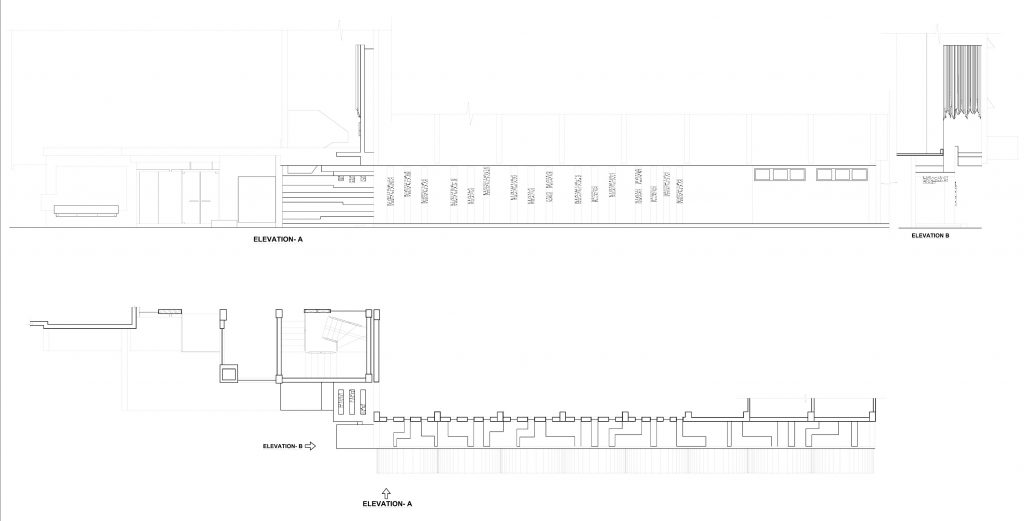
‘Collaborative’ designed the series lights along the exterior wall named as ‘Thousand Moons’, which lends an unmistakable character to the façade.

Lalita designed all the architectural graphics as well as the stationeries, menu, etc for the project.
The biggest challenge was to execute a sophisticated project like this in a tier 3 city of the sub-continent, where the very basic work done satisfactorily itself is a challenge. The project had a bizarre mix of logistics – local as well as international. So was the case with the execution team.

The restaurant became the ‘Destination Dining’, acquiring almost 85% additional clientele paving way for a seismic shift in the customer profile. The new positioning of the restaurant enhanced the business of the hotel, becoming the best-rated hotel in town surpassing two, existing 5 star properties. It also brought about an immense dialogue among the general public of the benefits of good design, and how they impact business in a positive way.

The idea of ‘design as a tool to transform business’ was not what this client was exposed to or experienced personally in their business before. So it was more like a close collaboration of opposing ideas, converging at the right junctures for an immensely satisfying project!

FACT FILE

Project: MEZBAN – INVERTED TOPOGRAPHY
Location : Calicut, Kerala
Client: Mr. Mohamed
Design Firm: COLLABORATIVE ARCHITECTURE
Design Team: Lalita Tharani & Mujib Ahmed
Project Team: Muneeb, Mazhar, Shaoukath, Vineeta Parekh

Leave a Reply

Your email address will not be published. Required fields are marked *

This site uses Akismet to reduce spam. Learn how your comment data is processed.

Recent

Source - Deccan Chronicle

Wall As a Public Space
“To read public space only as a spatial condition, as a matter of square footage, zoning, or physical access, is to miss half the picture.”
—Reshma Esther Thomas

Reshma Esther Thomas examines how Hyderabad’s flyover pillars, painted with Cheriyal-style murals under the GHMC’s ‘City Art Scape’ initiative, reveal the paradox of managed public space. What appears to be beautification is actually cultural assertion in the wake of the 2014 bifurcation, bureaucratising a surface that once belonged to those without institutional power.

Read More »
Khazans in Slavador du Mundo, Bardez, Goa. © Kusum Priya (1)

The Map That Was Never Yours
“If publicness is reduced to what is legally accessible, then these landscapes were never public to begin with.”
—V.V. Kusum Priya

As part of our editorial: What makes a space public?, V.V. Kusum Priya argues that Section 39A of Goa’s 2024 Town and Country Planning Act this isn’t just a legal issue, and that it’s the erosion of an unrecognised but collectively sustained commons, and a question of what “public” really means and who benefits from the legislations surrounding this.

Read More »
Life on the public spaces in downtown Calcutta. Source - Wikimedia


“Appropriation of public spaces is the genesis of political movements, of ideological apparatus, and of endangering the city’s multi-dimensional fabric.”
—Dr. Seema Khanwalkar

Dr. Seema Khanwalkar, explores how the public spaces in India are dynamic, contested areas shaped by informal economies, migration, and social negotiation. She reveals how the transactional activities democratise ownership of these spaces, while the political and religious appropriation increasingly displaces this organic vitality, creating exclusion and anxiety. This shrinking of inclusive public space threatens urban social fabric, yet remains largely absent from city planning conversations, making it a far deeper crisis than mere encroachment.

Read More »
Sen Kapadia


“… people like Sen [Kapadia] don’t really leave. They become the questions we continue to ask.”
—A Tribute by Nuru Karim

Nuru Karim reflects on his relationship with Sen Kapadia through three transformative “states of being”—as a student, as a studio colleague, and as an independent professional. To capture Sen’s essence, Karim draws on three powerful metaphors: a mountain (commanding yet silent), a banyan tree (generous and sheltering), and a river (unseen yet ever-present). Together, these images paint a portrait of a man whose quiet depth left an indelible mark on all who encountered him.

Read More »
Sen Kapadia

Nirbhaya Nirgun
“Sen [Kapadia] found his own light early. He followed it without apology and without detour, and never let anyone dim it.”
—A Tribute by Pinkish Shah

Pinkish Shah’s homage to Sen Kapadia, celebrates him as fearless and formless in both life and work. Intellectually rooted in Louis Kahn and Sri Aurobindo, Sen pursued architecture that transcended form toward essential silence. Known for his courage, he maintained quiet, unwavering independence throughout his career.

Read More »
Prof Shireesh Atmaram Deshpande

“Professor Shireesh Deshpande chose the far more difficult task: to mould young minds into thoughtful, responsible, and rooted architects.”—A Tribute by Sarbjit Singh Bagha

Sarbjit Singh Bagha shares his tribute to Prof. Shireesh Atmaram Deshpande (1934–2026), a pioneering figure in Indian architectural education who passed away on 10 April 2026 at 91. Known affectionately as “Dada,” he spent nearly four decades at VNIT Nagpur, founding India’s first M.Arch. programme and introducing innovative pedagogy. He served as President of the Indian Institute of Architects (1992–1994). Choosing teaching over professional practice, he shaped generations of architects.

Read More »

Featured Publications

New Release

Stories that provoke enquiry into built environment

www.architecture.live

Subscribe & Join a Community of Lakhs of Readers

We Need Your Support

To be able to continue the work we are doing and keeping it free for all, we request our readers to support in every way possible.

Your contribution, no matter the size, helps our small team sustain this space. Thank you for your support.

Contribute using UPI

Contribute Using Cards