Taansa thane - M+P Architects

Architectural Portfolios – Clarity is must, Says Meghana Kulkarni, M+P Architects, Pune

Taansa thane - M+P Architects

Every architectural office has a different way of selecting candidates for different job positions. Last time we discussed things that matter most to Biome Environmental Solutions, Bangalore. In this post, we discuss how M+P Architects, Pune decides on interns / architects.


About M+P Architects:

M+P architects collaborative is a Pune based joint practice between architects Meghana Kulkarni and Pooja Chaphalkar. The firm works on residential, institutional and master planning projects across India. Their philosophy is to attempt to interpret ecologically sound principles into architecture, planning and interiors through design.

Taansa at Thane is one of their highly acclaimed architectural works.

Taansa thane - M+P Architects
Taansa at Thane, by M+P Architects

On Architectural Portfolios, their views are below:

“Clarity matters most to us.” – Meghana’s  reply on the question, ‘What do you look for in an architectural portfolio?’

“Presentation of portfolio and student’s selection of projects in the portfolio, gives us idea about student’s design temperament and presentation skills.” She continues.

“We understand, not every student has in depth knowledge of materials, construction technologies, processes and design skills. But if the student has a good hold of basic software, is willing to learn and to travel to sites, we would be happy to shortlist them. Design skills and knowledge of materials can be acquired over a period of time.”

The Process of deciding on the deserving candidates for job positions at M+P Architects involves, shortlisting of portfolios and a personal interview. Meghana shares:

‘..personal interviews help us understand their likings and strengths better. This way they can also understand a bit more about our workplace, nature of work and we encourage them to interact with other architects and interns in the office.’

Pune is architecturally active city. M+P Architects encourages trainees and other architects in their office to be a part of architecture/design forums and events, and also interact with other architects, designers, environmentalists etc in the city.

In addition to the common message about CC / BCC Emails, some important tips from M+P Architects include:
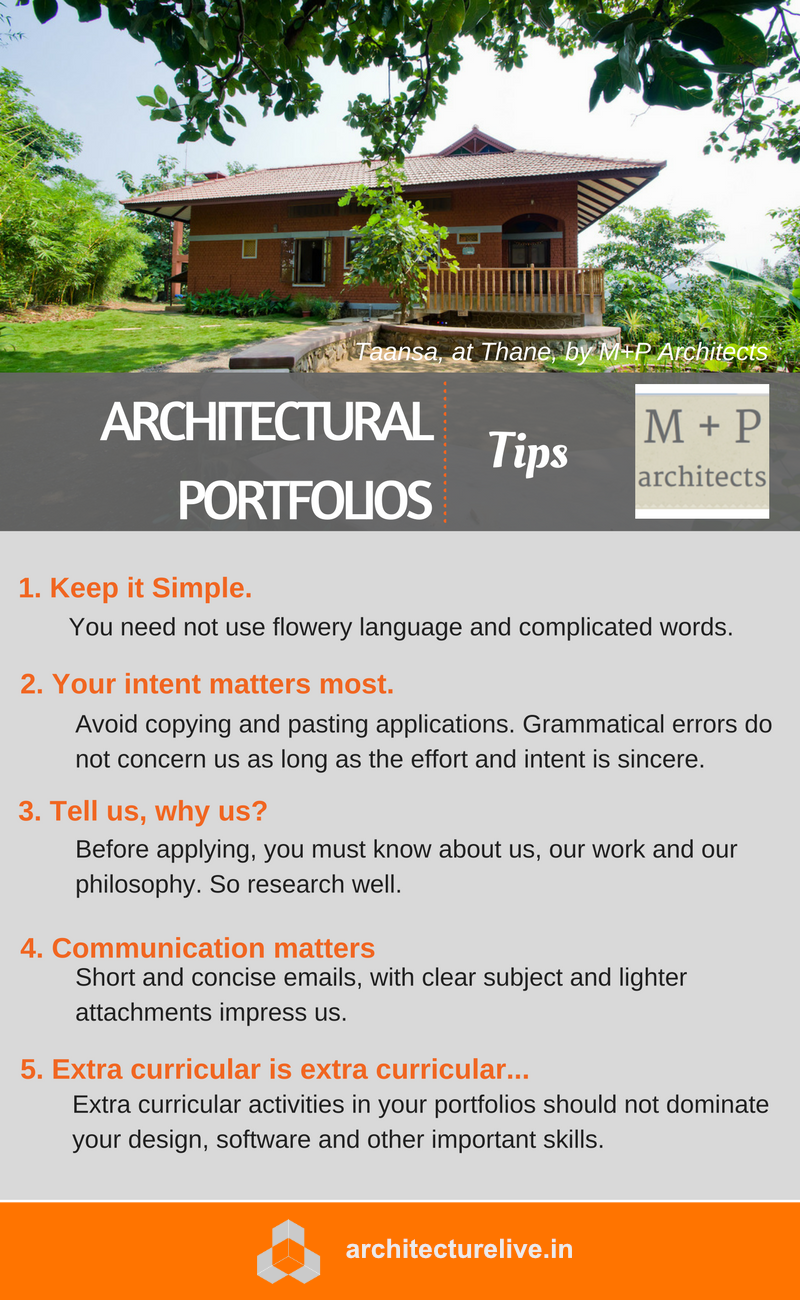

Architectural Portfolios - Meghana Kulkarni

Leave a Reply

Your email address will not be published. Required fields are marked *

This site uses Akismet to reduce spam. Learn how your comment data is processed.

Recent

Gender. Hysteria. Architecture. | What Might Care Look Like If It Were Not Afraid of Women? 4

Gender. Hysteria. Architecture. | What Might Care Look Like If It Were Not Afraid of Women?

What kinds of spaces exist where women can breathe without being watched? If hysteria no longer exists as a diagnosis, why does its architecture remain? Aditi A., through her research study as a part of the CEPT Writing Architecture course, in the third and last chapter of this series follows the spatial logics that developed to manage hysteria, which continue in the contemporary environments of care safety, and everyday life. If the diagnosis has been discredited, what explains the persistence of its walls?

Read More »
Kirtee Shah on architecture profession at CEPT University alumni meet

“… the way architecture [profession] is perceived and practised, it needs to move from the pedestal to the ground.”—Kirtee Shah

In his presentation at the CEPT Alumni Meet, in January 2026, Kirtee Shah offers “something to think about” for the architects and planners regarding the future of architecture profession. He urges architects to relearn and refocus on service, sustainability, and inclusivity while addressing urban chaos, poor housing, rural neglect, and climate challenges.

Read More »
Folles de la Salpétrière, (Cour des agitées.) (Madwomen of the Salpétrière. (Courtyard of the mentally disturbed.))

Gender. Hysteria. Architecture. | “How Did a Diagnosis Learn to Draw Walls?”

Did these spaces heal women or teach them how to disappear? Aditi A., through her research study as a part of the CEPT Writing Architecture course, in this chapter follows hysteria as it migrates from text to typology, inquiring how architectural decisions came to stand in for care itself. Rather than assuming architecture responded to illness, the inquiry turns the question around: did architecture help produce the vulnerability it claimed to manage?

Read More »

Featured Publications

New Release

Stories that provoke enquiry into built environment

www.architecture.live

Subscribe & Join a Community of Lakhs of Readers