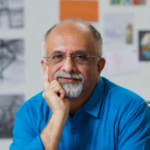
The passing of Navnath Kanade yesterday is a loss to architecture in India and a personal loss of a friend and colleague of decades.
We were fellow members of the “BASE Group” – a small group of architects in Bangalore who used to meet regularly to share travel experiences, have passionate discussions on architecture, and get together with interesting architects who were visiting the city. The official expansion of BASE was “Bangalore Architects Society for Education,” but we would always say the more accurate expansion was “Beer and Slides Evening.”

Navnath struck you as soon as you met him as a good person, not a bad bone in his body, unpretentious and genuine, ever ready to smile, eager to share, possessing a visible and spontaneous quickening of interest as soon as any conversation took an interesting turn.
I have often spoken of what I call my most profound teaching experience, and it is significant that this was an experience enabled by Navnath, for that conversation would probably have taken a very different turn if he was not there. The two of us were in conversation with a first-year student of architecture in Hassan who was terrified by the prospect of attempting, for the first time in her life, the design of an architectural project. We began by asking her why she was so scared, and she said it was because she knew so little about how to design. Their task was to design a kindergarten, and she said she did not even know how wide the path from the front door to the gate of the compound needed to be, and if she did not know something so basic it was beyond her to design a complete building.
Somehow, by an unspoken agreement, neither Navnath nor I answered her directly. We posed a series of questions to her regarding her confusion on the width of the path. “How much space do you take when you walk down a path?” “This is a kindergarten, so you may be leading a child by the hand, and how much space would that take?” “You may meet someone coming in the opposite direction, so how much space is needed for you to cross?” “That person may also be leading a child by the hand, so how much space is needed now to cross?” Through responding to these questions, she arrived at the realisation that the width of the path needed to be between 2.5 to 3 metres, at which point Navnath asked her, “See! You knew the answer! Why did you ask us?”
I will never forget the light that came into her eyes when Navnath posed that last question. I do not believe it was because she had discovered the width of a path. Rather, it was because she had discovered a foundation of learning, the ability to interrogate her own experience to tackle a question to which the answer was not immediately apparent. If I have ever been able to spark such a light in the eyes of a student or young architect, whatever ability I may have to do so has been learned in no small measure from Navnath. He could light that spark effortlessly, far better than I will ever be able to, because he embodied that unique combination of a zest for life combined with voluntary simplicity, unpretentiousness, rigour of mind and hand, and spontaneous compassion. These qualities made him a teacher and architect par excellence. It is also rare to find a person in whom these very same qualities also make him a good friend to have.
I will miss him greatly and will always regret that in recent times we did not meet as often as we could have. I will always be grateful that I was able to join him for his last evening in Bangalore in late January this year before he returned to his native home near Sangli, having wound up his architectural practice in the city (my gratitude to Satyaprakash Varanashi for making that evening possible). We spent a couple of pleasant hours over drinks and dinner, talking about architecture and life, remembering and reliving memories of the times we have shared.
My heart goes out to Navnath’s elder brother Shankar, his partner in architectural practice, fellow member of BASE Group, who probably never dreamed that Navnath would go before him.
Navnath my friend – wherever you are now, I like to believe you have joined Nikhil Arni and Sharad Padhalkar, fellow BASE members who left before you, and you are all together engrossed in the sacred quest of what architecture may be, lighting sparks in others, and holding heated arguments about architecture over glasses of rum. You may have left this earth, but you have touched many hearts in your time here and you will live there forever.