


Landmark Retail Boulevard, Victoria Island: by ANA Design Studio Pvt. Ltd.
Design Objective:
The Landmark Village is a 38,000 sqm mixed-use site along the Atlantic Ocean beachfront in Victoria Island, Lagos set to emulate Rosebank in Johannesburg, the Victoria and Alfred Waterfront in Cape Town and Canary Wharf in London. The site is being developed into an ultramodern business, leisure and lifestyle destination over the next 5 years.
It was noted as the most visited leisure destination in Lagos, with an average footfall of up to 55,000 visitors weekly.
The first phase of the Landmark Village scheme is complete with the Landmark Events Centre (the largest purpose-built event centre in Lagos), as well as the first and only Hard Rock Café in West Africa and the Oriental themed Shiro restaurant.
Planning:
The Landmark Group has appointed ANA as the master plan and detailed engineering consultants for this very challenging site. In order to utilize the complete potential of the site, the sequential mode of development was planned as a business development scheme to have an interconnected revenues and development cost.
ANA designed the master plan, as a series of incremental plans, allowing the client to keep on offering tangible and substantial improvements and results to their tenant businesses, while they continued to improve and enhance the infrastructure. The Principle applied was to create more than 3 revenue streams with no one type of stream more than 60%.

Once the Landmark Village is fully complete, the site will include The Landmark Waterview Luxury Residential Apartments, a 4 Star Renaissance Hotel by Marriott International, Marriott Executive Apartments, over 20,000sqm of office space and the noteworthy Landmark Village Retail Boulevard.
The Landmark Event Centre is truly a well-known landmark in Victoria Island, Lagos, and the business hub of Nigeria.With this consideration of Existing Event Centre and usability of facilities, the design principles of Place making were adopted and applied. The intentions were to create public spaces that promote people’s health, happiness, and well-being.
Place-Making:
Integration of buildings with public plazas with uninterrupted walkable connectivity was designed to develop an Urban spaces based on “live – work – play”. Pedestrian movement and public nodes were strategically planned leading to the destination hub at both ends and Intersection axis connecting the entrance to the ocean.


All of this to be constructed while the event center and the restaurants remain live.
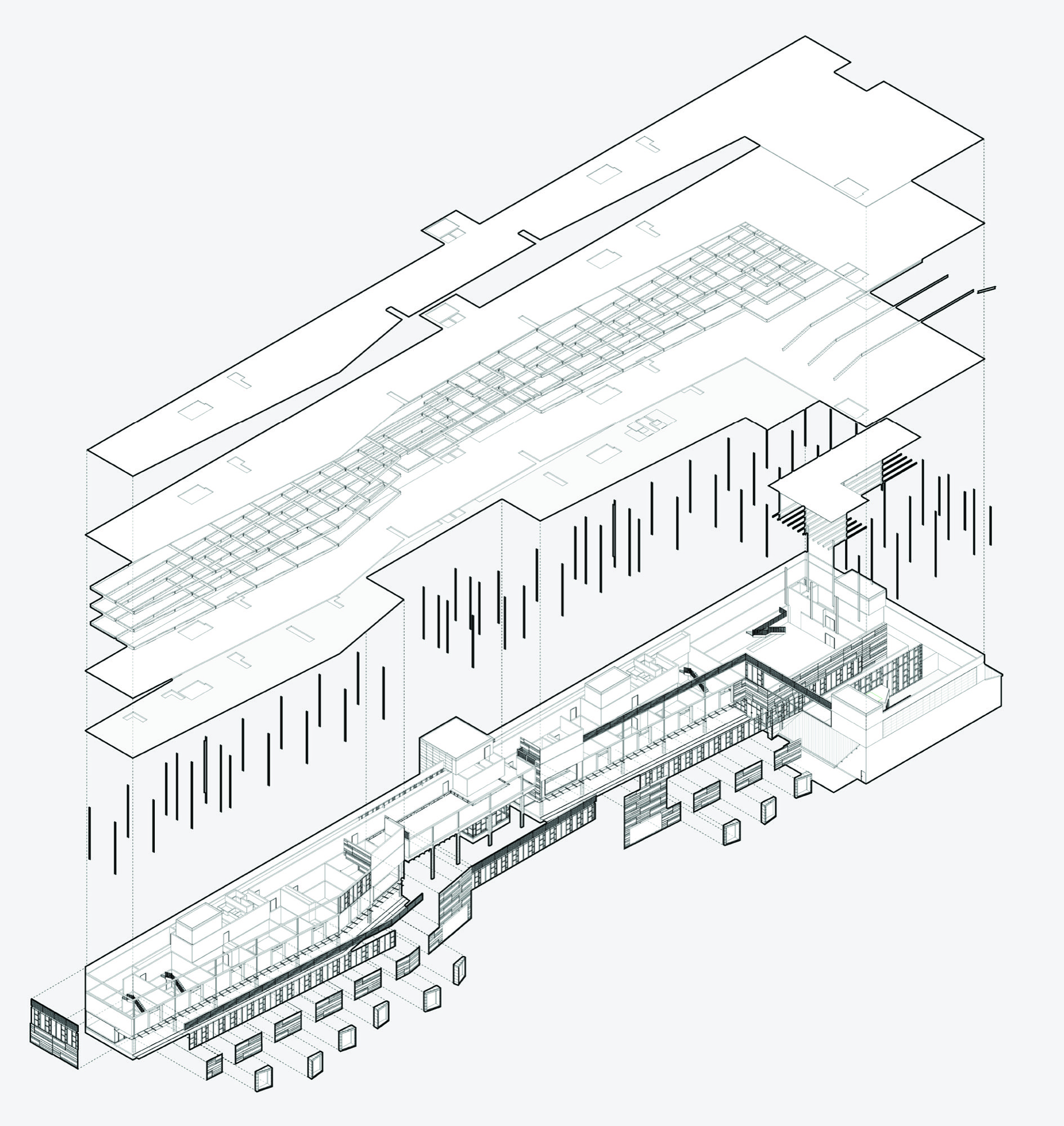
The first phase of development was high end retail/leisure broad-walk and office spaces. The retail block was designed as a three storey structure consisting of line shops, supermarket and cinema on ground and first floor and open plan office space/ training centre on second floor. The linear strip retail created an envelope along the boulevard and hence giving that space a sense of enclosure and yet open from all fronts.
Streetscape:
Delivering the public realm is one of the most important components of any city or neighborhood. As such, the built form and streetscape treatments provided were an attractive, safe and comfortable pedestrian environment, while maintaining the overall visual cohesiveness of the area.
This was achieved through a variety of design responses, which included open shop fronts, covered retail passage on ground floor, placement of stairs connecting floors and open plaza, acrylic light boxes being the part of façade cladding system.
The architectural details in terms of paving patterns, shaded seating, pop-up shops, adequate sidewalk widths, easy accessibility of ramps and other features for comfortable and safe movement spaces for both pedestrians and the disabled.

Well thought locations for utilities and advertising/signage were proposed to connect well to all other street functions. The appropriate provision for access, deliveries and parking of vehicles was provided and hence catering to high end commercial urban hubs.
With challenges while development on the waterfront and construction in sequential phases, the complete master plan with detailed building designs and engineering were developed and coordinated on BIM. With the three dimensional design features the two other dimensions, time and cost were also coordinated together in this “Mixed Use Development”.
Sustainable Features:
Building load and structure system was optimized by using slab on grade footings, with almost zero excavation and loss of top soil. The existing green areas and trees were conserved on site. The building profile was adapted for existing trees. High performance glass with Low-E value was used for better thermal performance. A highly insulated roof, collecting 100% rain water on the roof was used. Couple of more features include 100% recycling of greywater, highly insulated facades, and a highly insulated roof. All shops and building doors were designed for sealing and avoidance of AC losses.
Sustainable Initiatives:
Local materials for all wet and concrete works were used. Work contracts for all wet works and MEP Engineering were awarded to local contractors as a commitment to local skill development and economy. Shaded walkways and universal access was created in all parts of the building to minimize urban heat island effect.
There was zero disruption to existing businesses on the premises, and construction management was carried out to avoid dust/ debris and safe walkways for patrons during construction which is a testament of financial sustainability.
All lighting was LED, external lighting was adapted into the facade, so no extra wiring/ cables or light fittings needed in the landscape. Low maintenance plant species were used. Spaces were planned with natural lighting for all office areas.Charging points were planned for Electric Vehicles with internal movement designed for deployment the same. All kitchen waste from restaurant kitchens is being composted on site.
Anchors such as Family entertainment cute/ QSR and cinemas were placed as “magnets” on either end of the boardwalk. All the buildings, their facades and “show windows” were angled to allow deep views across the development, and a sense of adventure and discovery to different experiences, as one moved around the premises.
The “pedestrian” is the king here. In a city like Lagos, this is arguably, the safest, most fun “urban space” that can be enjoyed by people and families from all walks of life. The connection to the beach has been revitalized, and people enjoy “hanging out” in the new space, and it drives retail business. There is a plan to construct residences and a Hotel linked to the event center, and truly achieves a “Live – Work – Play” environment.
Detailing:
The building detailing is done in simple, rectilinear steel frame, and the facade is designed to create maximum visibility and “pull” into the first floor retail areas. All areas can be accessed by service and emergency vehicles, but the overall environment is overwhelmingly pedestrian.
The project is also a showcase of the prowess of design, engineering, detailing and project coordination at an international scale where the client and local contractors are from Lagos, design/engineering/ coordination from India and steel design/fabrication and façades from China, HVAC equipment from Vietnam.
Drawings:


Project facts:
Typology: Mixed Use
Status: Built
Year: 2019
Size: 300,000 sqft
Client: BB Landmark Realty Ltd. | CEO Paul Onwuanibe
Photograph Credits: BB Landmark Realty Ltd.
Graphic Credits: ANA Design Studio Pvt. Ltd.



One Response