Bamboo Pavillion by Abin Design Studio

Abin Design Studio wins The International Architecture Award’15

Bamboo Pavillion by Abin Design Studio

A Temporary Temple Pavilion built for a local socio – religious festival in a small town on the fringes of Kolkata has recently been awarded The International Architectural Award for 2015 by The Chicago Athenaeum: Museum of Architecture and Design and The European Centre for Architecture Art Design and Urban Studies. Honouring new and cutting-edge design, the award organised by both the above institutions promotes international architecture and design to the global public audience. This award adds to a series of distinguished and prestigious awards for the project, and further secures Abin Design Studio’s presence in the top architecture and design firms in the world.

We congratulate Abin Design Studio for achieving recognition at the international level and promoting working with the community, keeping India at par with the rest of the world in terms of architecture  in today’s age.

In November 2015, The Chicago Athenaeum, together with The European Centre for Architecture Art Design and Urban Studies will present a special exhibition of all awarded building at their annual symposium, “The City and the World” in Chicago.

About the project – A Temporary Temple

Bamboo Pavillion by Abin Design Studio

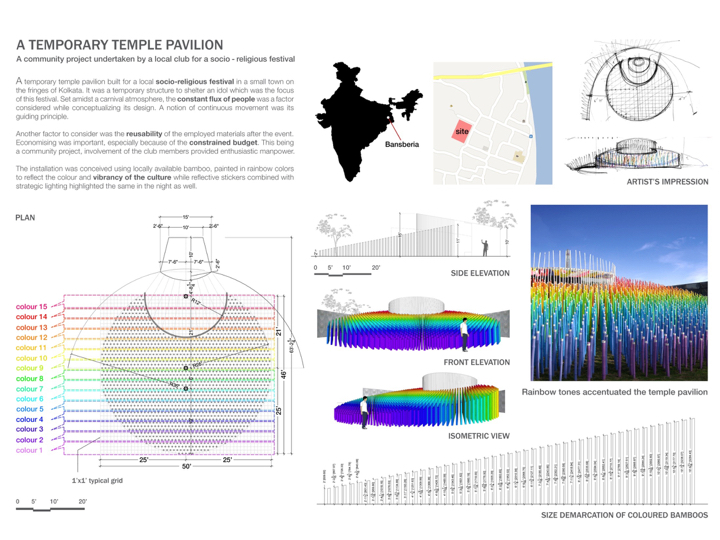
A temporary temple pavilion built for a local socio-religious festival was constructed to shelter an idol. Set amidst a carnival atmosphere, the constant flux of people was a factor to be considered while conceptualising its design. The constant flow of people was its guiding principle.

Locally available bamboo cut to specific lengths were rooted to the ground  in a regular grid and painted in spectral hues. Close to 1800 bamboo poles were arranged according to their length ranging from 2 to 15 feet. Bamboo, being durable, bio-degradable and locally available, was a strategic choice of material for the project. The poles were planned for reuse after the festival and were carefully re-catalogued and stored for the future. They are currently being used to create fencing for the football field of the same community.

Instead of using expensive LEDs for lighting, they put retro reflective stickers around the tops of the poles, and hired halogen lights to illuminate the project at night, creating a glowing effect.

Bamboo Pavillion by Abin Design Studio.001

The composition of light and color, thus achieved created a gradually rising volume conveying implied movement while creating playfulness.


Bamboo Pavillion by Abin Design Studio.002More images of the award winning project:

Leave a Reply

Your email address will not be published. Required fields are marked *

This site uses Akismet to reduce spam. Learn how your comment data is processed.

Recent

Vision Pakistan, Pakistan by DB Studios 1

Vision Pakistan, Islamabad, Pakistan, by DB Studios

Vision Pakistan, a project by DB Studios recently recognized with the 2025 Aga Khan Award for Architecture. Set within Islamabad, Pakistan, the project offers a ‘second chance’ to disadvantaged males who have fallen into aggression, depression, drug use and/or crime.

Read More »
Source - Deccan Chronicle

Wall As a Public Space
“To read public space only as a spatial condition, as a matter of square footage, zoning, or physical access, is to miss half the picture.”
—Reshma Esther Thomas

Reshma Esther Thomas examines how Hyderabad’s flyover pillars, painted with Cheriyal-style murals under the GHMC’s ‘City Art Scape’ initiative, reveal the paradox of managed public space. What appears to be beautification is actually cultural assertion in the wake of the 2014 bifurcation, bureaucratising a surface that once belonged to those without institutional power.

Read More »
Khazans in Slavador du Mundo, Bardez, Goa. © Kusum Priya (1)

The Map That Was Never Yours
“If publicness is reduced to what is legally accessible, then these landscapes were never public to begin with.”
—V.V. Kusum Priya

As part of our editorial: What makes a space public?, V.V. Kusum Priya argues that Section 39A of Goa’s 2024 Town and Country Planning Act this isn’t just a legal issue, and that it’s the erosion of an unrecognised but collectively sustained commons, and a question of what “public” really means and who benefits from the legislations surrounding this.

Read More »
Life on the public spaces in downtown Calcutta. Source - Wikimedia


“Appropriation of public spaces is the genesis of political movements, of ideological apparatus, and of endangering the city’s multi-dimensional fabric.”
—Dr. Seema Khanwalkar

Dr. Seema Khanwalkar, explores how the public spaces in India are dynamic, contested areas shaped by informal economies, migration, and social negotiation. She reveals how the transactional activities democratise ownership of these spaces, while the political and religious appropriation increasingly displaces this organic vitality, creating exclusion and anxiety. This shrinking of inclusive public space threatens urban social fabric, yet remains largely absent from city planning conversations, making it a far deeper crisis than mere encroachment.

Read More »

Featured Publications

New Release

Stories that provoke enquiry into built environment

www.architecture.live

Subscribe & Join a Community of Lakhs of Readers

We Need Your Support

To be able to continue the work we are doing and keeping it free for all, we request our readers to support in every way possible.

Your contribution, no matter the size, helps our small team sustain this space. Thank you for your support.

Contribute using UPI

Contribute Using Cards